Top 10 Tips For Creating Fundraising Pitch Deck

Top 10 Tips For Creating Fundraising Pitch Deck

Having worked as an investment banker for more than 15 years, I’ve managed a lot of fundraising initiatives and have learned a lot about what makes a pitch deck compelling enough to get money. Knowing the difficulties that budding business owners have, I am aware of how important it is to develop a polished investor pitch deck in order to realize creative ideas.

In order to assist you in creating an engaging fundraising pitch deck to impress investors, I hope to provide you with some useful tips and tactics that I have collected from successful fundraisers and industry insiders. This guide is designed for you if you’re a visionary entrepreneur with a game-changing idea, a motivated team eager to take your project to the next level, or a budding firm looking for funding to expand.

let’s go on this life-changing adventure as we explore the eleven most perceptive, captivating, and frequently ignored suggestions for creating an fundraising pitch deck.

What Are Investors Seeking In A Pitch?

Let’s unlock the secrets to what investors crave in a pitch to secure your next big investment.

a. The Strength of Your Idea:

A captivating and unique concept is paramount. Ideas that stand out from the competition and have the potential to have a big market effect are what investors look for.

b. Unique Selling Proposition (USP):

Highlight what sets your offering apart from the competition. Emphasize distinct features, benefits, or advantages that make your product or service stand out.

c. Market Potential:

Showcase the size, growth potential, and opportunities of your target market using interesting statistics and insights. Draw in investors by showcasing the substantial benefits your company can offer the sector.

d. Business Model:

Simplify your revenue generation strategy for investors. To explain the process, use visual aids like pricing charts and flowcharts. To highlight the distinctive value proposition of your business, discuss price, cost of products sold, sales and distribution, target client segments, and competitive advantages.

e. Market Understanding:

Highlight your understanding of the target market’s dynamics, growth trends, and potential customer adoption rates. Craft a compelling narrative around how your product or service addresses critical needs or pain points within the market.

f. Team Competence:

Your group is essential to your success. Emphasize each team member’s knowledge and skills while highlighting their relevant accomplishments and credentials. Give investors the impression that your business can carry out the suggested strategies successfully.

1. Develop A Clear And Succinct Concept

When presenting your business idea to investors, it’s vital not to presume their interest. The success of your fundraising pitch deck hinges on guiding them to grasp the market’s scope and your product’s unique potential. It all commences with crafting a clear and concise concept that grabs their attention and highlights the value you offer.

The following important information will help you create an engaging elevator pitch and successfully communicate your idea:

a. Clarity In Thought, Clarity In Expression:

To captivate investors, it’s imperative to have a lucid understanding of your idea and its fundamental purpose. Give a clear, concise explanation of your idea while eliminating any ambiguity. Remember that confidence comes from clarity. Developing an idea that is both clear and succinct draws in investors and establishes the foundation for an engaging pitch deck. It is important to express your notion with confidence and clarity because investors may lose interest if your idea is unclear at this point.

b. Problem Identification:

Describe the particular problems that your target audience is facing. What difficulties do they face, and what effects do they experience? This is a critical step in demonstrating your understanding of the market and the problem you are trying to solve.
Note that investors are looking for creative, scalable concepts that address real issues that people encounter on a daily basis. For example:

Issue: The traditional job boards are uniform in their presentation of job postings and candidates. It is difficult to determine someone’s genuine identity from resumes and plain text alone.

Solution: Using vibrant images and photos to create engaging candidate profiles, FirstJob transforms the job search process. The portal offers thorough details into hiring organizations, including culture, rewards, and office environments, and appeals to young prospects.

2. Unveiling The Problem Your Solution Addresses

Illustrate how the existing problem is presently tackled and emphasize the deficiencies of the current solution. Follow these steps to identify the problem and elucidate it clearly in your investor pitch deck:

a. Engage directly with your target demographic through surveys, interviews, focus groups, or online platforms. Pose open-ended queries to unveil the specific challenges they face and the repercussions on their personal or business endeavors.

b. Collect insights from current patrons or early adopters of akin products or services. Pay heed to their encounters, grievances, and recommendations to detect recurring themes and prevalent pain points.

c. Step into the shoes of your prospective clientele and observe their daily rituals, work processes, and decision-making methods. This firsthand observation may unveil latent pain points or inefficiencies not discernible via conventional research approaches.

d. Analyze current competitors and other solutions available in the market. Determine the areas in which they fall short of the target demographic’s requirements as well as their strengths and limitations.
This aids in positioning your solution as a superior alternative.

e. Based on your scrutiny and analysis, pinpoint the lacunae and prospects present in the market. Identify underserved customer segments, unmet requirements, or areas where current solutions fall short.

f. Validate your suppositions and discoveries by seeking validation from specialists, industry insiders, or potential patrons. This guarantees that the identified problem is not only pertinent but also resonates with your target audience.

g. Highlight how the identified problem aligns with contemporary market trends and requisites. Demonstrate that your solution addresses a timely and pertinent issue, thereby enhancing its market viability.

3. Introduce Your Solution

During this phase, it’s imperative to persuade investors that your solution effectively alleviates the pain points of your target demographic.

a. Emphasize The Unique Advantages.

A startup pitch deck should illustrate how your solution distinguishes itself from competitors and the specific benefits it offers your target audience. Spotlight the key features, functionalities, or innovations that set your product or service apart. Clearly elucidate how these distinctive aspects directly address the problems of your target audience.

b. Provide Evidence Of Efficacy.

Substantiate your assertions with evidence, such as case studies, user endorsements, or data demonstrating successful implementation or outcomes. Presenting tangible proof of how your solution has previously resolved issues for others fosters trust and credibility with investors.

c. Address Scalability And Future Expansion.

Exceptional pitch decks should always outline your strategies for scalability and growth, showcasing how your solution can adjust and progress to meet the evolving needs of your target audience. Highlight potential collaborations or strategic initiatives to further fortify your solution’s market position.

4. Identify the Right Audience

When crafting fundraising pitch deck, offer investors a clear insight into your target demographic and the market scale you’re targeting. Consider the following:

a. Define Your Ideal Clientele.

Delve into the specifics of your target demographic, spotlighting their demographics, behaviors, and preferences. Explicitly delineate who your clientele are and the issues they encounter, underscoring how your product or service provides a resolution.

b. Segment Your Market.

If applicable to your enterprise, contemplate segmenting your market into sectors that can be approached with distinct marketing strategies or product offerings. This demonstrates a thoughtful approach to capturing diverse clienteles and maximizing market penetration.
Keep in mind that, at this stage, you’re also appealing to investors. To increase the chances of building a genuine relationship with possible investors, adapt your language and answer their concerns.

c. Conduct Thorough Research:

Delve extensively into your target market to identify the types of investors most likely to exhibit interest in your sector and business model. Grasp their investment focus, prior investments, and performance track record.

5. Evaluate Market Opportunities

Thoroughly analyzing market opportunities and effectively conveying them in your pitch deck demonstrate your company’s readiness to thrive in a lucrative market. This entails assessing industry trends, growth potential, and market size.

a. It is imperative to amass pertinent data and statistics that bolster your assertions and lend credibility to your claims. When presenting this information, consider incorporating links or citations to the sources from which the data is derived. Because of this transparency, investors can independently confirm the correctness and dependability of the information, which builds confidence in your proposal. You may emphasize your commitment to doing extensive research and make your proposal more compelling by supporting your claims with solid evidence and citing your sources.

b. Stay abreast of industry trends, emerging technologies, and consumer preferences. Highlight any trends that present opportunities for your business and elucidate how your product or service capitalizes on these trends.

c. Assess the size of the identified market niche in terms of its customer base and potential revenue. Understanding the size of the market segment provides information about its profitability and room for expansion. Understanding the size of the market niche you are targeting is very important to investors since it indicates the possible market share and income your company may achieve.
Furnishing data and statistics on the volume of the market niche bolsters the credibility and reliability of your fundraising pitch deck.

d. Undertake a competitive analysis to identify existing market players and evaluate their strengths, weaknesses, and market positioning. Set your business apart by accentuating your unique value proposition and competitive edge.

e. Describe your plan of attack for entering the market and gaining market share. Provide specifics on your distribution methods, marketing and sales plans, and any alliances or partnerships that provide you a competitive edge.

6. Develop a Robust Business Model

To present a robust business model, adhere to these guidelines for crafting successful startup pitch decks:

a. Outline Your Revenue Streams.

Describe in detail how your startup makes money. Describe in detail how your startup makes money. Determine the different revenue streams, including advertising, subscriptions, product sales, and license fees. Provide a thorough explanation of your pricing strategy and how it relates to consumer demand and market conditions.

b. Elucidate Your Cost Structure.

Define your operational expenditures, encompassing production, marketing, distribution, and overhead costs. Demonstrate a profound comprehension of your financials and illustrate how your cost structure facilitates sustainable growth. Explicitly delineate your pricing strategy and the parties responsible for financial obligations. Determine whether users directly pay for your product or if alternative revenue streams, like advertising or partnerships, contribute to your revenue.

c. Present Financial Projections.

Offer pragmatic and data-driven financial projections, incorporating revenue growth, profit margins, and key performance indicators (KPIs). Leverage market research, industry benchmarks, and historical data (if available) to substantiate your projections. Investors seek a clear path to profitability and a comprehensive grasp of your financial forecast.

7. Assess The Competitive Landscape

Even in unfamiliar markets, it’s vital to acknowledge that potential customers currently utilize other alternatives to address their needs. Your business concept may not be novel, but it can become the premier choice in the market.
To underscore your competitive advantage and craft successful fundraising pitch deck, endeavor to:

a. Conduct a competitive analysis to identify existing market participants and assess their strengths, weaknesses, and market positioning. Set your business apart by spotlighting your unique value proposition and competitive strengths.

b. Clearly define your startup’s market position and accentuate how you differentiate yourself from competitors and alternatives. Identify your key advantages or distinctive “secret sauce” that distinguishes you from the competition.

c. Articulate precisely how your offering stands out and why customers would opt for your solution over others. Emphasize the specific benefits and unique value that your product or service brings to the forefront.

d. Evaluate the competitive landscape and how your pricing strategy aligns with market dynamics. Determine whether you position your offering as a premium, high-priced option or a budget-friendly alternative that disrupts existing solutions.

Additionally, consider integrating the following components into your startup pitch deck to bolster your competitive analysis:

  • Highlight any enduring advantages possessed by your startup, such as intellectual property, proprietary technology, or exclusive partnerships. Emphasize how these factors confer a sustainable competitive edge and contribute to the enduring success of your venture.
  • Showcase your adaptability and innovation in response to evolving market dynamics. Spotlight any ongoing research and development endeavors or prospective product enhancements that further differentiate your offering.

8. Present Social Validation And Momentum

If you’re in the phase of seeking pre-seed funding for your existing solution, it’s crucial to prioritize building credibility and showcasing the strides your startup has made. Investors seek evidence that your solution is effective and that your business model is gaining traction.

a. Quantify Achievements:

Wherever feasible, quantify the impact and outcomes your startup has accomplished. Employ metrics, data, and key performance indicators to elucidate the positive outcomes of your solution. This enables investors to assess the scalability and financial viability of your venture.

b. Spotlight Collaborations:

Exhibit any strategic partnerships or alliances you’ve forged. These partnerships indicate that esteemed entities recognize the value of your startup, enhancing the credibility of your business model.

c. Highlight Early Adopters:

Share favorable experiences and the impact of your product or service on early adopters. This validates the market and underscores the potential for widespread adoption.

d. Showcase Milestones And Progress:

Emphasize significant milestones attained by your startup, such as revenue growth, user acquisition, or product development achievements. These milestones denote progress and momentum, underscoring your capability to execute and yield tangible results.

9. Harness Team Expertise

Investors aren’t just backing your idea or product; they’re investing in the collective capabilities of your team—seasoned and astute individuals. Maximize your team’s proficiency on the team slide:

a. Team Introduction:

Present key team members, offering succinct backgrounds that underscore their relevant experience and achievements. Highlight how their distinct skills and expertise align with your startup’s needs, positioning them as invaluable assets.

b. Roles And Responsibilities:

Define each team member’s roles and duties, emphasizing how their expertise contributes to the venture’s overall success. Spotlight any exceptional skills or industry knowledge that distinguishes your team.

c. Track Record And Accomplishments:

Showcase the team’s past victories and accomplishments, especially those pertinent to your startup’s industry or target audience. Display notable accolades, awards, or previous ventures as evidence of their capabilities.

d. Advisory Board Or Mentors:

If applicable, mention esteemed industry figures or advisors supporting your startup. Their involvement enhances credibility and illustrates your venture’s reputation and respect within the industry.

10. Communicate Funding Needs For Expansion

It’s critical at this point to clearly explain to potential investors the funds required to support the expansion of your firm and the financial requirements.

a. Allocation of Funds:

Break down how the funds will be utilized on the team slide, outlining the specific areas of your business requiring financial backing. Provide a detailed breakdown of the allocation of the investment between product development, sales and marketing, operational costs, and team growth. This shows how to manage resources strategically and purposefully.

b. Return on Investment:

Articulate the potential return on investment for potential investors, emphasizing the value they stand to gain by supporting your startup. Emphasize how your company’s development potential, competitive advantage, and market opportunity make it an appealing investment possibility.

Key Slides For Your Fundraising Pitch Deck

Improve your chances of getting funding by creating a well-organized pitch deck. Together, we can incorporate the previously mentioned processes and add the necessary slides to successfully communicate your vision, market potential, and growth strategy:

a. Problem Statement:

Define the problem that your target audience has in detail so that you may introduce your solution with confidence.

b. Solution:

Present your distinctive solution to the identified problem, elucidating how it addresses pain points and adds value to customers.

c. Market Analysis:

Provide a thorough summary of the market that includes its size, growth potential, and important trends to demonstrate your in-depth knowledge of the dynamics of your target market.

d. Competitive Landscape:

Evaluate competitors and delineate your competitive edge, spotlighting what distinguishes your business and why customers would prefer your solution.

e. Business Model:

Talk about your pricing strategy, income streams, and cost structure as you outline your revenue creation and sustainability in terms of profitability.

f. Go-to-Market Strategy:

Present your marketing and sales approach, including target audience, distribution channels, and customer acquisition strategy.

g. Team And Expertise:

Present the key members of your team, highlighting their relevant background and abilities, and explain why they are well-positioned to carry out the plan.

h. Financial Projections:

Provide realistic financial forecasts that are backed by reliable facts and assumptions. These should include revenue estimates, spending estimates, and growth projections.

i. Milestones And Timeline:

List your primary achievements and benchmarks, together with a timeline for reaching them, to describe your route and development.

j. Funding Requirements:

Clearly state the amount of financing that is being requested and how it will be allocated to promoting business growth, emphasizing how the investment will help you reach important benchmarks.

In Conclusion

That’s it, You should be able to create fundraising pitch deck that are convincing with your newly acquired knowledge and confidence. Always keep in mind that your primary focus should be on comprehending your target market and clearly conveying how your company meets their wants.

Give special attention to the advantages of your product or service and how it may solve particular problems. Craft an engaging story that is both relatable and compelling to your audience. Finally, express your passion and belief in the value proposition of your company by delivering your pitch with unshakeable confidence.

a. Start With A Captivating Hook:

Start your pitch with a compelling opening line that highlights the issue your concept attempts to solve.

b. Spotlight Uniqueness:

Stress what makes your idea distinct from existing solutions or competitors. Concentrate on the innovative features, technology, or approach that sets your startup pitch deck apart.

c. Convey The Value:

Clearly state the advantages that clients will receive from your product or service. In what ways does it improve their life, save time, or increase output? Write the value proposition clearly, concisely, and convincingly.

d. Utilize Visual Helps:

Integrate visual elements like infographics or diagrams to help investors visualize your concept. This can improve the engagement of your pitch and successfully communicate difficult concepts.

e. Keep It Concise:

Don’t confuse investors with too much information. Aim for conciseness and clarity while concentrating on the most important facets of your concept and its value proposition.

Don’t Forget These Crucial Points:

  • Utilize Visuals: Elevate your pitch’s impact with infographics, charts, or graphs showcasing your startup’s progress visually. Visual elements enhance information comprehension and stick in investors’ minds.
  • Financial Projections: Present realistic, data-backed financial forecasts demonstrating potential ROI. To verify scalability and profitability, support your estimates with market research, industry benchmarks, and historical data.
  • Growth Strategy: Clearly articulate your strategic growth plan and how funding will be utilized to achieve key milestones. Develop a concise roadmap highlighting the value and outcomes of proposed investments.

Check Out Our Fundraising Pitch Deck Templates

Startup Due Diligence -Things Entrepreneurs Should Know

Startup Due Diligence-Things Entrepreneurs Should Know

Due diligence is a crucial step in the ever-changing startup funding landscape that has the power to make or destroy an investment agreement. Knowing the details of due diligence is crucial for confidently navigating the funding route, regardless of experience level or level of inexperience with startups. We’ll cover what company founders need to know about due diligence in this extensive guide, including its goal, when it happens, what investors look for, and how well-prepared businesses can be.

Understanding Due Diligence: A Fundamental Overview

In the startup space, due diligence refers to the meticulous audit process undertaken by potential investors before committing to funding a business.Due diligence’s main goal is to confirm that the startup’s information matches real facts in order to protect investors from danger and provide transparency.

Investors use due diligence in search for any hidden issues or warning signals that could impact the investment, in addition to ensuring that a company is speaking the truth about what it says. Two factors that can influence how extensive and rigorous the due diligence process is are the stage of development at which a startup is in and the amount of capital involved.

When Does Due Diligence Occur?

Due diligence typically occurs after a startup has presented to an angel or venture capital firm. After investors express interest in the plan, it seems sense to begin the process of researching the company. This process is comparable to conducting a thorough survey before purchasing real estate, which is a crucial stage for investors to feel safe and confident in the venture.

The duration of the due diligence process might vary, ranging from a post-pitch in-person discussion to a more drawn-out investigation involving attorneys, accountants, and a thorough evaluation of all supporting material. Consequently, investors use this crucial stage to verify the startup’s claims, evaluate its financial standing, and investigate the operational and legal elements of the company.

What Will Investors Ask for During Due Diligence?

During due diligence, investors usually use a basic checklist that is customized to meet their needs. Even while each investor may have a different checklist, companies can expedite the process by ahead of time creating standard documentation. To assist startups in successfully navigating the due diligence evaluation, consider the following eight points:

1. Financial Information and Business Plan:

Present financial statements and a well-developed business plan outlining revenue streams, cost structures, and growth projections for investor assessment.

2. Intellectual Property Rights:

Submit copyright, patent and trademark to protect assets and ensure legal protection of intellectual property.

3. Minutes and Business documents:

Provide corporate records, meeting minutes, and legal documents to demonstrate regulatory compliance, corporate governance, and transparency in business operations.

4. Lawsuit Transparency:

To reduce risks and give prospective investors transparency, disclose information about any pending or settled legal disputes, settlements, or litigations.

5. Team Interviews and Background Checks:

Facilitate interviews with key team members and allow investors to conduct thorough background checks to assess team competence and reliability.

6. Supply Chain Contracts and client Data:

To assess market reach and scalability, share with suppliers contractual agreements and information into client demographics, retention tactics, and acquisition methods.

7. Revenue and Sales Numbers:

Provide comprehensive revenue reports, sales projections, and customer acquisition metrics to showcase business growth potential and financial performance.

8. Market Analysis:

To show that you understand the market, see growth prospects, and evaluate the positioning of your competitors, provide comprehensive market research, competition analysis, and industry insights.

How to Prepare a Startup for Due Diligence?

Preparing for due diligence is a strategic opportunity for startups to conduct an internal audit, optimize formalities, and verify their growth plans. Consequently, it entails transparent organization and careful attention to detail, making sure that every documentation is correct and consistent with the investment pitch.

Preparing the following ahead of time can help startups:

Articles of incorporation, ownership structure specifics, organizational chart, and other corporate information and structure.

  • Material Importance Agreements including overview of marketing, service, and distribution agreements and Documentation of agreements with major customers and suppliers.
  • Intellectual Property and Technology like copies of intellectual property agreements and invention agreements. Overview of owned and developed items, including patents and trademarks.
  • Documents pertaining to labor and employment, such as conventional employment contracts, personnel data, pension policy details, and any unpaid balances.
  • Financial projections, reports comparing the budget to the actual, and financial statements. details about capital commitments, mortgages, and debt securities.

Startups can give prospective investors a strong and transparent profile by carefully arranging these elements, which will inspire trust and make the due diligence process go more smoothly.

Why Should Startups Be Grateful for Due Diligence?

While due diligence may seem like a rigorous and meticulous process, startups should view it as a valuable opportunity for improvement. Due diligence can reveal areas for optimization, enabling businesses to strengthen any areas of weakness and improve their operations. Additionally, the due diligence procedure gives companies an opportunity to demonstrate their dedication to accuracy and transparency—qualities that are critical to winning over investors.

Due diligence is essentially a two-way street where investors learn everything there is to know about the startup and entrepreneurs learn important things about possible places to improve. Startups that embrace due diligence as a cooperative and advantageous process have a better chance of obtaining capital and progressing to the next stage of development.

Conclusion

Due diligence is a crucial milestone that necessitates planning, openness, and a dedication to accuracy in the cutthroat world of startup fundraising. Consequently, startups that handle due diligence with honesty and diligence will have an easier time getting funding and starting a lucrative new stage of development.

It’s critical for startup founders to view due diligence as a strategic opportunity rather than a barrier. Startups can boost their chances of getting the money required for success by proactively compiling the relevant documentation, understanding investor expectations, and exhibiting a transparent and well-organized profile. These actions will help them negotiate the due diligence landscape with confidence.

Due diligence serves as more than just a gatekeeper—rather, it opens doors for development, advancement, and successful collaborations between investors and businesses. Accept it, get ready for it, and allow it to spark the beginning of the next phase of your business ventures.

Seed Funding For Startups

Seed Funding For Startups- Strategies Entrepreneur Should Know

Entrepreneurship is an exciting journey filled with promises of innovation, disruption, and success. The climb is indeed challenging and demands resilience and perseverance, in addition to resources and network. While arranging resources can be a challenging task, arranging one for a new startup can be even more challenging. Hence, FundTQ has come up with this step-by-step guide to help your startup procure its seed funds, ensuring a strong foundation for growth. Explore our comprehensive insights and strategies customized for securing seed funding for startups.

What is a Seed Fund?

A seed fund is a type of private fund that provides initial capital to startups in their early stages of development. Seed funding is crucial for fledgling businesses, helping them go from concept to a more mature stage where they can attract larger investments. Raising seed capital is a long and complex process, hence a thorough understanding of the same is necessary to undertake a successful fund-raise. Explore our comprehensive insights and strategies customized for securing seed funding for startups.

Plan Your Business

A strong business is like well-oiled machinery with a combination of several levers, interacting with each other efficiently to form a well-oiled machinery. Building one requires a careful understanding of one’s customer, market, industry and Unique Value proposition.

You can always use an MVP (Minimum Viable Product) to test your product’s competitiveness. This would give you an idea as to where your product stands in the industry, and the improvements required thereon to suit the customer’s needs.

Build Your Financial Plan

Seed funds can be arranged both internally (i.e. founder’s past savings) as well as from external investors. While arranging funds from external investors, you must build a clear and concise financial plan. Building a financial plan has three major components:

1) Plan your fund requirements– Calculate your operational costs, product development costs, talent costs and other costs to estimate the total fund requirement.

2) Planning fund utilization- Identify the areas that would require fund allocation. Prioritize areas that will drive growth and prove your business model, such as product development, hiring, marketing, sales and business operations.

3) Creating financial projections- Financial projections for the next three to five years, including revenue, expense and profitability projections, as well as cash flow statements. Despite being estimates, these ought to be reasonable and predicated on reliable information.

Creating An Investor Deck

Once the financial projections have been made, an investor deck or a pitch deck is prepared to garner investor interest. A pitch deck is a presentation that startups use to explain to investors their business model and its evolution in the upcoming years. A successful pitch must contain:

1. The Business Problems that your startup intends to solve and the solutions it offers
2. Market Analysis i.e. how big is the industry and how much you aim to capture
3. Your product and business model
4. Marketing and Sales Strategy
5. Your team signifies their strengths and expertise
6. Financial Projections and how much are you looking to raise

Reach Out To Investors

Once the investor deck is ready, one may leverage one’s professional network to reach out to investors. Startups can either be bootstrapped (i.e. self-financed) or funded by external investors. While both are efficient mechanisms for building a profitable venture, if you want to raise capital from a VC, ensure that your startup satisfies the high return benchmarks set up by VCs (typically 10x returns). You may strengthen your network by visiting industry events and conferences and using online networking platforms, and social media engagement. Hiring an investment banker typically helps in this stage.

Preparing For Investor Due Diligence

Due Diligence is the financial, legal and operational analysis of your business helping investors validate the information presented by you in the previous discussions. They can also evaluate your startup’s growth and possible return on investment, as well as confirm that it complies with all applicable rules and regulations.

Preparing for due diligence can be long and intense. Hence, it is always advisable to keep all the necessary documents ready. You may go through our previous blog Things startups should know about Due Diligence to learn more about DD.

Deal Negotiation And Closure

Negotiating with investors requires a careful balancing act. It requires a thorough understanding of the business’s worth in addition to the perspective of your investor. Be open to discussions and potential changes in terms. However, also know your non-negotiables — the terms you’re unwilling to budge on because they might jeopardize your startup’s interests. Hiring a legal counsel typically helps in this stage.

Conclusion

In the entrepreneurial journey, securing support from diverse investors is vital. Effective communication is pivotal—whether pitching to investors, building your team, or pursuing grants. Articulate your vision, progress, and potential clearly. Be adaptable, refining your strategy based on feedback, and continuously improving as your startup progresses. Remember, fundraising is just one aspect; maintaining transparent and effective communication throughout is key to long-term success.

moms-home-funding

FundTQ Helps In Moms Home Raise Funds Process From Mistry Ventures

FundTQ acted as an exclusive advisor for Mom’s Home in raising its first institutional investment from Mistry Ventures. Mistry Ventures invested an undisclosed amount in the Organic Baby Essentials brand, Mom’s Home, known for its organic clothing and baby essentials range for kids aged 0-5 years. This marks a significant milestone for Moms Home raise funds.

MomsHome specialises in 100% organic bamboo clothing, organic diapers, infant clothing, maternity range and baby organic quilts. FundTQ, the exclusive advisors to MomsHome, played an integral role in making this transaction possible.

FundTQ, a leading mid-market investment banking firm, played a pivotal role in connecting MomsHome with potential investors who shared a common commitment to fostering positive change. By leveraging FundTQ’s innovative approach to fundraising and its wide investor network, MomsHome was able to connect and successfully raise funds from Mistry Ventures.

FundTQ’s unique approach towards investor connect, startup fundraising, valuation discussions enhances its ability to connect with investors and successful closure of deals. By leveraging technology and data-driven insights, FundTQ facilitates meaningful connections between fundraisers and investors, streamlining the fundraising process and maximizing the potential for success.

The success of Moms Home raise funds campaign showcases the effectiveness of FundTQ’s platform. It acts as a bridge between organizations with impactful missions and investors aiming to make a difference. FundTQ is among the leading investment banks in India known for its strategic approach. It specializes in Startup Fundraising, Mergers and Acquisitions, Startup Valuation, and Wealth Management.

About FundTQ

Founded in 2020, FundTQ operates as an investment banking company. It offers various services including Fundraising, M&A, Wealth Management, and Impact Funding. The company operates with a success-driven approach, placing significant importance on achieving successful outcomes for each transaction within its portfolio.

FundTQ stands out as one of the leading Investment Banks, ranking among the Top 10. Its notable expertise spans various industries, with a remarkable track record in both domestic and cross-border transactions. The company’s diverse client base demonstrates its capacity to support startups and MSMEs throughout their journey. They help secure growth-stage funding and facilitate significant transactions. Additionally, they offer expert M&A advisory services.

Angel Investors vs Venture Capital

Angel Investors vs Venture Capital- Choosing The Right Path

Doing a startup can be a challenging task. From building an idea to testing one to launching the same in the market, it requires rigor and making the right decisions. These decisions range from marketing and operations to strategy and fund-raising, and having all weapons on a founder’s bandwagon can be difficult. While the importance of each decision is paramount, this blog attempts to clear one major confusion in the minds of early-stage founders i.e. Angel Investors vs Venture Capital which one to choose

Lack of capital and mentorship is a common problem among several startup founders. Capital can be arranged from a variety of sources viz. Friends, family, relatives, etc., Angel Investors and Venture Capitalists are two important capital providers for any startup.

Who is an Angel Investor?

Angel Investors are high-networth individuals known for providing initial seed capital in a company. They generally invest in smaller cheque sizes and that too from their own personal money. Angel investors can be found among an entrepreneur’s friends and family or they can be involved in a number of initiatives only on a professional basis. An investor’s participation can take the form of a one-time seed investment or a continuous flow of funds to bring a product to market. Angel investors aren’t usually in the loan business. They are investing in an idea they find appealing, with the understanding that they will only get paid if and when the company succeeds.

Who is a Venture Capitalist?

A venture capitalist (VC) is a private equity investor who provides capital to companies with high growth potential in exchange for an equity stake. They are generally formed as limited partnerships (LPs) where the partners invest in the VC fund, with a committee being formed tasked with making investment decisions. Once a promising emerging growth company comes, the pooled investor capital is deployed to fund these companies, in exchange for a sizable stake of equity.

VCs are willing to risk investing in such companies because they can earn a massive return on their investments if these companies are a success. However, VCs experience high rates of failure due to the uncertainty that is involved with new and unproven companies.

Angel Investors vs Venture Capital

Though there is no hard and fast rule related to choosing between the two, there are some general thumb rules that are followed while deciding the right set of investors.

Angel InvestorsVenture Capital
Right Choice For:1. Early-stage startups looking forward to market entry and late-stage technical development.
2. Startups looking for a cheque size of $25,000- $100,000
3. Startups looking forward to gain  little or no strategic expertise from angels on different aspects for their business.
4. Startups which expect to generate a return of 25%-35%.
1. Relatively more mature companies who have some track record of success.
2. Startups looking for a relatively larger cheque size. 
3. Startups are looking forward to getting more expertise for their business.
4. Startups which expect to generate a return of 30%-40%.
Advantages1. More flexible terms of investment.
2. Faster decision making w.r.t investment making or not
3. Might connect you with industry experts helping you in your faster business growth.
4. Deploy relatively less pressure to scale quickly
1. Typically invests money with a larger cheque size
2. Generally, provide more experience and expertise
Disadvantages1. Provide access to limited funding
2. May not be as experienced in running the business
Deploy more pressure to scale quickly
Have a more formalisd investment process, hence decision making is quite slow.
Relatively less flexible terms of investments.
Deploy more pressure to generate high returns

Conclusion

Both Angel Investors and Venture Capitalists come up with relatively high expectations of returns, while joining the cap table. The choice between the two would significantly affect any startup’s future returns and even business trajectory. Therefore, making the decision of whether to seek funding from angel investors or venture capitalists after carefully analyzing specific business needs and goals is important. Additionally, taking fundraising services can provide valuable insights and guidance throughout the fundraising process, helping startups make informed decisions aligned with their objectives.

Reasons Why Business Valuation Is Important For Investors

7 Reasons Why Business Valuation Is Important For Investors?

Success in the dynamic world of banking and investments depends on making well-informed judgments. One of the most important aspects that plays a central role in these decisions is calculating company valuation. For investors, comprehending the true worth of a business goes beyond a mere number on a balance sheet – it’s a strategic necessity. In this blog post, we will delve into the Importance of calculating business valuation for investors, exploring what it entails and why it should be a critical consideration in their investment journey.

What is Business Valuation?

Before we start discussing the importance of business valuation for investors, let’s clarify what business valuation is and how it’s conducted.

Business valuation is essentially the process of determining the economic value of a business or company. This involves a comprehensive analysis of various factors, including financial statements, market trends, industry conditions, and the company’s overall performance. Valuation methods can vary, with common approaches including the discounted cash flow (DCF) method, comparable company analysis (CCA), and precedent transactions.

Understanding the intricacies of these valuation methods is crucial for investors seeking to make well-informed decisions. It goes beyond a simple assessment of assets and liabilities, providing a holistic view of a business’s potential for growth and profitability.

Why Calculating Company Valuation is Important for Investors?

Now, let’s explore the key reasons why company valuation is vital for investors:

1. Informed Investment Decisions:

Investors often face the challenge of choosing where to allocate their funds among various opportunities. Calculating valuation of a company provides a comprehensive view of a company’s financial health, helping investors make informed decisions based on solid data rather than speculation.

2. Risk Mitigation:

Assessing the true value of a business aids in identifying potential risks. A thorough calculation of company valuation can uncover hidden liabilities, weak financial structures, or unsustainable business models. Armed with this information, investors can mitigate risks and make strategic choices that align with their risk tolerance.

3. Negotiation Power:

In scenarios such as mergers and acquisitions or when buying/selling equity stakes, business valuation gives investors negotiation power. Understanding the fair value of a business ensures that investors don’t overpay or undersell, facilitating mutually beneficial deals.

4. Performance Benchmarking:

Company valuation serves as a benchmark for a company’s performance. Periodic valuations allow investors to track a business’s progress over time, assessing whether it meets growth expectations or if adjustments are needed to the investment strategy.

5. Portfolio Optimization:

For investors managing a diverse portfolio, calculating company valuation is instrumental in optimizing the allocation of resources. By understanding the relative value of each investment, investors can rebalance their portfolio to achieve a well-diversified and risk-adjusted mix.

6. Attracting Capital:

Companies seeking capital infusion often find that a well-documented and transparent calculation of company valuation can attract investors. It instills confidence by providing a clear picture of the company’s worth, potentially leading to better terms and conditions for both parties involved.

7. Strategic Planning:

Valuation is not only about the present; it plays a crucial role in strategic planning for the future. Investors can use valuation insights to develop growth strategies, anticipate challenges, and align their investment goals with the long-term prospects of a business.

Conclusion:

In conclusion, calculating company valuation is not just a financial exercise but a strategic imperative for investors. In a landscape where uncertainty and risk abound, having a clear understanding of a company’s value is akin to having a compass in uncharted territory. It guides investors in making sound decisions, mitigating risks, and optimizing their portfolios for sustained success.

As we navigate the complex world of investments, let us not underestimate the power of knowing – and truly understanding – the value that businesses bring to the table. In the end, it is this knowledge that empowers investors to unlock the full potential of their investment endeavors.

Also Read: Things You Should Know About Business Valuation

Powering AI Revolution

Powering AI Revolution: Opportunities and Sustainability in Generative AI

Generative Artificial Intelligence (AI) has emerged as a transformative force, reshaping industries and pushing the boundaries of what technology can achieve. However, alongside its revolutionary capabilities comes a significant energy demand, raising questions about sustainability and infrastructure. As generative AI continues its exponential growth trajectory, understanding its energy requirements and potential impact becomes crucial. In this blog, we delve into the implications of powering the AI revolution, exploring opportunities for data centers and power providers while considering sustainability aspects.

Understanding The Energy Demand

The growth of generative AI is unprecedented, with projections indicating a staggering 70% annual increase in energy demand. By 2027, the energy consumed by generative AI could rival the entire power usage of a country like Spain. This surge presents both challenges and opportunities for various stakeholders, from data center operators to renewable energy providers.

Opportunities in Data Center Infrastructure

Data centers play a pivotal role in supporting the computational needs of generative AI applications. As demand escalates, so does the need for robust data center infrastructure. Companies involved in building and maintaining data centers stand to benefit significantly from this trend. 

Expansion and Construction:

  • With the surge in demand for generative AI, there’s a pressing need for new data centers and the expansion of existing ones. Consequently, this translates into a wealth of opportunities for companies specializing in construction and engineering.
  • Construction firms can capitalize on the need for purpose-built data center facilities, incorporating cutting-edge design principles to maximize efficiency and sustainability.
  • Engineering firms play a crucial role in designing and implementing robust infrastructure solutions, from power distribution systems to advanced cooling mechanisms, tailored to the specific requirements of generative AI workloads.

Technological Innovation:

  • The relentless pursuit of performance optimization drives innovation within the data center ecosystem. Companies focusing on developing next-generation hardware and software solutions stand to benefit.
  • Innovations in processor architectures, such as accelerators optimized for AI workloads, can significantly enhance the computational efficiency of data centers, thereby reducing energy consumption.
  • Advancements in data center management software, including AI-driven predictive analytics and automation tools, enable operators to optimize resource allocation and mitigate downtime, improving overall operational efficiency.

Energy Efficiency and Sustainability:

  • The exponential growth of data centers has raised concerns about their environmental impact, particularly in terms of energy consumption and carbon emissions.
  • Companies specializing in energy-efficient infrastructure solutions, such as modular data center designs, liquid cooling technologies, and renewable energy integration, are poised to thrive in this burgeoning market.
  • Sustainability initiatives, including the adoption of green building standards and renewable energy sourcing, not only align with environmental objectives but also offer cost-saving opportunities for data center operators in the long run.

Edge Computing and Distributed Infrastructure:

  • The proliferation of IoT devices and real-time applications necessitates the deployment of edge computing infrastructure to minimize latency and bandwidth constraints.
  • Companies at the forefront of edge computing technologies, including edge data centers and micro-data centers, can capitalize on the growing demand for distributed computing resources.
  • Edge computing architectures complement centralized data centers by offloading processing tasks closer to the point of data generation. Consequently, this enables more efficient and responsive AI applications.

Managed Services and Outsourcing:

  • As the complexity of data center operations increases, many organizations opt to outsource management and maintenance tasks to specialized service providers.
  • Managed service providers offer a range of services, including colocation, cloud hosting, and managed security, catering to the diverse needs of businesses leveraging generative AI.
  • Outsourcing data center operations allows organizations to focus on their core competencies while benefiting from the expertise and scalability offered by third-party providers.

Investment Opportunities

  • Integrated Power Management Systems: With the growing demand for computing power, integrated power management systems become essential for optimizing energy usage within data centers.
  • Property Owners and Suppliers: Companies specializing in industrial properties and suppliers of cooling systems, racks, and processing units are poised to capitalize on the burgeoning data center market.
  • Flash Storage Systems: As data storage requirements skyrocket, companies offering efficient storage solutions will witness increased demand.

Energizing Power Providers

The expansion of generative AI relies heavily on the availability of power infrastructure. Power providers need to upscale their capacity to meet the surging demand from data centers. This presents lucrative opportunities for various segments within the power sector.

Benefiting Segments

  • Regulated Utilities: Utilities capable of scaling up infrastructure to meet data center demands stand to gain substantial earnings. However, significant capital investments may be necessary to accommodate the increased load.
  • Fuel Cell Manufacturers: Fuel cells offer reliable power generation, particularly for data centers aiming to integrate renewable energy sources. Manufacturers providing these solutions will experience heightened demand.
  • Nuclear Power Generators: Nuclear power presents a viable option for providing uninterrupted power to data centers, potentially reducing operational costs.
  • Providers of Power Purchase Agreements (PPAs): PPAs facilitate long-term agreements for electricity supply, offering stability to data centers reliant on renewable energy sources.

Sustainability Considerations

Despite concerns regarding its energy consumption, generative AI holds promise for advancing sustainability efforts. By optimizing power grids, enhancing agricultural practices, and improving weather forecasting, AI can contribute to mitigating climate change impacts. Moreover, data center operators are increasingly adopting renewable energy sources to meet their electricity needs, aligning with decarbonization goals.

Conclusion

The proliferation of generative AI presents a double-edged sword concerning energy consumption. While it poses challenges in terms of scalability and sustainability, it also unlocks unprecedented opportunities for innovation and investment. By leveraging advancements in data center infrastructure and collaborating with power providers, the AI revolution can be powered sustainably, driving positive impacts across industries. As we navigate this transformative era, striking a balance between technological advancement and environmental stewardship will be paramount in shaping a future powered by AI.

In summary, the AI revolution demands careful consideration of its energy implications, but it also holds immense potential for driving sustainability and innovation on a global scale. By harnessing the power of generative AI responsibly, we can pave the way for a brighter and more sustainable future.

Check Out our AI & Robotics Defence Sector Pitch Deck Template

Private Company Valuation Methods

Private Company Valuation Methods – Unlocking The Secrets

Are you a business owner thinking over the question, “What is the value of my business?” As the backbone of your financial portfolio, determining the worth of your private company is crucial for various purposes, from estate planning to potential sales. In this blog, we will learn about the easiest methods of finding a business valuation, especially for startups or companies who can’t afford to pay a high amount or dedicate much time to the process of valuing their business, including private company valuation methods.

Unveiling the Secrets: Private Company Valuation Method

The easiest and reasonable method of finding the valuation is to use an automated business valuation software. Specifically designed for reducing time and cost of finding the same. 

Here are some of the amazing features of automated business valuation software:  

1. Get Your Business Valuation in 10 Mins

Traditionally, business valuation has been a time-consuming and intricate process. However, with the advent of advanced business valuation software, you can now find the value of your private company in just 10 minutes. Imagine the efficiency and peace of mind this brings, allowing you to focus on strategic business decisions rather than grappling with lengthy valuation procedures.

2. Automated Statistical Calculations: Precision at Your Fingertips

Bid farewell to manual calculations and human errors. The latest business valuation software employs automated statistical calculations to ensure precision in your valuation. By leveraging cutting-edge algorithms, these tools analyze financial data, market trends, and other critical parameters, providing you with accurate and reliable valuation results.

3. Comprehensive Report-Impact Teaser: Insights That Matter

The business valuation software goes beyond mere numbers. It generates comprehensive reports, including an Impactteaser that highlights the significant factors influencing your company’s valuation. This insightful feature empowers you with a deeper understanding of your business’s strengths and areas for improvement, facilitating informed decision-making.

4. Advanced Analytics: Navigating the Complexity with Ease

Private company valuation involves a myriad of factors, and advanced analytics within the valuation software simplify this complexity. Whether it’s assessing EBITDA multiples, industry growth rates, or competitive advantages, the software’s analytics provide you with a holistic view, enabling you to make strategic decisions based on data-driven insights.

5. Hassle-Free Experience: Redefining Valuation Effortlessly

Say goodbye to the hassles and headaches associated with traditional valuation methods. The business valuation software streamlines the entire process, offering a hassle-free experience. No more wrestling with spreadsheets or juggling complex formulas; instead, enjoy a seamless and user-friendly interface that makes business valuation a breeze.

6. Easy to Use: Empowering Every Business Owner

Accessibility is key. The business valuation software is designed with simplicity in mind, ensuring that every business owner, regardless of their financial acumen, can easily navigate and utilize the tool. The intuitive interface guides you through the valuation process, making it accessible to all without compromising on accuracy.

Embrace the Future of Private Company Valuation

As we unravel the secrets of private company valuation methods, the evolution of business valuation software emerges as a game-changer. With features like rapid valuation, automated calculations, comprehensive reporting, advanced analytics, and a hassle-free, user-friendly experience, these tools empower business owners to unlock the true value of their enterprises effortlessly.

Say goodbye to the complexities of business valuation and embrace the future with innovative software that puts the power of precision at your fingertips. Your business’s true worth is just a few clicks away!

Also Read: Top Investment Banking Companies in India

Spotify Success Story

Spotify Success Story: Growth & Competition

In 2023, Spotify witnessed unprecedented success in both revenue growth and subscriber acquisition, with a record-breaking 31 million premium net adds and a surge of 113 million Monthly Active Users worldwide. Despite operational losses, Spotify plans to enhance profitability in 2024 through focused efforts on efficiency and monetization. While dominating the competitive music streaming landscape, Spotify faces challenges from rivals like Apple Music, prompting legal battles over fair competition. FundTQ’s analysis suggests Spotify may be overvalued, a sentiment echoed by its significant stock surge post Q3 2023 earnings. However, Spotify remains resilient, leveraging its vast music catalogue and user-friendly interface to maintain its leading position amidst industry competition and regulatory hurdles. Explore the Spotify success story with FundTQ’s analysis.

Record-breaking Success: Subscribers & Revenue Soar

One of the Most Important years in the history of Spotify is 2023 with unmatched successes in revenue growth and subscriber acquisition. By reaching a record-breaking 31 million premium net adds, Spotify proved that it could effectively turn free users into premium members, which improved its financial results. An amazing hike in Monthly Active Users (MAUs)—a total of 113 million more worldwide—further fueled this rise. These numbers demonstrate not only Spotify’s broad appeal but also how well it engages users in a variety of markets.

Profitability

Even though Spotify posted a loss in its operational cost in 2023, the company is expected to have improved financial results. In 2024, the corporation plans to sharpen its focus on efficiency and monetization. Spotify intends to increase its revenue through strategic price adjustments. Additionally, it plans to achieve this through the launch of new products. Moreover, it aims to do so through better resource management, building on its strong user base. 

Navigating the Streaming Landscape

With a substantial share of the global market, Spotify is the industry leader in music streaming. Competing companies such as YouTube Music, Amazon Music, and Apple Music pose a threat to this dominant position. Each competitor has certain advantages for example, Amazon Music’s connection to Amazon Prime is one advantage. Another advantage is Apple Music’s extensive interaction with iOS devices. Spotify’s large music catalog, easy-to-use interface, and customized playlists enable it to stay ahead of the competition.

Spotify’s Legal Dispute with Apple

Because of Spotify’s complaints about Apple Music’s business methods, Apple is facing an EU lawsuit and a $2 billion fine. Spotify’s main grievance is on Apple’s purported preferential treatment of Apple Music and its dominance over the iOS ecosystem. This lawsuit serves as a reminder of the continuous struggle for honest competition in the field of digital music streaming.

FundTQ’s Analysis

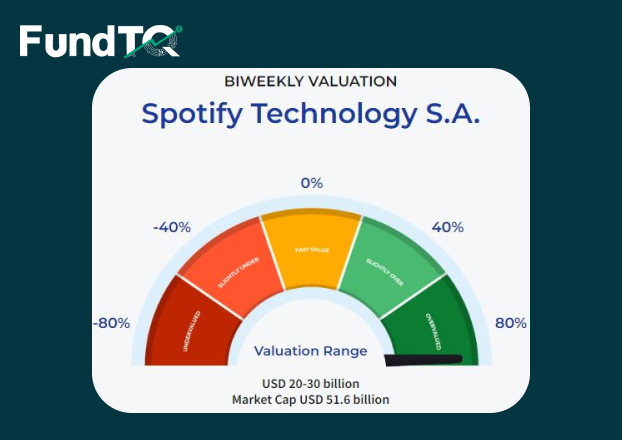
According to FundTQ’s analysis, Spotify might be overpriced. While Trading Comparables suggest a valuation range of USD 16–21 billion, the Discounted Cash Flow (DCF) assessment places Spotify’s value at USD 28.6 billion. Spotify’s stock had a notable upswing after the company revealed surprise earnings in Q32023; in the five months since the data were released, the stock has increased by almost 60%. The market’s jubilant reaction to Spotify’s surprising profitability and an optimistic outlook for the company’s financial future seem to be the root causes of this overvaluation.

Check Your Business Valuation for Free

spotify-valuation

Conclusion

In 2023, Spotify experienced significant growth in both revenue and subscribers. Nevertheless, a loss in operating cost as a result of strategic investments was also observed.. In order to turn a profit in 2024, the corporation is concentrating on monetization tactics. Spotify is a major participant in the music streaming business, showcasing its Spotify success story amidst competitive challenges.

Disclaimer: This article is for informational purposes only and does not constitute investment advice. None of the information contained herein constitutes a solicitation, offer or recommendation to sell or buy any financial instrument.

Also Read – About Business Valuation