
How Consumer Brands Are Raising Capital in India’s New Funding Era
India’s consumer market is one of the most actively funded segments in private equity and venture capital right now. From D2C beauty to ayurvedic wellness, from pet care to home goods — capital is flowing. But most consumer brand founders we speak to still ask the same question: “How do we actually get funded?“
This guide breaks down how consumer brand funding works in India, what investors expect, and what separates the deals that close from the ones that stall.

What Is Consumer Brand Funding?
Consumer brand funding is external capital that is collected by companies that make direct sales to end consumers – either directly via their own channels, via retail or via a marketplace. These are equity rounds (seed, Series A, strategic), PE buyouts, and acquisition-based results.
It is different as compared to general startup funding in India since consumer brands are not only tested based on growth, but also brand equity, repeat purchase behaviour, gross margins and scalability of distribution.
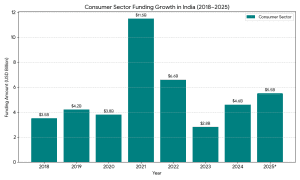
Why Consumer Brands Are Attracting Serious Capital
A few structural tailwinds are driving this:
- Rising premiumisation: The Indian consumers are trading up across categories, especially in Tier 1 and Tier 2 cities. This is benefiting directly on personal care, wellness, food, and lifestyle brands.
- D2C as a validation layer: The brands establishing a direct connection with consumers have more information about retention and cohorts, which facilitates more concrete due diligence discussions.
- Strategic buyers are present: Increasingly, large FMCG conglomerates are acquiring high-growth challenger brands instead of developing them internally. This is providing exit lines that are more expeditious to investors, making consumer deals at an early stage more fundable.
- Global investors are paying attention: Vehicles such as Unilever Ventures, L Catterton and others that are consumer-oriented are already in operation in India.
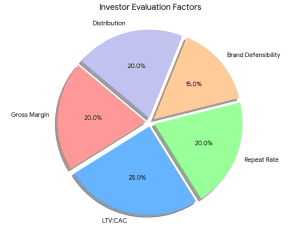
 What Investors Actually Evaluate in a Consumer Brand
 What Investors Actually Evaluate in a Consumer Brand
Before you build your deck or reach out to investors, understand that consumer brand evaluation has its own framework.
- Gross Margins: Consumer brands require healthy gross margins: 55-70 +% D2C, a bit less B2B marketplace-heavy. In case your COGS structure is unable to bear this, the pricing or supply chain work must come first.
- Repeat Purchase Rate and LTV: The early stages often have a high CAC. The more important thing is the return of customers. Investors desire to spend on LTV:CAC ratios greater than 3x and they will demand cohort information to confirm this.
- Brand Defensibility: What is not easy to duplicate about you? This may be formulation IP, a sourcing story that is unique, a personal brand of a founder, a community, or a niche leadership. Investable brands and those that will lose to bigger budgeted incumbents are separated by defensibility.
- Distribution Footprint: Are you expanding on a single channel or developing a multi channel presence? Investors are apprehensive of brands that are wholly reliant on a single market place or a single region.
- Founder-Market Fit: Particularly in the initial phases, investors are supporting the knowledge of the founder in terms of the consumer and the category more than the product itself.
Our Recent Deals: What Successful Consumer Brand Transactions Look Like
 Our Recent Deals: What Successful Consumer Brand Transactions Look Like
Emami Acquires Majority Stake in Axiom Ayurveda [Read Now]
FundTQ was an adviser on the acquisition of Axiom Ayurveda by Emami, one of the most recognised FMCG conglomerates in India. Axiom Ayurveda had developed a robust product range in the herbal and Ayurveda wellness sector with deep distribution in the offline channels.
This acquisition is indicative of a larger trend: big incumbents buying challenger brands that have already taken a targeted niche of a consumer market. Instead of creating competing products. In the case of Axiom, the strategic acquisition gave it the capital, distribution and brand halo it needed, to grow much more quickly than it would have done had it grown organically.
What founders can learn: A strong niche position, even without massive revenue scale, can attract strategic acquirers if the brand is differentiated and the consumer relationship is real.
Secret Alchemist on Successful Fund raise Led by Unilever Venturesu [Read Now]
Secret Alchemist — the beauty brand by actress and entrepreneur Samantha Ruth Prabhu — has been able to raise funds through Unilever Ventures as the principal investor with FundTQ serving as the sole financial advisor.
There are several reasons why this deal is important. Unilever Ventures is among the most discriminative consumer-oriented funds in the world. Their leadership of this round is indicative of the strength of the brand, the consumer relationship, and the potential of the category in the long run. To Secret Alchemist, this was not capital per se, but the Unilever world manual on how to create beauty brands.
What founders can learn: Investor-brand fit is as important as the size of the cheque. An investor with a strategic approach and knowledge of your category can speed up growth in a manner not possible to financial only investors.
How FundTQ Works With Consumer Brand Founders
FundTQ is a mid-market investment banking and advisory firm with a dedicated focus on consumer, healthcare, and industrial sectors. Our team has backgrounds from IIT Delhi, KPMG, PwC, and EY — and more importantly, we’ve closed transactions across brand categories, which means we understand what investors in this space actually need to see.
As investment banking advisors for consumer brands, we work with founders at different stages:
- Pre-raise: Positioning your brand, building the financial model, and preparing investor-ready materials. If you need a starting point, we also offer startup financial model frameworks and free pitch deck templates for consumer brands.
- During the raise: Investor identification, outreach, and managing the process so founders can stay focused on the business.
- Transaction advisory: For founders exploring acquisitions, strategic investments, or equity funding for retail businesses.
We’ve been ranked among India’s top investment banks by Venture Intelligence. Our investor network spans domestic PE/VC funds, family offices, and global strategic investors.
Ready to explore your funding options? Write to us at deals@fundtq.com or visit fundtq.com.
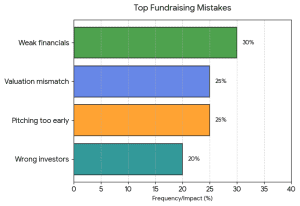
Common Mistakes Consumer Brand Founders Make When Raising Capital
- Pitching too early: Investors in consumer brands desire to have evidence not merely a great story. When untested in your repeat rates or unclear in your margin structure, invest more time in product-market fit before formal raise processes.
- Underprepared financials: The majority of founders do not realise the extent to which investors question unit economics. Before your first investor meeting, know your contribution margin, your payback period, and your channel-wise CAC.
- Wrong investor targeting: The difference between a generalist fund and a consumer-oriented fund is not the same. Before outreach, align your stage, sector, and geography to the mandate of the investor.
- Valuation mismatch: Brand valuation is dependent on revenue multiples and brand potential, not only growth rates. Being aware of similar deals assists in setting realistic expectations.
FAQs: Consumer Brand Funding in India
 FAQs: Consumer Brand Funding in India
- How much funding can a consumer brand raise at the seed stage?
Consumer brand seed rounds in India typically fall between ₹2 crore and 10 crore. This will be based on traction – that is, revenue run rate, repeat-buy data and the ability to illustrate unit economics clearly. Strong D2C metrics and differentiated positioning lead to higher brands increasing on the upper part of this spectrum. - What financial metrics do investors look for in a consumer brand?
The non-negotiables include gross margin (5570%+ when dealing with D2C) and LTV:CAC ratio (3x or higher), repeat purchase rate, and month-on-month revenue growth. Payback period and contribution margin are also other factors that investors will consider to determine whether the business can expand without ablaze unwarranted capital. - Is it possible to raise funding without a formal pitch deck?
Technically yes – warm introductions and conversations may sometimes come before official materials. Practically, however, any investor serious about a deal will desire a deck and a financial model ahead of term sheets. Consider the pitch deck as the instrument that will allow investors to say yes sooner rather than a formality. - What’s the difference between strategic and financial investors for consumer brands?
A financial investor (VC, PE fund) is maximising mainly the capital. A strategic investor (such as a group of FMCGs or a worldwide brand house such as Unilever Ventures). Also seeking synergies – distribution leverage, category adjacency, or talent. Strategic investors usually come along with non-capital value that can speed up growth tremendously. - Do I need an investment banker to raise a consumer brand funding round?
Not necessarily- but advisory becomes more valuable with increased deal size. In rounds above ₹1015 crore, an established investment banking advisory service can get you access to a larger pool of investors. Deal more favourable terms and structural errors are difficult to correct once closed.
—————————————————————————-
FundTQ is an investment banking and advisory firm focused on consumer, healthcare, and industrial sectors.We’ve advised on transactions including the Emami–Axiom Ayurveda acquisition and the Secret Alchemist fundraise led by Unilever Ventures. To discuss your raise, reach out at deals@fundtq.com
