Building an AI SaaS startup today is easier than ever—but raising capital for it is harder than most founders expect. Over the last 11+ years working in investment banking and startup fundraising, I’ve helped early-stage and growth-stage companies raise capital from angel investors, venture capital firms, and growth funds. One pattern appears again and again:
“Great technology does not guarantee funding.
Investors fund scalable business models, strong metrics, and clear market opportunities.”
This guide breaks down how AI SaaS startups actually get funded, what investors look for at each stage, and how founders can strategically raise capital. If you’re building an AI-powered SaaS product, this article will help you understand the funding landscape—from pre-seed to Series B and beyond.
The AI SaaS Funding Landscape in 2026
The combination of AI + SaaS (Software as a Service) is one of the most attractive startup categories today.
Why investors love AI SaaS:
- Recurring revenue (sub model)
- High scalability
- Strong margins
- Global distribution
- Data network effects
But the market is also competitive. Investors are seeking serious differentiation and actual traction.
Typical funding journey:
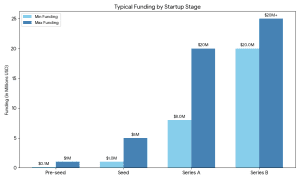 For AI SaaS startups, early traction matters more than hype.
Understanding the AI SaaS Business Model
Before investors fund you, they evaluate whether your business model is scalable.
Typical AI SaaS revenue models include:
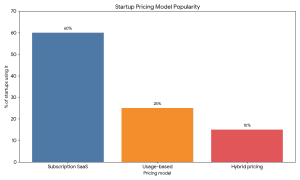 1. Subscription SaaS
Monthly or yearly subscription.
Examples:
- Automation tools of AI marketing.
- AI CRM software
- AI productivity tools
2. Usage-Based Pricing
Common in AI infrastructure.
Examples:
- API calls
- AI inference usage
- GPU compute consumption
3. Hybrid Pricing
Subscription + usage pricing.
Example:
Base plan + more AI credits.
Shareholders would like a stable revenue pattern with growth prospects.
Key Funding Stages for AI SaaS Startups
1. Pre-Seed Funding
Goal: Build the initial product (MVP).
Typical investors:
- Angel investors
- Startup accelerators
- Friends & family
- Early-stage venture funds
List of famous accelerators:
- Y Combinator
- Techstars
What investors expect:
- Strong founding team
- Technical capability
- Clear AI use case
- Prototype or MVP
Common indicators in this stage:
- Early beta users
- Initial product validation
- Clear problem statement
2. Series A Funding
Goal: Prove product-market fit.
Typical raise: $8M – $20M
SaaS metrics have become a priority to investors.
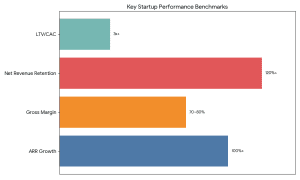
Important metrics include:
 1. ARR (Annual Recurring Revenue)
Investors prefer:
$2M – $5M ARR minimum
Strong growth (100%+ YoY)
2. CAC (Customer Acquisition Cost)
The cost per customer of acquisition.
3. LTV (Lifetime Value)
One customer expected to bring in a total revenue.
A good SaaS company tends to possess:
LTV / CAC ratio ≥ 3
4. Net Revenue Retention (NRR)
Measures expansion revenue.
Strong AI SaaS firms tend to possess:
NRR > 120%
3. Series B and Growth Funding
At this stage, investors focus on scaling and market leadership.
Funding is used for:
- International expansion
- Enterprise sales teams
- Product development
- AI infrastructure
Typical requirements:
- ARR: $10M+
- Proven business model
- Strong retention
Growth investors include:
- Late-stage venture capital
- Private equity
- Growth funds
How Investors Evaluate AI SaaS Startups
Investors typically evaluate startups across five core pillars.
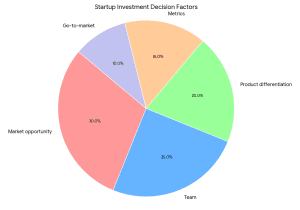 1. Market Opportunity (TAM)
TAM = Total Addressable Market.
Investors desire big markets.
Example:
The AI SaaS categories that have been funded:
- AI productivity tools
- AI developer platforms
- AI marketing automation
- AI healthcare software
Big market = Bigger Exit Opportunity.
2. Product Differentiation
Many AI startups fail because they rely solely on existing AI models.
Investors look for:
- Proprietary data
- AI workflows
- Custom models
- Unique user experience
A strong moat includes:
- Data advantage
- Workflow lock-in
- Integration ecosystem
3. Founding Team
Investors invest heavily in founders.
They evaluate:
- Domain expertise
- Technical capability
- Execution speed
- Founder-market fit
The founders of many funded AI startups have worked at companies such as:
- OpenAI
- Microsoft
However, good founders may be of any type so long as they portray execution.
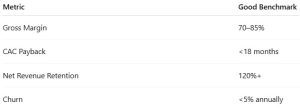
4. SaaS Metrics
For AI SaaS startups, investors closely track:
Important metrics:
- ARR growth
- CAC payback period
- LTV/CAC ratio
- Churn rate
- Gross margin
Healthy SaaS benchmarks:
5. Go-to-Market Strategy
Great products fail without distribution.
Investors want to see:
- Product-led growth
- Sales motion
- Channel partnerships
- Community adoption
Popular GTM models of AI SaaS:
- Freemium model
- Developer API adoption
- Enterprise sales
- Marketplace integrations
Startup Valuation for AI SaaS Companies
Valuation depends on growth and revenue multiples.
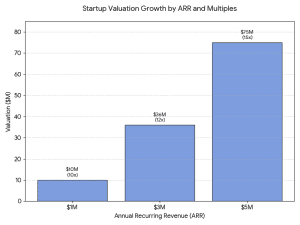 For SaaS startups:
Typical revenue multiples:
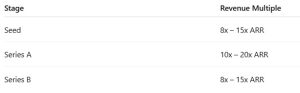
Example:
Startup ARR = $3M
Series A multiple = 12x
Estimated valuation: $36M
However, AI hype can temporarily increase multiples.
Strategic Fundraising Advice (From Investment Banking Experience)
Here are practical strategies founders often overlook.
1. Raise Before You Need It
Fundraising takes 4–6 months.
This is to start when you have 12 months of runway.
2. Establish Relationships with Investors.
Investors usually finance founders that they are familiar with.
Strategies:
- Share quarterly updates
- Attend startup events
- Warm introductions
3. Focus on One Clear Metric
The most successful startups point out a single metric.
Examples:
- Fast ARR growth
- Massive user adoption
- Enterprise customer pipeline.
- Transparency attracts investor confidence.
4. Build a Strong Data Room
Before fundraising, prepare:
- Pitch deck
- Financial model
- SaaS metrics dashboard
- Customer pipeline
- Product roadmap
Deals are accelerated by professional preparation.
5. Do not Raise the Wrong Investors.
The mischief of investors gives rise to long term problems.
Choose investors who:
- Understand SaaS
- Support founders
- Add network value
 Common Fundraising Mistakes AI SaaS Founders Make

Mistake 1: Raising Too Early
It is hard to raise money without traction.
Focus first on:
- MVP
- Early customers
- Product-market fit
Mistake 2: Overbuilding AI
Most founders create AI functionality that is not necessary to customers.
Focus on: Solving real problems.
Error 3: Weak Go-to-Market Strategy.
- Technology by itself does not sell.
- Distribution matters more.
Error 4: Unrealistic Valuation.
Overpriced seed rounds may damage subsequent financing rounds.
Be realistic.
Best Funding Sources for AI SaaS Startups
Founders should explore multiple funding sources.
1. Angel Investors
Perfect in pre-seed and seed rounds.
Advantages:
- Flexible
- Founder friendly
2. Venture Capital
Best for scalable startups.
VC investors bring:
- Capital
- Network
- strategic guidance
3. Startup Accelerators
Programs provide:
- Small funding
- Mentorship
- Investor access
4. Venture Debt
Later-stage SaaS companies used it to extend the runway.
The Future of AI SaaS Funding
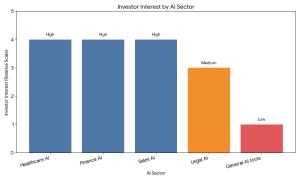 Several trends are shaping AI startup funding.
Key trends:
- Infrastructure investments in AI.
- Vertical AI SaaS
- AI copilots for industries
- AI developer platforms
Investors are no longer interested in general AI tools, but rather industry solutions.
Example verticals:
- Healthcare AI
- Legal AI
- Finance AI
- Sales AI
Vertical AI SaaS startups are another area that is getting keen investment by funds.
Final Thoughts
Raising funding for an AI SaaS startup is not just about building great technology.
Investors evaluate:
- Market size
- Revenue traction
- SaaS metrics
- Founder execution
- Go-to-market strategy
The founders who succeed are those who combine technology vision with strong business fundamentals. If you focus on solving real problems, building recurring revenue, and demonstrating growth, funding opportunities will follow.
FAQs: AI SaaS Startup Funding
Q. How much funding do AI SaaS startups usually raise?
Typical ranges:
- Pre-Seed: $100K – $1M
- Seed: $1M – $5M
- Series A: $8M – $20M
- Series B: $20M+
Real capital is based on traction, market size and caliber of the team.
Q. What metrics do investors look for in AI SaaS startups?
Key SaaS metrics include:
- ARR (Annual Recurring Revenue)
- LTV/CAC ratio
- Net Revenue Retention
- Churn rate
- Gross margin
- CAC payback period
These ratios represent scalability and profitability.
Q. How long does startup fundraising take?
Common fundraising schedules:
- Seed round: 3–4 months
- Series A: 4–6 months
The process can be reduced greatly through preparation.
Q. What is the best funding stage to raise capital?
The best time is when you have:
- Early traction
- Strong growth
- Clear product-market fit
Better valuations are achieved by raising capital during momentum.
Q. Do AI startups get higher valuations than traditional SaaS?
Yes, sometimes when:
- The startup possesses proprietary AI models.
- There is strong user growth
- The market size is big.
Nonetheless, long-term valuations remain pegged on revenue and growth metrics.