
A HealthTech startup is not an easy task to build. The actual process of raising money towards one is even more difficult. It is not just a product you are selling, you are dealing with FDA regulations, hospital sales cycles, insurance reimbursement and clinical evidence simultaneously.
The good news? The market is robust into 2026-2027. Investors are returning, and they are being highly picky. They desire evidence, not possibility. This guide reveals to you what they are seeking and how to present it to them, in language easily understood.
What’s Happening in HealthTech Funding in 2026
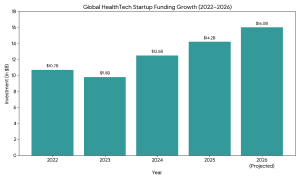
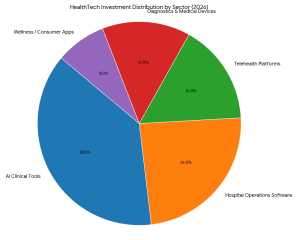
HealthTech fundraising recovered with a vengeance after a downturn in 20222023. In 2025, US digital health startups experienced the most investments in history, with an amount of 14.2 billion, and this trend is carrying over to 2026. But money is becoming concentrated. Less dealings, larger checks, and a much stricter purse on which companies receive funding.
 Here’s where investors are putting their money right now:

- AI is the biggest story right now. In early 2025, nine of eleven mega-deals (over $100M) were sold to AI-driven healthcare startups. Some firms such as Abridge that help physicians save 3 hours a day in documentation became unicorns quickly. When your product utilizes AI in a clinically meaningful manner, then that is a big advantage.
- Specialisation beats broad platforms. As reported by Galen Growth (2026), 62% of the highest-funded startups in the first stage are very narrow and specific — not general wellness. Deep focus defeats “we solve everything.”
- Operational health tools are exploding. Startups to handle hospital administration – scheduling, billing, prior auth, clinical documentation – are receiving substantial investment due to the need by health systems to be efficient.
What investors are avoiding in 2026: DTC health apps with no enterprise path, subscription wellness without clinical proof, and anything described as “Uber for healthcare” without a reimbursement model.
 The Four Funding Stages — Where Do You Fit?
 The Four Funding Stages — Where Do You Fit?
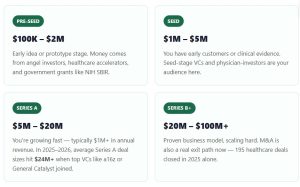
Approaching the wrong investor for your stage is one of the most common and costly mistakes founders make. Here’s a simple breakdown:
Free money most founders don’t know about:
NIH SBIR/STTR grants provide up to 2M without any equity to HealthTech startups. When your product is clinical or scientific, this is among the most intelligent first steps you may take. It finances early validation and conveys credibility to future VCs.
The Numbers Every Investor Will Ask About:
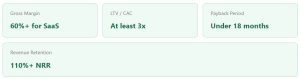
You don’t need to be a finance expert — but you do need to know these numbers coldly. Every investor will ask, and vague answers kill deals
In Simple Words:
- Gross Margin – this is the amount of money you retain after rendering your service. Better is healthier business.
- LTV/CAC – is the lifetime value of a customer worth more than 3 times its cost? 3x is the lowest the investors are willing to accept.
- Payback Period – How many months before a customer recovers what you spent to acquire them? Shorter is better.
- NRR (Net Revenue Retention) – are current customers spending more as time goes on? 110 or above is yes and this is good news to investors.
FDA and Compliance — Don’t Avoid This Conversation
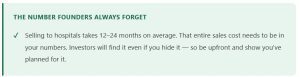
In their pitch, most founders omit regulation. That’s a mistake. Regulatory risk is priced in regardless of the situation – therefore, you are better showing that you considered it thoroughly.
Before your first investor meeting, the three questions to answer are:
- Is my product an FDA-regulated medical product or AI tool?
- If yes – what is my approval route and how long should it take?
- Is my product billable to doctors? (Known as reimbursement – this is a big issue to investors.)
Already have FDA clearance? It will also increase your valuation by at least $2-5 million, since you have eliminated the largest risk that investors fear.
Selling to hospitals? They will inquire about HIPAA compliance, data security and SOC 2 certification and will not sign until they are sure they are assured. Get this sorted prior to your Series A – hopefully before your seed round if you can.
Also Read: Fundraising for Healthcare
How to Run Your Fundraiser the Right Way?
The majority of founders use fundraising as a random meeting. Those who grow quicker take it as an organized plan with a definite schedule.
Talk to many investors at the same time
Not one, not one, not one after another — that can make a seed grow round between 3 months and a year. Contact 20-40 investors simultaneously. When your pitch is sharp, play on your highest-priority targets first before moving on to your lower-priority targets.
Create honest urgency
It is fully alright to inform other people that you have some active discussions going on when one of the investors begins taking things seriously. This is natural and moral – and it makes everybody move faster.
Your pitch deck is a business document, not a brochure
Keep it to 10–12 slides. The ones that are important to investors in 2026:
- The clinical problem — backed by real data, not your opinion
- Your solution and how it actually works in a clinical workflow
- How big the market is — be specific, not just “$500 billion”
- How you make money and who pays (payer, provider, employer, consumer?)
- Your traction — revenue, growth rate, hospital or payer logos
- Your regulatory plan — show you’ve thought about it
- Your team — clinical + technical + commercial is the winning combo
- How much you’re raising and exactly what you’ll use it for.

Who to Approach — Investors & Accelerators in 2026
Targeting the right investor for your stage saves months of wasted effort. Here’s who’s active right now:
Healthcare VC firms by stage
- Seed: HealthX Ventures, Flare Capital Partners, Rock Health.
- Round A/B: FundTQ, General Catalyst, a16z Bio, GV (Google Ventures), Bessemer Venture Partners, Transformation Capital.
- Growth: OrbiMed, Foresite Capitals, Deerfield Management, RA Capital.
- Corporate VCs: Optum Ventures, Kaiser Permanente Ventures, CVS Health Ventures, Johnson & Johnson Innovation, Medtronic Ventures
Worth knowing: in 2025–2026, mega funds like General Catalyst and a16z participated in nearly 80% of the largest deals. When they join a round, average deal sizes jump significantly — so a warm intro to these firms is worth a lot.
Accelerators worth your time:
- Rock Health: the most respected digital health company.
- Y Combinator: 36 HealthTech startups in recent batches, almost all AI-oriented.
- MATTER (Chicago): has ties to large hospital networks, including Northwestern Medicine.
- MassChallenge HealthTech: none of the equity, robust Boston clinical ecosystem.
- Cedars-Sinai Accelerator: direct clinical validation access run by the hospital.
- HIMSS Emerge (HIMSS26): It is excellent in seeing health system investors and payer partners in person.
Read About: The Best Healthcare Investment Banking Firms [Updated List]
Common Questions About Funding for HealthTech Startup in 2026
1. How much should I raise at seed stage in 2026?
Usually $1M–$5M. Target 18-24 months runway and tie the amount to certain milestones – normally to $1M+ annual recurring revenue which would make you eligible to talk Series A. No more than necessary, additional dilution at this point is expensive.
2. Do I need FDA approval before talking to investors?
No — but you need a clear plan. FDA clearance already existing companies have valuations that grow at much higher rates (often 2040% higher) since the largest uncertainty has been eliminated. Though you do not have it, know your regulatory route, your approximate schedule and cost. Unclear responses are an alarm to investors.
3. How long will the fundraising process take?
The time of seed rounds is usually 3-6 months. Series A takes 4–9 months. HealthTech is slower than standard tech fundraising, as investors will root deeper in your clinical and regulatory side. The most effective way of reducing that time is by running parallel conversations with 20-40 investors simultaneously and not one at a time.
4. Is it possible to raise money without equity?
Yes. NIH SBIR/STTR grants include $150K-2M no strings attached -no equity, no repayment. When you are earning more than 500K in revenue, revenue-based funding sources such as Lighter Capital are available where they provide loans to companies based on future revenue without requiring you to sell any ownership. These are clever aids to make between equity rounds to lengthen your runway.
5. Is the IPO market back for HealthTech?
It’s reopening. In 2025, five digital health firms such as Hinge Health and Omada Health had broken a three-year IPO dry spell. All other dealings are also rampaging with 195 deals in 2025 (up 61%). To founders, this represents the fact that there exist more ways out than there were two years ago which also makes investors more open to write checks knowing that there is a way out to return.