Raising Capital for Your AI Startup?
India’s AI startup ecosystem raised over $1.5 billion during 2024–25, but most founders still face the same challenge: no warm investor introductions, no structured fundraising process, and VCs who disappear after the first meeting. The problem usually isn’t the technology in the process of funding for ai startup. It’s positioning, preparation, and getting in front of the right investors.
At FundTQ, we’ve advised on 50+ transactions across technology, healthcare, and consumer sectors. After speaking with 50 investors across venture capital, fintech investment banking, and technology investment banking, one theme emerged repeatedly:
“The founders who raise capital are rarely the ones with the best technology. They are the founders who are best prepared.”
Who This Guide Is For
This guide is designed for:
- AI SaaS companies
- Enterprise AI startups
- HealthTech AI businesses
- Revenue-generating startups
- Founders preparing for Series A and growth capital raises
- Companies seeking ₹35 Cr+ capital
Not a Fit If:
- You’re raising a small angel round
- You’re seeking seed funding
- You’re still validating an idea
- You’re pre-revenue
FundTQ does not work with seed-stage mandates.
Why Most AI Startups Fail to Raise Funding
After interviewing investors and transaction advisors, we found that most AI startups struggle because of:
- Weak pitch decks
- No investor relationships
- Poor financial storytelling
- Lack of traction
- Generic AI products without defensible moats
- Constant VC rejections
Investors aren’t rejecting AI. They’re rejecting unprepared businesses.
Understanding AI Startup Funding Stages
Before approaching investors, founders need to understand where they fit.
# Pre-Seed Funding
Capital used to validate an idea or build an MVP.
Typically raised from:
- Angel investors
- Friends and family
- Incubators
# Seed Funding
Focused on product-market fit and early traction.
Typical investors include:
- Seed VCs
- Angel syndicates
- Accelerators
# Series A Funding
Designed for scaling.
Investors look for:
- Revenue growth
- Strong unit economics
- Product-market fit
- Market expansion opportunities
# Growth Capital
Growth equity and strategic investors provide capital to accelerate expansion and acquisitions.
What Investors Really Want From AI Startups in 2026
AI hype alone no longer attracts capital. Investors are looking for four things.
1. Defensibility
AI products are easy to copy.
Investors want:
- Proprietary datasets
- Network effects
- Distribution advantages
- Unique customer access
2. Strong Unit Economics
Founders must understand:
- CAC
- LTV
- Gross margin
- Burn multiple
- Customer retention
Nothing kills investor confidence faster than weak financial understanding.
3. Proof of Market Demand
Traction matters more than presentations.
Examples include:
- Paying customers
- Pilot programs
- Revenue growth
- Enterprise contracts
- Retention metrics
4. A Large Market Opportunity
Investors want to know:
- How big is the market?
- Why now?
- Why your team?

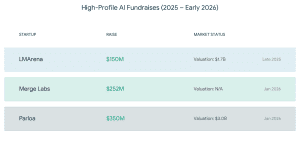
Late-stage rounds dominated AI funding in 2025
——————————
Not sure if your current traction is investor-ready?

7 Proven Ways AI Startups Raise Capital
1. Build an Investor-Ready Pitch Deck
A strong pitch deck should explain:
– Market Opportunity
What problem are you solving?
– Product Differentiation
Why can’t competitors easily replicate your AI solution?
– Business Model
How do you make money?
– Traction
What proof exists that customers want the product?
– Financial Projections
How will capital accelerate growth?
2. Use Online Platforms and Communities
Founders no longer need warm introductions.
Platforms like:
- AngelList
- Crunchbase
allow startups to connect with investors and build visibility. Investors increasingly research founders before meetings.
3. Work With Technology Investment Banking Advisors
Professional advisors help founders with:
- Investor mapping
- Fundraising strategy
- Valuation positioning
- Deal structuring
- Due diligence preparation
- Negotiation support
According to deal advisors, founders who start investor targeting and transaction structuring simultaneously often close rounds 40–60% faster.
Case Study: Structured Deals Create Better Outcomes
FundTQ advised on the acquisition of Axiom Ayurveda by Emami Limited through a ₹200 Cr majority stake transaction.
The process involved:
- Deal structuring
- Investor mapping
- Negotiation support
FundTQ also advised StepOut’s fundraise backed by Rainmatter, Zerodha‘s investment arm.
Although sectors differ, the process remains similar:
- Positioning
- Valuation strategy
- Investor targeting
- Deal execution
4. Build Strategic Partnerships
Strategic relationships with:
- Technology accelerators
- Corporate venture arms
- Fintech investment banks
- Industry ecosystems
can create opportunities that cold outreach cannot.
5. Show Traction Early
Investors care about results.
Examples include:
– Revenue Growth
Monthly recurring revenue growth.
– Customer Adoption
Enterprise customers and pilot programs.
– AI Performance Metrics
Model accuracy and customer outcomes.
– User Retention
Evidence that customers stay.
A startup with three paying customers is usually more attractive than one with a beautiful deck.
6. Apply to Accelerators
Programs like:
- Y Combinator
- Techstars
offer:
- Capital
- Mentorship
- Credibility
- Investor access
Acceptance itself acts as validation.
7. Become a Thought Leader
Investors often research founders before taking meetings.
Publishing:
- Technical blogs
- AI insights
- Market commentary
- Customer case studies
helps build trust and authority.
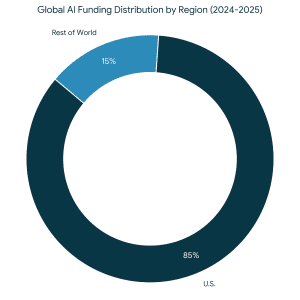
U.S. AI startups dominated investment flows in 2025 — capturing the majority of global funding.
Why Investment Banking Advisory Matters
Fundraising isn’t simply about introductions. Experienced advisors help founders:
- Structure the Round
Optimizing dilution and capital allocation. - Improve Valuation
Positioning affects pricing. - Manage Due Diligence
Reducing surprises during the process. - Negotiate Better Terms
Protecting founder ownership. - Access High-Quality Investors
Targeting investors aligned with your business.
Insights From 50 Investors
Here are the recurring themes we heard.
“Show us a moat, not just a demo.”
AI products are easy to replicate. Defensibility matters.
“Know your numbers.”
Investors expect founders to understand:
- CAC
- LTV
- Burn rate
- Margins
“Traction beats pitch quality.”
Three paying customers are worth more than forty slides.
“Good advisory support signals quality.”
Institutional investors appreciate professionally prepared opportunities.
AI Startup Investor Readiness Checklist
Before raising capital, ask yourself:
Product
– Working product
– Clear differentiation
– Defensible moat
Financial Metrics
– Gross margins
– CAC
– LTV
– Burn rate
Market
– Paying customers
– Repeatability
– Growth opportunity
Story
– Clear vision
– Capital utilization plan
– Expansion roadmap
Frequently Asked Questions – FAQs
1. Can I raise funding without investor connections?
Yes. Platforms, accelerators, and professional advisors help founders access investors. Ultimately, traction and positioning matter more than relationships.
2. What metrics do investors look at?
Investors commonly evaluate:
- Revenue growth
- CAC
- LTV
- Gross margins
- Burn multiple
- Retention
3. What does an investment banker do for an AI startup?
Investment bankers help with:
- Investor targeting
- Deal structuring
- Valuation strategy
- Due diligence
- Negotiation support
4. What traction should I have before raising Series A?
Investors typically expect:
- Product-market fit
- Paying customers
- Revenue visibility
- Customer retention
5. Does FundTQ provide seed funding?
No. FundTQ focuses on growth-stage transactions and mandates generally above ₹35 Cr.
Final Thoughts
Raising capital for an AI startup isn’t a lottery. The founders who successfully close rounds are rarely those with the most impressive technology. They’re the founders who prepare early, understand their numbers, and approach investors with a structured process. Fundraising is ultimately about trust. And trust is built long before the first investor meeting.
——————————
FundTQ has advised on 50+ transactions across technology, healthcare, and consumer sectors.
If you’re preparing for a ₹35 Cr+ raise, our team can help you evaluate whether you’re institutionally ready—and what gaps need to be addressed before approaching investors.
Request an Investor Readiness Assessment
We’ll tell you honestly:
- Whether you’re ready
- What investors will expect
- What needs improvement
- Whether a mandate makes sense