Bootstrapping vs. Fundraising: Which One Is Right for Your Startup?
Bootstrapping vs. fundraising has become one of the biggest choices that every founder has to make in the vibrant world of startups. The choice will not only define the way your business develops, but also the type of control, risks, expectations with which you will schlep as a founder.
If you are working on your next SaaS unicorn or D2C brand, or even a marketplace, you decide to bootstrap it, or raise a round of funding, knowing how Bootstrapping vs. fundraising can make or break the growth process.
In this BLOG, we are going to deconstruct each of them, reveal the strengths and weaknesses, and assist you in working out what suits your startup the most.
Must Read: How to Get Funding for a Startup Business?
What is Bootstrapping?
Bootstrapping describes any beginning or expansion of your business with your own money (personal savings), internal cash flows or restricted outside resources (friends/family). Quite simply it refers to self financing a startup without investor monies or venture financing.
It is common to most startups, particularly in the early days of the MVP (Minimum Viable Product) or product-market-fit stage, when they may not be able to raise the money easily, or they do need to raise money yet.
Advantages of Bootstrapping:
- Absolute Corporate Decision Making: There are no investors or a board to whom you report. It is your road-map.
- Equity Preservation: 100 percent of your business remains there. No dilution.
- Financial Discipline: Bootstrapped companies tend to form lean establishments, where there is no wastage and unnecessary things.
- Helps to Establish a Great Business Framework: You will only increase in size once your product or service has caught on and generated profits.
- Exit Pressure Free: You are able to grow at your pace without the pressure of living up to unrealistic growth criteria of the investors.
Cons of Bootstrapping:
- Availability of limited Capitals: The cash flows may be limited hence slow growth.
- Improving Personal Financial Risk: You can put in personal savings and assume debt.
- Difficult to Scale-Up Fast: It is difficult to go out and make big hires, go out and do marketing blitzes, and expand without external financing.
- Burnout Risk: It is not uncommon that founders have to do a variety of activities, sometimes wearing many hats and are at risk of burnout.
What is Fundraising?
The fundraising is a task involved in acquiring capital through external funds including venture capitalists (VC), angel investors, accelerators or even crowd funding platforms. It is generally the exchange of ownership (equity) in exchange of capital.
The use of this method is appropriate in case you require quick growth or development of the products, marketing them or expanding in a way which cannot be funded by your existing income or bootstrapping.
Pros of Fundraising:
- Access to Larger Capital: You may indulge in extensive spending in product development, recruiting, advertising, and growth.
- Faster Growth Trajectory: Coupled with sufficient funds, it is one of the ways in which you can however be able to capture a market share
quicker than your competition.
- Investor Network and Mentorship:
Talent Attraction:
Startups with funding are able to give more attractive packages, perks and ESOPs.
- Validation and Media Attention:
The fact that it is supported by known investors makes it more credible and it paves the way to the media and collaboration.
Cons of Fundraising:
- Dilution of Ownership:
You sell off some part of your company, sometimes the control as well.
- Investor Pressure and Expectations:
Value added Investors will demand increases in value, dividends and commonly the sale (IPO/acquisition), enough to potentially mandate dangerous decisions.
- Time-Consuming Process:
It is a long process of angling, due diligence and negotiation to raise the capital.
- Shift in Vision and Strategy:
It may be tempting you to pivot or scale to the areas not consistent with your initial mission.
Bonus Tip:
Startup looking for funds but unsure how to find your business valuation or create a pitch deck? Don’t worry! Try this free Business Valuation Calculator and ready-to-use Pitch Deck Templates—designed to help you raise smart, fast, and confidently.
Bootstrapping vs. Fundraising: Comparison Table
| Feature | Bootstrapping | Fundraising |
| Capital Source | Individual savings and company profits | External investors (Angels, VCs, etc.) |
| Equity Ownership | 100% with founders | Shared with investors |
| Speed of Growth | Slower, sustainable growth | Faster, aggressive expansion |
| Decision-Making Power | Solely with founders | Shared with board/investors |
| Risk Level | High personal financial risk | Shared financial risk with investors |
| Investor Support | Limited | Access to mentorship, networks |
| Operational Flexibility | High | Moderate to low (depending on investors) |
| Exit Pressure | None | High (due to ROI expectations) |
Which One Is Correct For You?
The decision between bootstrapping vs fundraising is based on your market, business model, and attitude. There is no universal solution, but the given below guiding questions may help you to consider what you want to do:
- Do you need quick capital to get market share or develop your product on a rush?
The nature of your business: In some cases, your business must proceed quickly you may have a first-mover advantage to gain or have invested heavily in technology upfront. You will need more capital than you, perhaps, can afford. Such example is the winner taking all in such industries as AI, logistics, or e-commerce. Bootstrapping may in this case drag you behind and enable your competitors to hop forward. - Is your business niche, service-oriented or B2B and has an opportunity of steady and organic growth?
In cases where you have a niche of customers or when your start-up business provides high-margin services, then bootstrapping may be a better option. These models do not usually need a lot of capital at the outset and are instead tied to good relations, customer loyalty and business efficiency rather than blitz-scaling. - Do you want to relinquish equity and share power?
This is because fundraising will bring on board third party stakeholders, including angel investors, and venture capitalists, who will have an influence on the growth of your company. This can benefit you in case you are not opposed to teamwork, formal management, and forfeiting ownership of some share. Otherwise bootstrapping will save your independence. - Are you interested in sustainable long term growth, independence and freedom?
Bootstrapping is a strategy that fits your vision when, in order to achieve a profitable and long-term company on your own, you want to avoid the pressure of Wall Street-mandated growth targets and investor demands, as well as fundraising schedules. It is not as fast but then, it is all yours in terms of direction and choice. - Does your market deal sharply with competitive conditions or time-urgency (e.g. fintech, market places, fast-commerces)
Fundraising can provide you with the muscle necessary to move quickly, attract quality personnel and beat competitors when time is of the essence. In such instances, bootstrapping may not give you an opportunity to grow at a pace that can keep you relevant.
Learn About: How Do Investment Banks Help Structure Large Funding Rounds?
Real Talk: Both Action and Talking are Done by Many Startups
Truth is, the journey isn’t binary.
Bootstrapping is one of the ways used by many successful startups, who then get funds. Such a hybrid allows proving traction, gaining credibility, and allowing to demand more advantageous conditions upon going to raise at long last.
For example:
- Zoho, and Zerodha are unicorns which were bootstrapped.
- Freshworks initially bootstrapped, and later took in VC cash to expand worldwide.
- Never did Mailchimp ever raise any funds and leave with billions.
Even lean startups can seek grants, governmental funding or debt as it is the kind of money they can raise without being equity-related or belong to the realm of a group relying on traditional VC fundraising but they can fill in the gaps.
How FundTQ Can Help?
When it comes to fundraising, the investor scene may be too much to handle, especially when you are going through the process the first time with your startup. This is where FundTQ comes in. FundTQ is a fundraising enablement that assists startups to prepare, connect and close funding rounds in an efficient way. At FundTQ, we provide end-to-end support to all your future financing needs be it a seed-round, Series A or even venture debt, all this at the stage and sector of your startup. They offer an investor readiness service, a pitch deck / financial model and data room preparation, relevant investor outreach and data room management.
The strategic, smart insight is what is unique about them– they help founders, not only raise money, but help them raise it in smart ways. The team of FundTQ can help guarantee that you will be speaking to the right investors and people sharing your vision, business development path, and industry. FundTQ makes the fundraising process less frictional in bootstrapped startups who are ready to scale, or in early-stage ventures wanting to win the confidence of investors. They can also help in legal documentation, valuation strategy and closing support as well-which saves a great amount of time and money. In the bootstrapping vs fundraising debate, if you decide to raise capital, FundTQ can be your partner in securing the right funding at the right time, so you can focus on growing your business instead of getting lost in the paperwork.
Final Thoughts
There is no universal answer in the bootstrapping vs fundraising debate. It is a trade-off (among growth and control, speed and sustainability, risk and ownership). The most important thing is to be aligned with your own personal ambitions, as well as resources and goals because of your startup. Bootstrapping makes one strong. The fundraising creates momentum.
The most intelligent founders know the differences between the two and when it is appropriate to apply them.


 Why Does Business Valuation Matters?
 Most reliable
 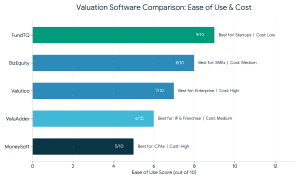 With many options on the market, choosing the right business valuation program is key. Meet the leading tools that we can expect in 2025: