
Types-of-investors

What Types of Investors Do Investment Banks Work With?

Investment banks provide money-related help to people and organisations such as large financial firms. Have you ever considered the identity of the people they do business with? Which companies and organisations are the firm’s clients. This blog will focus on the types of investors that typically connect with investment banking services. We will outline the services these banks give to various investors such as high-net-worth individuals (HNWIs) and institutional investors.

Understanding Investment Banking Services

Before diving into the different types of investors, let’s briefly define investment banking services

These Services  generally belong to three types.

  • Advisory Services: Mergers, acquisitions, restructuring and strategic planning assistance are part of advisory services.
  • Underwriting: Giving clients a way to raise capital by offering debt or equity.
  • Trading and Brokerage:Traders and brokers manage their client’s investments, focus on risk and may be involved in establishing market prices.

Now, let’s look at who  makes up the main users of these services.

What Do Investment Banks Do?

It’s important to know what investment banking services are first, before discussing investors.

  • People and companies use investment banks for help with:
  • Helping clients decide whether to acquire or merge with another business (called M&A)
  • Getting funds by offering shares or bonds
  • Selling shares and making investments through the stock market
  • Using special financial tools called derivatives is an example of managing risks.

Unlike normal banks, they do not offer the chance to open a savings account. They usually deal with clients who either want to invest or want to handle sizeable investments.

1. High-Net-Worth Individuals (HNWIs)

Who Are HNWIs?

An HNWI is a person who has assets amounting to over $1 million (excluding their house). Certain individuals have vast amounts, for example $5 million or even $30 million or more.

Why Investment Banks Work with HNWIs?

HNWIs receive special services from investment banks, for example:

  • Supporting them in looking after and increasing their assets
  • Figuring out what to do with their estate
  • Making private and exclusive investments open for their clients
  • Working on real estate, business startup or international initiatives

Most high-net-worth clients are offered guidance by a personal financial advisor.

2. Institutional Investors

Who are Institutional Investors?

Institutional investors are organisations that gather large amounts of money to put into securities, real estate and different assets. Examples include:

  • Pension funds
  • Insurance companies
  • Mutual funds
  • Hedge funds
  • Organisations called endowments and foundations
  • Sovereign wealth funds

Because they hold so many assets, these investors influence the capital markets a lot.

Bonus Tip: Are you a startup struggling to define your business value or pitch to investors? Don’t worry — use our free business valuation software and pitch deck templates to present your startup with confidence!

Why Investment Banks Serve Institutional Investors?

Institutional investors use investment banks for a wide range of services:

  • The ability to complete big deals with low market influence
  • Offerings of IPOs and debt
  • Market studies and intelligence reports
  • Techniques for trading derivatives and hedging are now widely available.
  • Financial products specifically tailored to a person’s needs

Because institutional investors typically trade in sizeable amounts that move the markets, the services of investment banks are very important.

Also Read: Comprehensive Guide to Investment Banking Services for Startups and Enterprises

3. Corporations

Who are Corporations?

Even though corporations are not directly referred to as “investors,” they make up a main client group for investment banks.

Why Corporations Engage with Investment Banks?

Raising Capital: Raising money by either issuing debt or conducting an IPO

Mergers & Acquisitions: Provide services for securing and carrying out buyouts, mergers and divestitures

Treasury & Cash Management : It involves ensuring there are sufficient funds and resources to meet financial needs

Risk Management:Using derivatives and investor protection to control risk.

In some cases, corporations also act like institutional investors by managing employee pension funds and excess reserves through structured investment vehicles.

4. Family Offices

Who are Family Offices?

Family offices are private companies that look after the money of the extremely wealthy, as most families using them have at least $100 million. Some family offices supervise just one family’s funds and others figure out the finances for a number of families.

Why Family Offices Engage with Investment Banks?

  • Only partners get access to these deals.
  • Projects have access to private equity and venture capital.
  • Ways to arrange investments for lower tax exposure
  • Real estate and art investment management
  • Philanthropic advisory

Similar to HNWIs, family offices value privacy, worldwide connections and detailed financial planning and investment banks are good at providing these services.

5. Government and Sovereign Entities:

Who are Government and Sovereign Entities? 

Governments and sovereign wealth funds (SWFs) are  qualify under the broader types of investors working with investment banks.

Why Government and Sovereign Entities Engage with Investment Banks?

  • Administration of sovereign wealth is usually related to long-term investments worldwide.
  • Advice on government plans to privatise companies
  • Currency and commodity hedging are types of risk management strategies.
  • Issuing and managing government bonds

Those in this industry need their banks to be highly trustworthy and knowledgeable about regulations.

6. Private Equity and Venture Capital Firms

Who are Private Equity and Venture Capital Firms?

They are companies that put money into businesses, mostly those that are starting out or trying to grow. The Private equity firms purchase larger businesses.On the other hand,Smaller and newer businesses are the main targets of venture capital firms.

Why Private Equity and Venture Capital Firms Engage with Investment Banks?

  • Search for deals and identify which stocks to invest in.
  • Working on helping the company make sales or prepare for an IPO
  • Supply information and help with making financial decisions

Many times, investment banks remain partners with these firms for several years.

7. Retail Investors (Small Investors)

Who are Retail Investors?

The majority of  retail investors, are not involved with investment banks.

But still,

Why Retail Investors Engage with Investment Banks?

  • Trading platforms found online
  • Guidance and resources for financial decisions
  • The Basic types of investment opportunities

Still, big investment banking services like mergers or big investments are not meant for small investors.

Why It Matters: Different Services for Different Investors

As every type of investors are different in what they want and can afford, investment banks do not give out the same services to everyone. A High-net-worth individuals (HNWIs) may require guidance on keeping their savings, saving on taxes or finding unique private investment deals. On the other hand, big investors such as pension funds or mutual funds need help with large trading, thorough market analysis and complex strategies to handle managing billions of dollars.

Corporations may approach banks to get funds, spread into other markets or manage merger or acquisition activities, whereas family offices look for wealth plans that last for several generations and a wide range of assets. Public funds and global investment decisions are regularly approached by governments and sovereign wealth funds with advice from investment banks. Alternatively, private equity and venture capital companies rely on services for finding deals, valuing companies and managing exits. Even though each of these types of investors work with the same investment bank, their needs are very different. That’s why investment banking services are always tailored—designed to match the investor’s size, goals, and risk tolerance. Many aspects of finance, including why investment banks are vital, rely on understanding these differences.

Conclusion

Investment banks work with many different types of investors from High-net-worth individuals (HNWIs)

to huge institutional investors and even governments. Various types of investors hope to improve their wealth, but some choose to involve themselves in national or regional investment plans. They are all united because people in these situations need expert advice, large transactions and careful planning.

By understanding who uses investment banking services, you get a better idea of how global finance works—and how important investment banks are in managing money and opportunities around the world.

FAQs

Q1: Who are the main types of investors investment banks work with?

They usually work with high-net-worth individuals (HNWIs), institutional investors, big companies, family offices, and governments.

Q2: What do rich individuals get from investment banks?

Managing wealth, cutting down on taxes and looking for special investment ideas are areas where they need help.

Q3: What is meant by an institutional investor?

It is a kind of large investment body such as a pension fund or mutual fund, that looks after other people’s funds.

Q4: Are there examples of investment banks working with individual small investors?

Not usually. Mostly, their services target big organisations, yet they can provide some tools for users online.

Q5: What does a family office handle?

They work with the wealthy to look after their finances, choose suitable investments, handle taxes and plan for the future.

Investment Banking

What is Investment Banking and Why It Matters for Growing Business

When businesses begin to grow, they often need more money, better advice, and stronger partnerships to keep that growth going. This is where investment bankers come into play. It is a part of the financial services sector that helps companies raise capital, buy or sell other companies, go public, or manage their financial structure better.

Investment banking may sound like a complex term, but at its core, it is about helping businesses handle their financial needs innovatively and structured. Whether a company wants to expand into a new market or improve its economic strength, investment banks provide the necessary tools, advice, and resources.

Investment banking helps businesses raise the money they need to grow

Working with investment banks is one of the most common reasons businesses seek capital. A business expands and needs capital to buy machinery, technology, human resources, and new locations. Investment banks link business entities with investors willing to lend out that money.

Critical roles played by the investment banks in capital raising;

  • Equity financing: Helping companies find investors with whom to sell shares privately or publicly.
  • Debt financing: Helping companies seek bonds or favorable government loans.
  • Private placements: Forming deals with investors of their own choice instead of using public markets.
  • Structured financing: Creating a financing plan effective to the business’s current position and future requirements.

Based on a report by Statista, equity issuance worldwide exceeded $840 billion in 2023. This shows how huge amounts of funds are still being accessed by businesses with the help of investment banks.

Investment banks provide sound financial advice for business planning

Managing finances becomes increasingly complex as a business grows and expands. Investment banks offer advice to companies so that they can plan their next course after understanding financial outcomes better.

Examples of financial advice provided:

  • Capital structure decisions: Whether a company should borrow or apply for equity.
  • Valuation services: Assisting a business to learn its actual worth particularly in negotiations or expansion plans.
  • Cash flow analysis: Knowing where the money is going and how it can improve.
  • Market analysis: Offering insights into industry trends, the nature of the competition, and the actions of the investors.

Such advice can help businesses make key decisions and prevent expensive errors.

Mergers and acquisitions are easier with professional guidance

Acquisition or merger with another business is a very effective method of quick growth. However, such deals are complex, and much may go wrong without adequate help. Investment banks take business through the entire process.

Roles performed by investment banks in mergers and acquisitions.

  • Matching the right target/ buyer: Leveraging networks and market research to identify suitable companies for potential mergers or acquisitions.
  • Valuation and negotiation support: Guaranteeing that the business pays or receives the fair value.
  • Due diligence: Scrutinizing the deal’s financial, legal, and operational aspects to prevent future issues.
  • Deal structuring and execution: Developing how the deal will be done legally and financially.

According to PWC, total global M&A activity has gone over $3.2 trillion in 2023, demonstrating how this space is active and competitive.

Tip for Founders: Struggling to raise funds? Let FundtQ help you with ready-to-use pitch deck templates and instant business valuation software — everything you need to pitch with confidence and clarity.

Initial Public Offerings (IPOs) are handled more effectively by experienced firms

Going public is a major milestone for any business—it not only boosts market visibility but also opens the door to raising capital from a broader pool of public investors. However IPOs have different steps and KRA has to be adhered to fully. It is through the investment banks that the businesses can go through such a process smoothly.

The role played by investment banks in IPOs:

  • Underwriting: Bearing the risk of selling off the shares to the investors.
  • Regulatory compliance: Guaranteeing every paperwork and legal requisite is fulfilled.
  • Valuation and pricing: Assisting in determining the number of shares to be issued, and for how much.
  • Marketing the IPO: Generating interest from institutional and retail investors.

In 2023, the IPO market in the world was approximately $123 billion with investment banks being the leading participant in all listings.

Also Read:  Investment Banking Services for Startups and Enterprises

Strategic planning is more effective with the right financial partner

Apart from providing funds and deal handling, investment banks assist the business to think long term. They help in matching financial strategies to business goals. Such strategic support is crucial for companies that aim to achieve ahead of challenges and innovatively use the resources.

How investment banks contribute to strategic planning:

  • Business expansion financing: Planning ways to finance the entry into a new market or product line.
  • Long-term forecasting: Testing various scenarios to prepare for future business cycles.
  • Risk management: Identifying and managing financial risks.
  • Investor relations support: Assisting companies to keep good relations with their investors.

Why investment banking is necessary for business growth

For expanding firms, investment banking is not all about the money. It’s about making the right choices at the right time with the right advice. If one’s company is about to expand with an unbelievable speed or if a company wishes to gain a strong financial foundation, an investment bank can be the key to success or failure.

Most important reasons why investment banking is essential to business growth:

  • It provides avenues of accessing money that drives expansion and innovation.
  • It gives straightforward advice research-based in terms of market conditions.
  • It enables complex processes such as mergers, acquisitions and IPOs.
  • It allows companies to plan for the future confidently.
  • It makes it comply with financial rules and the investors’ expectations.

Also Read: Future of Investment Banking in India 

Conclusion

Investment banking is an essential aspect in growth of any serious business. It helps companies to raise funds, strategize, and make important decisions about the future. In the form of IPOs, acquisitions, or long term strategy, investment banks serve as trusted advisors in assisting businesses in moving forward with stability and mission.

A good investment bank relationship is something every business that intends to grow steadily and successfully should consider.

At FundTQ, we specialise in helping businesses like yours access smart capital, strategic insights, and expert financial planning.


Ready to elevate your business strategy? Talk to our experts today and find out how FundTQ can support your next big move.

guide to investment banking services

Investment Banking Services: The Core of the Financial Industry Explained

Investment banking services help businesses raise capital, manage mergers and acquisitions, and make strategic financial decisions.

Do you know what lies at the heart of the financial industry?

The financial sector comprises of the insurance sector, real estate agencies, consumer financing firms, and mortgage lending firms. Nonetheless, there is one participant that can be considered as particularly influential, which is the investment bankers.

These professionals play significant roles in the world economy and can be regarded as the financial superheroes. They are at the centre stage of key financial activities and they affect both businesses and individuals.

In a case in point, imagine a multinational corporation intending to grow, a government intending to get money to finance a project, or an owner of a business undertaking a merger and acquisition. That is the niche that the corporate investment banking services play, serving as the mediator between companies and the financial system.

This guide will help you maximise the opportunities in financial services and/or know how this world works in case you are interested or want to know more about it.

  • Gain expert perspectives
  • Learn key skills and methods
  • Manage complicated financial scenarios with ease.
  • Keep up with the trend and opportunities in the industry.

So, let’s get down to it and discuss the importance of investment banking services – and their influence on the worldwide financial arena.

An Overview of Investment Banking Services

overview of investment banking

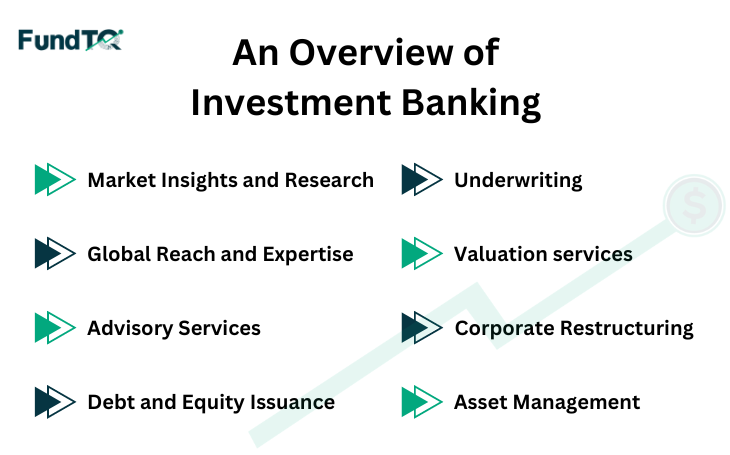
Corporate investment banking can be likened to a financial giant in the corporate world. It links the businesses with the financial system that assists them to tap into capital that allows them to develop and grow. It also comes with strategic guidance which not only creates markets but also encourages innovation and economic growth.

The following are some of the base investment banking services and their significance:

1. Market Insights and Research

In finance, expertise is authority. To enable clients to make informed decisions, investment banks conduct thorough research to provide them with the insights about the market.

2. Global Reach and Expertise

As global financial institutions, corporate investment banks find it easy to cross-border, with all the experiences of diverse markets and regulations.

3. Advisory Services

The investment bankers provide expert advice to companies about mergers, acquisitions, capital structure and financial strategies- hence allowing business owners to make sound decisions.

4. Debt and Equity Issuance

They assist firms to raise capital through issuance of debt (bonds) or equity (shares).

5. Underwriting

Investment banks as underwriters assume risk when they buy securities of a company and sell them to the investors.

6. Valuation Services

They ensure the fair value of a company or an asset – a major process when making decisions on mergers and acquisitions or investing in a company or asset.

7. Corporate Restructuring

The investment bankers help organizations to restructure the debt, assets, and operations in order to increase efficiency and profitability.

8. Asset Management

There are those investment banks that handle investment portfolios of both institutional as well as individual clients and assist them in building and preserving wealth.

Simply put, investment banking services are the brains of financial success.

In this article, I am going to give you a short brief of the major stakeholders in the finance industry.

Every one of these players has their role and all they do collectively to foster company growth, success in business while keeping investors profitable.

Major Stakeholders in the Finance Industry

The finance ecosystem is composed of all players, whose functions are tailored to achieve the success of business and investor prosperity. The three most important stakeholders are:

1. Investment Banks
FundTQ, Goldman Sachs or Morgan Stanley are financial institutions that provide mergers and acquisitions advice and capital raising services.

Example: FundTQ assists a software company to become a publicly traded company by means of an IPO ( Initial Public Offering).

2. Corporate Clients
These are the companies who are dependent on investment banks on how to raise capital and give strategic advice on merger or acquisition processes.

3. Institutional Investors
Such institutions as HDFC Asset Management Company gather funds from investors and invest them in stocks, bonds and other securities to increase wealth.

These players collectively contribute towards the growth and innovation of the investment bank sector.

Major Units of Investment Banking

Whether you’re studying finance or just curious, understanding the core divisions of investment banking services is essential. These include:

Accordingly, in this module we will review main corporate investment banking products: capital markets, corporate finance and advisory services.

The basics of the investment banking industry are vital for anyone interested in finance — from those who aspire to work on Wall Street one day, all the way down to a casual bystander curious about how things function within the realm of high Finance.

Thus, this article will explore the major building blocks of Capital Markets, Corporate Finance and Advisory Services that have an impact on the corporate investment banking universe.

Factors Capital Markets Corporate Finance Advisory Services
Nature of Services Deals with buying and selling financial securities like stocks, bonds, etc. Focuses on financial activities within funding and investment decisions. It provides expert guidance and recommendations to various companies, including financial matters to individuals and businesses.
Scope and Clients It involves a broad range of investors, including individuals, institutions, and governments. Specific to a single company or organization. Serves both individual and corporate clients.
Regulatory Framework Highly regulated to ensure fair and transparent trading. Subject to regulations, particularly regarding regulations based on the company operations. Subject to a specific type of advice offered.

Front Office: The Action Zone of Investment Banking

The client-facing and deal-making portion of the organisation, where strategic consulting, relationship management, and capital-raising activities flourish, is referred to as the investment banking front office.

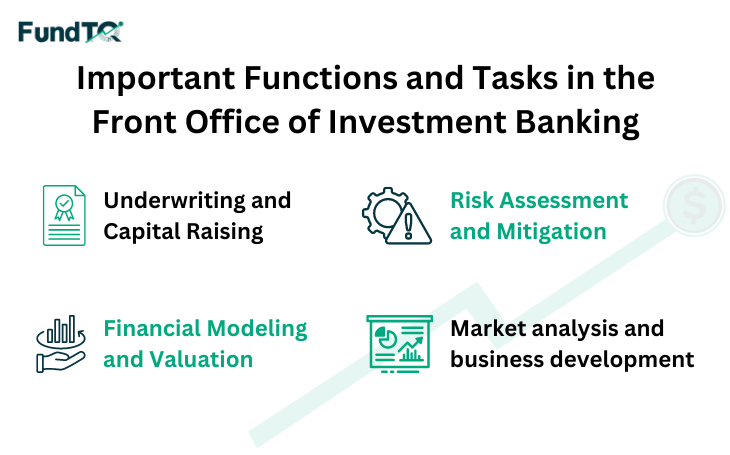
important functions and tasks in the front office of investment banking

The front office is the client-facing, deal-making part of an investment bank — where relationship management and capital-raising thrive.

1. Client Relationship Management
Front-office bankers establish and sustain good relations with their clients by knowing their financial objectives and market positions.

2. Pitching and Advisory
They offer personalized financial services and recommend capital raise, restructuring or acquisitions and mergers.

3. Execution and Due Diligence
The bankers conduct a thorough due diligence analysis of the target company operations, finances, and risks before any merger or acquisition.

4. Underwriting and Capital Raising

Underwriting is assisting an organization to raise new shares or bonds. The process involves:

  • Evaluating the finances of the company.
  • Setting the offering price
  • Reporting to the regulators (such as SEC)
  • Making sales to investors.
  • After offering prices are to be stabilized.

5. Financial Modeling and Valuation

Valuation is an actual worth in a company and financial modeling is a forecast of a future performance of the business, and therefore it enables a banker to make informed decisions in regards to a deal.

6. Risk Assessment and Mitigation

The investment bankers are always on the lookout of risks in a deal and designing a plan that safeguards the client as well as the bank.

7. Market Analysis and Business Development
Knowing the trend in the market will assist bankers to spot new opportunities and reinforce portfolios of clients.

Trends and Challenges in Investment Banking Services

In this guide, it’s important to look at the trends and challenges in Corporate investment banking firm. Let’s have a peek at it then-

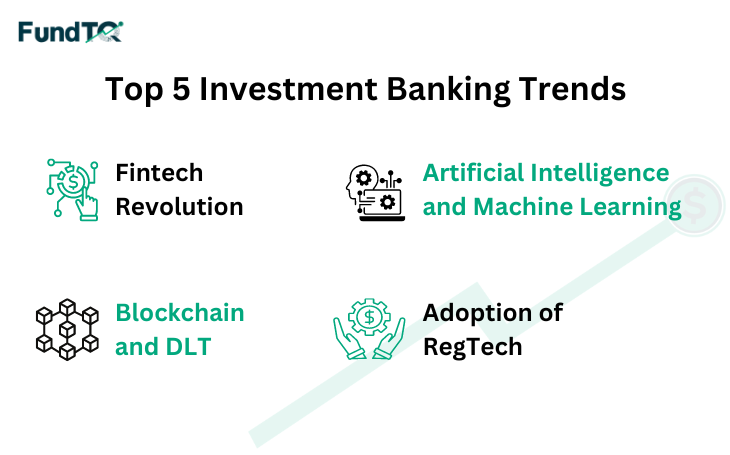
Top 5 Investment Banking Trends:

top 5 investment banking trends

1. Fintech Revolution:

Fintech businesses are using creative ways to challenge established banking models. These technologies, which include online payment systems and robo-advisors, are continuously altering the way financial services are rendered.

2. Artificial Intelligence and Machine Learning:

These two powerful technologies are transforming data analysis and decision-making. Investment banks are using AI for risk assessment, portfolio optimization, and fraud detection.

3. Blockchain and DLT:

These technological advancements are revolutionizing the safe recording and verification of transactions. Investment firms are investigating the potential benefits of blockchain technology for increased transparency and efficiency.

4. Adoption of RegTech:

RegTech gives banks the ability to more skillfully negotiate changing regulatory environments. Thus, in order to guarantee optimal regulatory conformance, compliance operations are automated.

5. ESG considerations are incorporated into plans for socially concerned clients through sustainable and impact investing.

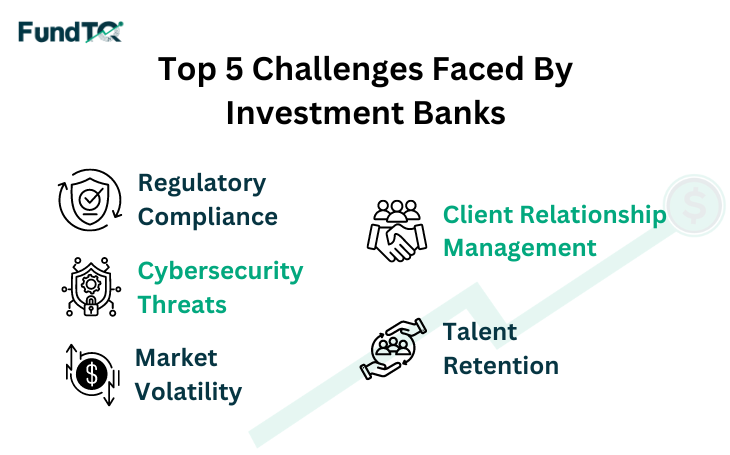
Top 5 Challenges Faced by Investment Banking Services Firm:

There are inevitably and probably will be issues as technology trends continue to emerge.

top 5 challenges faced by investment banks

Let’s examine a couple of them:

1. Regulatory Compliance:

It can be difficult to ensure compliance with the many financial regulations. Anti-money laundering (AML) regulations put banks under more scrutiny in an effort to stop illegal activity.

2. Cybersecurity Threats:

It’s a never-ending struggle to keep private financial information safe from hackers. Large-scale data breaches at financial institutions, such as the Equifax attack, make it abundantly evident that strong cybersecurity measures are essential.

3. Market Volatility:

Managing erratic shifts in the market presents difficulties for investment plans. Investment choices were significantly impacted by the COVID-19 epidemic and resulted in significant market fluctuations.

4. Client Relationship Management:

It takes skill to satisfy a wide range of client expectations and establish lasting bonds. Example: Managing disparate clients’ competing investing goals can be difficult.

5. Talent Retention:

High employee turnover in investment businesses may result from the need for qualified quant analysts.

Top 5 Global Impacts of Investment Banking

Let’s now examine the worldwide influence of corporate investment banking, having previously examined the new trends and obstacles.

1. Cross-Border Capital Flows:

Investment banks have a major impact on the global flow of capital by assisting with cross-border investments. For instance, an investment bank helps a US company get money from abroad investors to develop internationally.

2. Mergers and Acquisitions (M&A):

This department plays a key role in facilitating cross-border mergers and acquisitions services between foreign corporations. Investment banking services contributes to the shaping of the global corporate landscape as a result of this partnership.

3. Foreign Direct Investment (FDI):

Banks that support FDI make sure that it occurs, which in turn encourages global corporations to make economic investments in other nations. For instance, an investment bank assists a multinational company from Asia in business fundraising services the construction of a new manufacturing facility in Europe, thereby promoting economic expansion and job creation.

4. Capital Market Development:

It generates funding possibilities and liquidity while assisting in the expansion and efficiency of the world’s capital markets.

5. Economic Stability:

Global economic stability is ensured in part by investment banks’ prudent risk management procedures and investment strategies. For example, an investment bank’s risk management strategies can reduce losses and stabilize global financial markets during a financial crisis.

You should be keen to learn more about investment banking and look into career options after realizing its broad breadth. So let’s move on to the following part to learn more about this fascinating area of study and your career options.

free pitch deck templates
Careers and Skills in Investment Banking

Recall that there are excellent prospects for advancement and influence in both front- and back-office job routes if you want to leave your mark in the banking industry. To climb the success ladder, you must continue studying, networking, and improving professionally because this is a competitive field!

The last part of this extensive book will cover some important skills you can pick up to help you on your way.

Skills for Advancement in the Competitive Investment Banking Industry

1. Technical Expertise:

Pursue degrees in accounting, finance, economics, or other relevant discipline to ensure that you have a solid educational foundation. To improve your technical abilities, you should also think about taking specialist courses or obtaining certifications like CFA or FRM. To find out more about industry trends, check out the courses offered by IMS Proschool, including the CFA Program and Financial Modeling.

2. Analytical skills:

Improve your analytical abilities via case studies, financial modeling activities, and hands-on data analysis. Examine financial data to hone your analytical skills, evaluate prospects for investments, and carry out assessments. Never be afraid to ask mentors for input in order to improve your strategy and sharpen your critical thinking skills.

3. Interpersonal Skills:

To improve your leadership, conflict-resolution, and teamwork abilities, make sure to work together on group projects. In addition, take on jobs that require interaction with clients to hone crucial client relations abilities.

Keep in mind that you’ll need a combination of excellent technical askills, analytical aptitude, and strong interpersonal relationships to succeed in corporate investment banking.

Conclusion:

Now let’s conclude with a brief summary of this guide!

In order to better understand the importance of financial modeling, risk assessment, and relationship management, we have examined the fascinating field of corporate investment banking in this blog.

We now know that having a solid foundation is essential for anyone entering the exciting field of corporate investment banking, and that it can be compared to a compass in navigating this new and exciting environment.

business valuation software

Corporate investment banking offers a rewarding job that rewards ambition, effort, and adaptability. To succeed in this field, look for guidance from industry leaders and consider lateral movements for a variety of skills. Never be afraid of obstacles since they guarantee lifelong learning. As a candidate, make an effort to remain current, strike a balance between technical and people skills, and make an investment in your own growth to boost your self-assurance.

So take use of these chances to enhance value in your corporate investment banking journey by making use of our thorough guidance.

Prepare yourself to take advantage of this opportunity and begin a fulfilling career in corporate investment banking. Awaiting you is your success tale!

6 Frequently Asked Questions (FAQ)

1. What exactly are investment banking services?

Answer:
Investment banking services are all about helping businesses grow, raise money, and make smart financial moves. Think of investment banks as expert advisors and connectors between companies and the financial markets. They assist with things like raising capital, underwriting securities, mergers and acquisitions (M&A), valuations, and restructuring. In short, they make complex financial decisions easier and more strategic.

2. Why do companies need investment banking services?

Answer:
Companies turn to investment banks for their deep financial knowledge and experience in executing big, high-stakes deals. Whether a business wants to raise funds, sell a division, merge with another company, or simply understand its market value — investment bankers bring the right mix of strategy, analysis, and connections to make it happen smoothly and efficiently.

3. What are the main areas within investment banking?

Answer:
Investment banking typically has three key divisions:

  • Capital Markets: Focused on issuing and trading securities.

  • Corporate Finance: Advises companies on raising funds and managing their capital structure.

  • Advisory Services: Helps with M&A, restructuring, and other strategic moves.
    Each area plays a unique role, but together, they help companies access capital and unlock growth opportunities.

4. What do investment bankers actually do day to day?

Answer:
Investment bankers are hands-on problem solvers. They meet clients, build financial models, prepare proposals, research industries, negotiate deals, and manage the entire transaction process. From valuation and underwriting to closing complex deals, they’re involved in every step of turning a company’s vision into financial success.

5. What skills do you need to work in investment banking?

Answer:
It’s a mix of numbers, people, and problem-solving. You’ll need strong technical skills in finance and valuation, analytical thinking to model complex scenarios, and communication skills to manage client relationships. Investment banking is fast-paced and demanding — but it’s equally rewarding for those who enjoy challenges and continuous learning.

6. How can a startup or enterprise choose the right investment banking partner?

Answer:
Choosing the right investment banking partner comes down to trust and expertise. Look for a firm that understands your industry, has a solid track record, and aligns with your business goals. Transparency, communication, and cultural fit also matter — the right partner isn’t just a service provider; they’re a strategic ally who supports your long-term vision.

FCFF vs FCFE - Understanding Key Differences & Applications

FCFF vs FCFE – Understanding Key Differences And Applications

In the field of corporate finance, Free Cash Flow to Firm (FCFF) and Free Cash Flow to Equity (FCFE) are two key measures that are highly influential. Strategic investment decisions are made easier with these measurements, which are crucial indicators of a business’s financial health. Nonetheless, it is critical for investors, financial analysts, and company owners to comprehend the differences and uses of FCFF and FCFE. We go deeply into the complexities of FCFF vs FCFE in this extensive guide, discussing their subtleties, distinctions, and useful applications.

FCFF & FCFE Formula Explained

Let’s first build a basic knowledge of each statistic before exploring the differences between FCFF vs FCFE.

Free Cash Flow to Firm (FCFF):

FCFF is the amount of cash generated by a company that is available to all capital providers, including debt and equity investors, after taxes, operating expenses, and capital expenditures.

It functions as an indicator of the cash flow that is accessible to all investors, irrespective of the capital structure of the business. This formula is used to calculate FCFF:

FCFF = Net Income + Non-cash Charges + Interest (1 – Tax Rate) – Capital Expenditures – Changes in Working Capital

Free Cash Flow to Equity (FCFE):

In contrast, FCFE represents the cash available to equity shareholders after accounting for all expenses, reinvestment needs, and debt obligations. It shows the amount of cash flow that can be given to equity investors without endangering the business’s viability as a whole. This formula is used to calculate FCFE:

FCFE = Net Income – (Capital Expenditures – Depreciation) – Changes in Working Capital + Net Borrowing

Key Differences Between FCFF and FCFE:

While both FCFF and FCFE provide insights into a company’s cash flow dynamics, they differ significantly in their scope and applicability. Here are the key distinctions between the two metrics:

1. Perspective:

FCFF represents the cash flow that is accessible to all capital sources, including holders of debt and equity. The cash flow that is available to equity stockholders once debt obligations are taken into account is the primary focus of FCFE.

2. Capital Structure:

Changes in the company’s capital structure have no effect on FCFF because it takes into account cash flows that are accessible to all capital providers. FCFE considers the capital structure of the business as well as how debt financing affects the cash flows of equity shareholders.

3. Reinvestment Assumptions:

Only the cash flows available to equity owners for reinvestment or distribution are taken into account by FCFE; all other cash flows, including those attributable to debt holders, are assumed to be reinvested back into the company.

4. Valuation Implications:

To ascertain the inherent worth of a business’s activities, discounted cash flow (DCF) valuation models frequently employ the FCFF method. In equity valuation models, FCFE is used to calculate the fair value of a company’s common share.

Bonus Tip:
Are you a startup looking to raise funds but unsure of your business value? With FundTQ’s Business Valuation Software, you can determine your company’s worth in just minutes. Get accurate, real-time valuations to confidently navigate the fundraising process.

Practical Applications of FCFF vs FCFE:

For a variety of financial studies and decision-making procedures, it is essential to comprehend the subtle differences between FCFF and FCFE. The following are some real-world uses for both metrics:

1. Investment Valuation:

 – FCFF is employed in DCF models to assess the intrinsic value of a company’s operations, considering all capital providers’ perspectives.

– FCFE, which focuses on the cash flows to equity owners, is used in equity valuation models to determine the fair value of a company’s stock.

2. Capital Budgeting:

– Analysts use FCFF to assess whether investment projects can generate value for all capital providers.

– FCFE assists in evaluating investment projects’ viability from the standpoint of equity shareholders, taking shareholder wealth into account. Furthermore, it offers valuable insights into the potential returns and risks associated with such projects.

3. Financial Planning and Analysis:

– FCFF aids in assessing a company’s financial performance. It also helps determine its ability to generate cash flows to meet debt obligations and fund future growth.

– FCFE assists in evaluating the company’s capacity to distribute dividends, repurchase shares, or undertake other actions to enhance shareholder value. Moreover, it provides valuable insights into the company’s financial health and its potential for long-term growth.

free pitch deck templatesConclusion:

Conclusively, FCFF and FCFE are essential instruments in corporate finance. They offer invaluable perspectives into cash flow dynamics and financial well-being. Although the two indicators have different uses. When combined, they offer a thorough grasp of a company’s capital allocation and wealth creation potential. Understanding the subtle differences between FCFF and FCFE can help investors, financial analysts, and company owners. Additionally, it enables them to make well-informed decisions that optimize shareholder value and promote sustainable growth.

Also ReadStartup Due Diligence

FCFF vs FCFE FAQ:

Q1: What is the primary difference between FCFF and FCFE?
A: FCFF (Free Cash Flow to Firm) is cash available to all providers of capital including debt and equity, and FCFE (Free Cash Flow to Equity) is cash available to equity customers after payments on debt.

Q2: What is the best time to apply FCFF vs FCFE in valuation?
A: FCFF should be used to value firm-wide, and debt and equity-based DCF models. Apply FCFE in equity-oriented valuation in analyzing the possible dividends or shareholder returns.

Q3: What is the impact of FCFF and FCFE on stock value?
A: FCFF assists in the determination of enterprise value, which affects overall firm valuation. FCFE has a direct impact on the inherent value of equity and the likely returns to the shareholders.

Q4: Is it possible to have negative FCFE and positive FCFF?
A: Yes. Negative FCFE may occur when the debt repayments are higher than the cash that equity holders of the firm have even when the firm has a positive overall cash flow (FCFF).

Q5: What is more favorable in the case of startups FCFF or FCFE?
A: FCFF is more dependable in valuation since startups tend to have unstable debt and reinvested earnings. FCFE can be more unstable in the case of early-stage firms.

Reasons Why Business Valuation Is Important For Investors

7 Reasons Why Business Valuation Is Important For Investors?

Success in the dynamic world of banking and investments depends on making well-informed judgments. One of the most important aspects that plays a central role in these decisions is calculating company valuation. For investors, comprehending the true worth of a business goes beyond a mere number on a balance sheet – it’s a strategic necessity. In this blog post, we will delve into the Importance of calculating business valuation for investors, exploring what it entails and why it should be a critical consideration in their investment journey.

What is Business Valuation?

Before we start discussing the importance of business valuation for investors, let’s clarify what business valuation is and how it’s conducted.

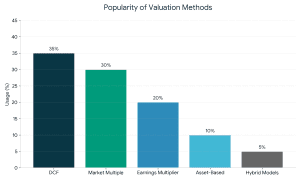
Business valuation is essentially the process of determining the economic value of a business or company. This involves a comprehensive analysis of various factors, including financial statements, market trends, industry conditions, and the company’s overall performance. Valuation methods can vary, with common approaches including the discounted cash flow (DCF) method, comparable company analysis (CCA), and precedent transactions.

Understanding the intricacies of these valuation methods is crucial for investors seeking to make well-informed decisions. It goes beyond a simple assessment of assets and liabilities, providing a holistic view of a business’s potential for growth and profitability.

Why Calculating Company Valuation is Important for Investors?

Now, let’s explore the key reasons why company valuation is vital for investors:

1. Informed Investment Decisions:

Investors often face the challenge of choosing where to allocate their funds among various opportunities. Calculating valuation of a company provides a comprehensive view of a company’s financial health, helping investors make informed decisions based on solid data rather than speculation.

2. Risk Mitigation:

Assessing the true value of a business aids in identifying potential risks. A thorough calculation of company valuation can uncover hidden liabilities, weak financial structures, or unsustainable business models. Armed with this information, investors can mitigate risks and make strategic choices that align with their risk tolerance.

3. Negotiation Power:

In scenarios such as mergers and acquisitions or when buying/selling equity stakes, business valuation gives investors negotiation power. Understanding the fair value of a business ensures that investors don’t overpay or undersell, facilitating mutually beneficial deals.

4. Performance Benchmarking:

Company valuation serves as a benchmark for a company’s performance. Periodic valuations allow investors to track a business’s progress over time, assessing whether it meets growth expectations or if adjustments are needed to the investment strategy.

5. Portfolio Optimization:

For investors managing a diverse portfolio, calculating company valuation is instrumental in optimizing the allocation of resources. By understanding the relative value of each investment, investors can rebalance their portfolio to achieve a well-diversified and risk-adjusted mix.

6. Attracting Capital:

Companies seeking capital infusion often find that a well-documented and transparent calculation of company valuation can attract investors. It instills confidence by providing a clear picture of the company’s worth, potentially leading to better terms and conditions for both parties involved.

7. Strategic Planning:

Valuation is not only about the present; it plays a crucial role in strategic planning for the future. Investors can use valuation insights to develop growth strategies, anticipate challenges, and align their investment goals with the long-term prospects of a business.

Conclusion:

In conclusion, calculating company valuation is not just a financial exercise but a strategic imperative for investors. In a landscape where uncertainty and risk abound, having a clear understanding of a company’s value is akin to having a compass in uncharted territory. It guides investors in making sound decisions, mitigating risks, and optimizing their portfolios for sustained success.

As we navigate the complex world of investments, let us not underestimate the power of knowing – and truly understanding – the value that businesses bring to the table. In the end, it is this knowledge that empowers investors to unlock the full potential of their investment endeavors.

Also Read: Things You Should Know About Business Valuation