
Investment banking services help businesses raise capital, manage mergers and acquisitions, and make strategic financial decisions.
Do you know what lies at the heart of the financial industry?
The financial sector comprises of the insurance sector, real estate agencies, consumer financing firms, and mortgage lending firms. Nonetheless, there is one participant that can be considered as particularly influential, which is the investment bankers.
These professionals play significant roles in the world economy and can be regarded as the financial superheroes. They are at the centre stage of key financial activities and they affect both businesses and individuals.
In a case in point, imagine a multinational corporation intending to grow, a government intending to get money to finance a project, or an owner of a business undertaking a merger and acquisition. That is the niche that the corporate investment banking services play, serving as the mediator between companies and the financial system.
This guide will help you maximise the opportunities in financial services and/or know how this world works in case you are interested or want to know more about it.
- Gain expert perspectives
- Learn key skills and methods
- Manage complicated financial scenarios with ease.
- Keep up with the trend and opportunities in the industry.
So, let’s get down to it and discuss the importance of investment banking services – and their influence on the worldwide financial arena.
An Overview of Investment Banking Services
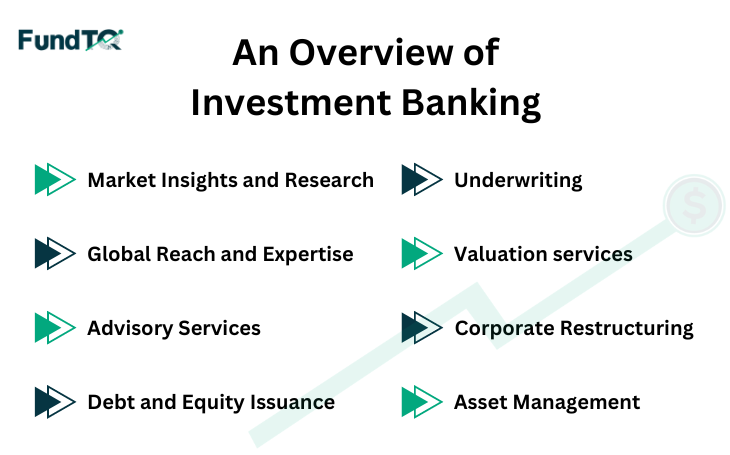
Corporate investment banking can be likened to a financial giant in the corporate world. It links the businesses with the financial system that assists them to tap into capital that allows them to develop and grow. It also comes with strategic guidance which not only creates markets but also encourages innovation and economic growth.
The following are some of the base investment banking services and their significance:
1. Market Insights and Research
In finance, expertise is authority. To enable clients to make informed decisions, investment banks conduct thorough research to provide them with the insights about the market.
2. Global Reach and Expertise
As global financial institutions, corporate investment banks find it easy to cross-border, with all the experiences of diverse markets and regulations.
3. Advisory Services
The investment bankers provide expert advice to companies about mergers, acquisitions, capital structure and financial strategies- hence allowing business owners to make sound decisions.
4. Debt and Equity Issuance
They assist firms to raise capital through issuance of debt (bonds) or equity (shares).
5. Underwriting
Investment banks as underwriters assume risk when they buy securities of a company and sell them to the investors.
6. Valuation Services
They ensure the fair value of a company or an asset – a major process when making decisions on mergers and acquisitions or investing in a company or asset.
7. Corporate Restructuring
The investment bankers help organizations to restructure the debt, assets, and operations in order to increase efficiency and profitability.
8. Asset Management
There are those investment banks that handle investment portfolios of both institutional as well as individual clients and assist them in building and preserving wealth.
Simply put, investment banking services are the brains of financial success.
In this article, I am going to give you a short brief of the major stakeholders in the finance industry.
Every one of these players has their role and all they do collectively to foster company growth, success in business while keeping investors profitable.
Major Stakeholders in the Finance Industry
The finance ecosystem is composed of all players, whose functions are tailored to achieve the success of business and investor prosperity. The three most important stakeholders are:
1. Investment Banks
FundTQ, Goldman Sachs or Morgan Stanley are financial institutions that provide mergers and acquisitions advice and capital raising services.
Example: FundTQ assists a software company to become a publicly traded company by means of an IPO ( Initial Public Offering).
2. Corporate Clients
These are the companies who are dependent on investment banks on how to raise capital and give strategic advice on merger or acquisition processes.
3. Institutional Investors
Such institutions as HDFC Asset Management Company gather funds from investors and invest them in stocks, bonds and other securities to increase wealth.
These players collectively contribute towards the growth and innovation of the investment bank sector.
Major Units of Investment Banking
Whether you’re studying finance or just curious, understanding the core divisions of investment banking services is essential. These include:
Accordingly, in this module we will review main corporate investment banking products: capital markets, corporate finance and advisory services.
The basics of the investment banking industry are vital for anyone interested in finance — from those who aspire to work on Wall Street one day, all the way down to a casual bystander curious about how things function within the realm of high Finance.
Thus, this article will explore the major building blocks of Capital Markets, Corporate Finance and Advisory Services that have an impact on the corporate investment banking universe.
| Factors | Capital Markets | Corporate Finance | Advisory Services |
| Nature of Services | Deals with buying and selling financial securities like stocks, bonds, etc. | Focuses on financial activities within funding and investment decisions. | It provides expert guidance and recommendations to various companies, including financial matters to individuals and businesses. |
| Scope and Clients | It involves a broad range of investors, including individuals, institutions, and governments. | Specific to a single company or organization. | Serves both individual and corporate clients. |
| Regulatory Framework | Highly regulated to ensure fair and transparent trading. | Subject to regulations, particularly regarding regulations based on the company operations. | Subject to a specific type of advice offered. |
Front Office: The Action Zone of Investment Banking
The client-facing and deal-making portion of the organisation, where strategic consulting, relationship management, and capital-raising activities flourish, is referred to as the investment banking front office.
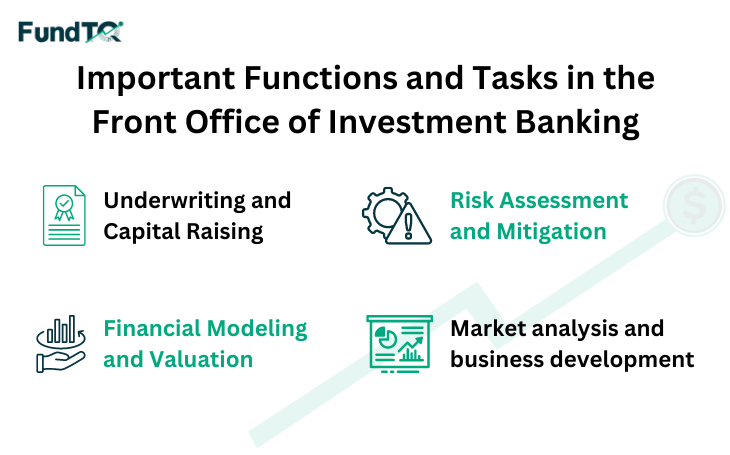
The front office is the client-facing, deal-making part of an investment bank — where relationship management and capital-raising thrive.
1. Client Relationship Management
Front-office bankers establish and sustain good relations with their clients by knowing their financial objectives and market positions.
2. Pitching and Advisory
They offer personalized financial services and recommend capital raise, restructuring or acquisitions and mergers.
3. Execution and Due Diligence
The bankers conduct a thorough due diligence analysis of the target company operations, finances, and risks before any merger or acquisition.
4. Underwriting and Capital Raising
Underwriting is assisting an organization to raise new shares or bonds. The process involves:
- Evaluating the finances of the company.
- Setting the offering price
- Reporting to the regulators (such as SEC)
- Making sales to investors.
- After offering prices are to be stabilized.
5. Financial Modeling and Valuation
Valuation is an actual worth in a company and financial modeling is a forecast of a future performance of the business, and therefore it enables a banker to make informed decisions in regards to a deal.
6. Risk Assessment and Mitigation
The investment bankers are always on the lookout of risks in a deal and designing a plan that safeguards the client as well as the bank.
7. Market Analysis and Business Development
Knowing the trend in the market will assist bankers to spot new opportunities and reinforce portfolios of clients.
Trends and Challenges in Investment Banking Services
In this guide, it’s important to look at the trends and challenges in Corporate investment banking firm. Let’s have a peek at it then-
Top 5 Investment Banking Trends:
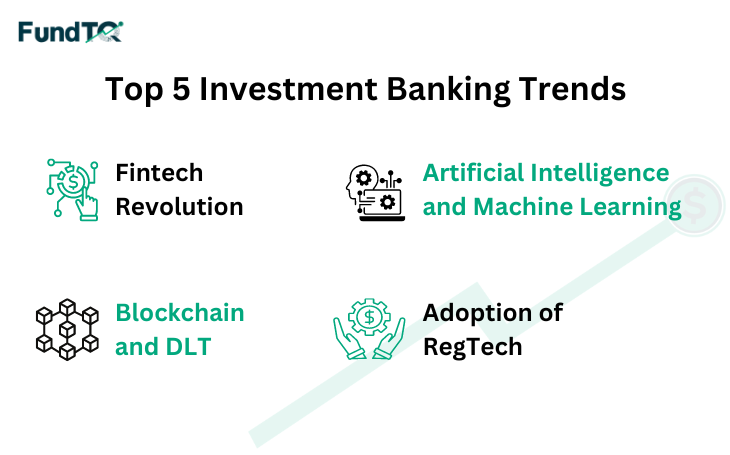
1. Fintech Revolution:
Fintech businesses are using creative ways to challenge established banking models. These technologies, which include online payment systems and robo-advisors, are continuously altering the way financial services are rendered.
2. Artificial Intelligence and Machine Learning:
These two powerful technologies are transforming data analysis and decision-making. Investment banks are using AI for risk assessment, portfolio optimization, and fraud detection.
3. Blockchain and DLT:
These technological advancements are revolutionizing the safe recording and verification of transactions. Investment firms are investigating the potential benefits of blockchain technology for increased transparency and efficiency.
4. Adoption of RegTech:
RegTech gives banks the ability to more skillfully negotiate changing regulatory environments. Thus, in order to guarantee optimal regulatory conformance, compliance operations are automated.
5. ESG considerations are incorporated into plans for socially concerned clients through sustainable and impact investing.
Top 5 Challenges Faced by Investment Banking Services Firm:
There are inevitably and probably will be issues as technology trends continue to emerge.
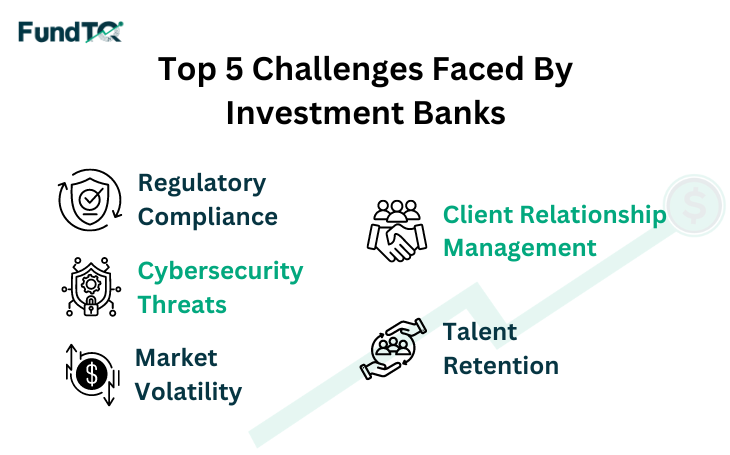
Let’s examine a couple of them:
1. Regulatory Compliance:
It can be difficult to ensure compliance with the many financial regulations. Anti-money laundering (AML) regulations put banks under more scrutiny in an effort to stop illegal activity.
2. Cybersecurity Threats:
It’s a never-ending struggle to keep private financial information safe from hackers. Large-scale data breaches at financial institutions, such as the Equifax attack, make it abundantly evident that strong cybersecurity measures are essential.
3. Market Volatility:
Managing erratic shifts in the market presents difficulties for investment plans. Investment choices were significantly impacted by the COVID-19 epidemic and resulted in significant market fluctuations.
4. Client Relationship Management:
It takes skill to satisfy a wide range of client expectations and establish lasting bonds. Example: Managing disparate clients’ competing investing goals can be difficult.
5. Talent Retention:
High employee turnover in investment businesses may result from the need for qualified quant analysts.
Top 5 Global Impacts of Investment Banking
Let’s now examine the worldwide influence of corporate investment banking, having previously examined the new trends and obstacles.
1. Cross-Border Capital Flows:
Investment banks have a major impact on the global flow of capital by assisting with cross-border investments. For instance, an investment bank helps a US company get money from abroad investors to develop internationally.
2. Mergers and Acquisitions (M&A):
This department plays a key role in facilitating cross-border mergers and acquisitions services between foreign corporations. Investment banking services contributes to the shaping of the global corporate landscape as a result of this partnership.
3. Foreign Direct Investment (FDI):
Banks that support FDI make sure that it occurs, which in turn encourages global corporations to make economic investments in other nations. For instance, an investment bank assists a multinational company from Asia in business fundraising services the construction of a new manufacturing facility in Europe, thereby promoting economic expansion and job creation.
4. Capital Market Development:
It generates funding possibilities and liquidity while assisting in the expansion and efficiency of the world’s capital markets.
5. Economic Stability:
Global economic stability is ensured in part by investment banks’ prudent risk management procedures and investment strategies. For example, an investment bank’s risk management strategies can reduce losses and stabilize global financial markets during a financial crisis.
You should be keen to learn more about investment banking and look into career options after realizing its broad breadth. So let’s move on to the following part to learn more about this fascinating area of study and your career options.

Careers and Skills in Investment Banking

Recall that there are excellent prospects for advancement and influence in both front- and back-office job routes if you want to leave your mark in the banking industry. To climb the success ladder, you must continue studying, networking, and improving professionally because this is a competitive field!
The last part of this extensive book will cover some important skills you can pick up to help you on your way.
Skills for Advancement in the Competitive Investment Banking Industry
1. Technical Expertise:
Pursue degrees in accounting, finance, economics, or other relevant discipline to ensure that you have a solid educational foundation. To improve your technical abilities, you should also think about taking specialist courses or obtaining certifications like CFA or FRM. To find out more about industry trends, check out the courses offered by IMS Proschool, including the CFA Program and Financial Modeling.
2. Analytical skills:
Improve your analytical abilities via case studies, financial modeling activities, and hands-on data analysis. Examine financial data to hone your analytical skills, evaluate prospects for investments, and carry out assessments. Never be afraid to ask mentors for input in order to improve your strategy and sharpen your critical thinking skills.
3. Interpersonal Skills:
To improve your leadership, conflict-resolution, and teamwork abilities, make sure to work together on group projects. In addition, take on jobs that require interaction with clients to hone crucial client relations abilities.
Keep in mind that you’ll need a combination of excellent technical askills, analytical aptitude, and strong interpersonal relationships to succeed in corporate investment banking.
Conclusion:
Now let’s conclude with a brief summary of this guide!
In order to better understand the importance of financial modeling, risk assessment, and relationship management, we have examined the fascinating field of corporate investment banking in this blog.
We now know that having a solid foundation is essential for anyone entering the exciting field of corporate investment banking, and that it can be compared to a compass in navigating this new and exciting environment.
Corporate investment banking offers a rewarding job that rewards ambition, effort, and adaptability. To succeed in this field, look for guidance from industry leaders and consider lateral movements for a variety of skills. Never be afraid of obstacles since they guarantee lifelong learning. As a candidate, make an effort to remain current, strike a balance between technical and people skills, and make an investment in your own growth to boost your self-assurance.
So take use of these chances to enhance value in your corporate investment banking journey by making use of our thorough guidance.
Prepare yourself to take advantage of this opportunity and begin a fulfilling career in corporate investment banking. Awaiting you is your success tale!
6 Frequently Asked Questions (FAQ)
1. What exactly are investment banking services?
Answer:
Investment banking services are all about helping businesses grow, raise money, and make smart financial moves. Think of investment banks as expert advisors and connectors between companies and the financial markets. They assist with things like raising capital, underwriting securities, mergers and acquisitions (M&A), valuations, and restructuring. In short, they make complex financial decisions easier and more strategic.
2. Why do companies need investment banking services?
Answer:
Companies turn to investment banks for their deep financial knowledge and experience in executing big, high-stakes deals. Whether a business wants to raise funds, sell a division, merge with another company, or simply understand its market value — investment bankers bring the right mix of strategy, analysis, and connections to make it happen smoothly and efficiently.
3. What are the main areas within investment banking?
Answer:
Investment banking typically has three key divisions:
-
Capital Markets: Focused on issuing and trading securities.
-
Corporate Finance: Advises companies on raising funds and managing their capital structure.
-
Advisory Services: Helps with M&A, restructuring, and other strategic moves.
Each area plays a unique role, but together, they help companies access capital and unlock growth opportunities.
4. What do investment bankers actually do day to day?
Answer:
Investment bankers are hands-on problem solvers. They meet clients, build financial models, prepare proposals, research industries, negotiate deals, and manage the entire transaction process. From valuation and underwriting to closing complex deals, they’re involved in every step of turning a company’s vision into financial success.
5. What skills do you need to work in investment banking?
Answer:
It’s a mix of numbers, people, and problem-solving. You’ll need strong technical skills in finance and valuation, analytical thinking to model complex scenarios, and communication skills to manage client relationships. Investment banking is fast-paced and demanding — but it’s equally rewarding for those who enjoy challenges and continuous learning.
6. How can a startup or enterprise choose the right investment banking partner?
Answer:
Choosing the right investment banking partner comes down to trust and expertise. Look for a firm that understands your industry, has a solid track record, and aligns with your business goals. Transparency, communication, and cultural fit also matter — the right partner isn’t just a service provider; they’re a strategic ally who supports your long-term vision.




Comments (09)