
Free Pitch Deck Templates

Free Pitch Deck Templates for Startups: Download Now

Hello founders, entrepreneurs and startup enthusiasts! It probably means that you are here on the search to find a free pitch deck template, pitch deck template free download, or pitch deck templates free on Google Slides. You may also be considering pitch deck template PPT free download, or just a free pitch deck template download next time you need to raise new capital in India. Fortunately, you are at the right place.

In this all-inclusive guide you will find:

  • Why a free pitch deck template is a good idea (and what to be wary of).
  • What are some of the important slides and format of your pitch (so that your deck matches what the investors would want)
  • Where to find the quality of free pitch deck templates (including Google Slides / PPT variations)
  • The way the deck connects to the business fundraising services, investment banking services, and the overall startup funding in India.
  • Ideas and advice to make your free template personal so that you do not simply download the so-called nice slide but create a powerful story to the investor.

Let’s dive in.

Why Use Free Pitch Deck Templates?

#1 Speed & Professionalism

Time is money when it comes to a start-up. The presence of a pitch deck template free or a free pitch deck template gives you the freedom to start your presentation with a pitch deck template. Effective slide layouts, uniform colour scheme and investor friendly structure is already implicated in good templates.

In the case of early stage founders in particular, this allows you to invest in content (story, traction, financials) instead of design.

#2 Cost-Effective

In different parts of the world such as India where most of the startups are bootstrapped or at an early stage, it is not always possible to spend large amounts of money on design. Granting free access to good design can be done using a free pitch deck template download or free pitch deck template Google Slides version where the money saved can be allocated to other important things (tech, staff, marketing).

#3 Investor Expectations Congruence.

Structures embedded in templates provided by experienced providers tend to be the ones that meet the expectations of the investors. For example, what is going to slide, storytelling, displaying the size of the market, problem/solution, traction etc. With a good template you increase your odds of your deck being investor-ready and not just pretty.

#4 Risk of Over-Reliance

But, there is a catch, though — applying a free template does not imply that the work is over. You still need to be able to make the existing content about your startup, your market in India (or wherever you are operating), your funding request, your metrics. When you just plunk your numbers in a standard format and hope, it will not work. One investor in a forum said:

A deck is meant to arrange a face-to-face meeting, it is not your complete resume.

Then select a template carefully, then personalise intensively.

What Should Your Pitch Deck Contain?

When the pitch deck free template or pitch deck free startup template is in use, ensure it contains the essential items that investors would require more so considering the environment of investing in India and dealing with business fundraising or investment banking services.

The major slides/sections are the following with a short explanation:

1. Cover / Introduction

  • Startup name, tagline, logo.
  • A single sentence value proposition that simply tells what you do, to whom, and why it is important.
  • First, ensure that your opening slide is powerful. Additionally, the initial slide should tell the story of the business in easily comprehended, straightforward language, as highlighted in one of the articles.

2. Problem

  • What is the pain/need in the market?
  • Who suffers from it? How big is the issue?
  • It is preferable to use actual stories or data.

3. Solution

  • What your product/service solves the problem.
  • Use images or screenshots where necessary.
  • Why is your solution unique?

4. Market Opportunity / Size

  • What is the Total Addressable Market (TAM), Serviceable Available Market (SAM), Serviceable Obtainable Market (SOM)?
  • In India, it assists in localising the numbers (India TAM + global provided you have global ambition).
  • Investors are interested in determining that the opportunity mattered.

5. Business Model

  • How you make money.
  • Sources of revenue, prices, channels of sale.
  • Connect this to actual measurements, not a we will charge it later.

6. Traction / Metrics

  • What you have already accomplished: users, revenue, growth rate, partnerships.
  • At least when you are still in the early stages, demonstrate something (pilot results, customer testimonials, etc).
  • One of the founders of Reddit pointed out:
    Demand some evidence that you are going the right way… No vanity metrics.”

7. Competitive Landscape

  • Who does the same? How do you compare?
  • Showcase your strengths (team, technology, go-to-market, cost structure).
  • Competition that is not discussed can be a cause of concern: “Unless other people are doing it, is the market there?

8. Go-To-Market Strategy

  • What will be your strategy of getting customers?
  • What are your marketing/sales channels? What are the costs?
  • Local context (distribution, regulation, partnerships) is useful to outline, particularly in India.

9. Team

  • Who are the founders? Their background. Why are they the right team?
  • Mention key advisors (let go lost) in case you have an advisory board.

10. Funding Ask & Financial Projections.

  • Level 3-5 years projection: sales, expenses, profitability (or trend).
  • Upon funding request: what you require, how you will utilise it (milestones).
  • When it comes to investors, this is what they want to know: how you are going to use the money, when it will be the next milestone.

11. Closing / Call to Action

  • Thanks slide, contact details, action plan.
  • Keep it crisp.

Where to Find the Best Free Pitch Deck Templates

When looking to find a free pitch deck template, pitch deck template free download, or free Google Slides pitch deck templates, these are effective ways to find one:

  • Sites where PPT/Google Slides can be downloaded (verify that licence is free).
  • Specific startup / fundraising templates. As an example, the cited resources include 35+ best pitch deck startups + free PDF downloads.
  • Make sure the template has layouts that can be edited, content and designed.

Tips when choosing:

  • Find PPT + Google Slides (then you can edit in Google Drive, in case you want to).
  • Make sure that the number of slides is not too many (10-20 slides is a typical case) but not too many.
  • Ensure that the style of design is professional but not complicated (not too many details, few words, clear images).
  • Ensure that the call to action or funding ask slide is present (significant in preparing investors).
  • Check that the template is easily customised to your brand (colours, logo, fonts).
  • Do not use templates that appear too generic or badly free in appearance – investors can detect this.

free pitch deck templates
How This Links to Investment Banking Services & Business Fundraising Services in India

When you are in India and considering raising funds to start your startup, it is worth knowing how your free pitch deck templates fit in the larger ecosystem.

Investment Banking Services Role.

Although we tend to think of investment banking services to be offered to large companies, in the case of most startups the services encompass: preparing the investor materials, valuation advice, fund round structuring, institutional investor/VC introduction, due diligence support. Having a good pitch deck (created using a free pitch deck template but modified), puts you in a better position when undertaking such processes.

For instance:

  • Your deck leads to the first investor outreach (the teaser).
  • Investment banking advisors can refreeze the deck, rehearse you, polish the numbers, structure the task.
  • They can assist in wrapping your fundraising proposal in a way that would be attractive to the local Indian investors as well as foreign investors.
  • Therefore: you start with a powerful free pitch deck template; you can add value to that by using professional fundraising services.

Business Fundraising Services

Same concept: various start-ups request agencies or consultants to assist in business fundraising (preparing financial models, investor presentations, term sheets, etc). The pitch deck is the key element of that material set. Therefore: the more the better you tailor your free startup pitch deck template, the easier your fundraising is.

Startup Funding in India

When in the Indian context, you should make your deck reflect market realities: regulatory environment (fintech, edtech etc), distribution and logistics issues, domestic costs of user acquisition, domestic competition (India vs global). When you are downloading a business pitch deck template free, you should make it an Indian one: state Indian market size, Indian case studies or pilots, your India-specific go-to-market. That will be well received by investors in India.

Free download of pitch deck templates will allow you to concentrate on the Indian content and not the design. So, when you are looking to fund (seed, angel, Series A), your deck will be next to term sheets, communication to your investors: therefore you want templates that are clean, flexible, and transformer friendly.

Best Free Pitch Deck Templates: What to Look For

When comparing several pitch deck templates that are free:

  • Is it investor-centric (problem 2 solution market business model traction team ask)?
  • Can it be edited in Google Slides (to work collaboratively) and PowerPoint?
  • Does it have a visual appearance of modernity, simplicity and legibility (on screen and PDF)?
  • Does it have specific financial and funding ask slides (not generic)?
  • Is the template too generic to be adapted but too specific to be pointless (not 100 slides of fluff)?
  • Is it easy to export (PDF, share link) since most Indian investors demand PDF decks?

When selecting the best free pitch deck templates you can compare a few; the one you can customise easily, you can make your story clear and the one that does not draw attention to itself.

Step-by-Step: Using a Free Pitch Deck Template

It has a simple workflow of how to download a free pitch deck template, making it a mission-ready investor deck.

1. Download & Review the Template

Select a nice free pitch deck template or free Google Slides pitch deck templates version. Open it, review all slides. Add or delete slides according to the needs of your business.

2. Customise Branding & Style

Insert blanked out logo, use your brand colours (where applicable). Make fonts readable on-screen and off.

3. Craft the Story Content

  • Issue: applicable to your target market (India/global).
  • Problem: what you make, how it is special.
  • Market: TAM/SAM/SOM (Include Indian context where relevant).
  • Business Model: the way you make a profit.
  • Traction: measurements, initial users, collaborations.
  • Team: emphasize founder credibility.
  • Questions: Amount raised, fund use, milestones.

Make every slide have one-line titles to ensure even when an investor is in a hurry to look through the presentation, he/she understands the message.

4. Visuals & Data

Use charts, icons, screenshots where possible. Effort to demonstrate actual data or be what you say. Avoid large blocks of text. As referenced by the guide:

“Be straightforward… Prioritise story over stats. Pitch decks should be short and informative.

5. Customize to your Audience/ Market.

When you are trying to raise money in India, make sure that the deck has references to Indian market size, local regulatory or competitive environment, Indian go-to-market plan. Also note how your startup is or will be linked or utilize local talent, cost structure, distribution, etc.

6. Collaborate & Iterate

Send the deck to mentors or advisors (or your business fundraising / investment banking services team). Get feedback, iterate, refine. You can use the initial investor surveys to enhance it significantly.

7. Export & Prepare for Presentation

Complete layout, export to PDF and retain editable version (Google Slides or PPT). Check all fonts, graphics are good. Ready to make it part of your fundraising package (in addition to the executive summary, business plan, term sheet), to investors in India or overseas.

8. Rehearse the Pitch

Your pitch is facilitated by the deck. It should be able to be presented within approximately 10-15 minutes, which should focus on the key slides and tell the story as opposed to slide reading. As one article pointed out: Various investors operate in various structures … What you need to be trying to do is to make the investor believe that some of his money needs to be invested in your business because it will multiply…

FAQs & Common Mistakes to Avoid

Q: Is it possible to use any free pitch deck template?
A: Yes, but make sure that it matches your business stage (seed, angel, Series A), and your market (India/global). Other templates are generic; they will still need to be customised on a profound level.

Q: How many slides is too many?
A: There is no strict guideline, but most investors would like it to be between 10-20 slides. Longer decks will be dilutive to concentration. One of the sources suggests that there might be enough slides (12).
Medium

Q: Is detailed financial modelling required?
A: Add top-level projections and important measures; you will not need 100 pages of spreadsheet in the pitch deck, but you must be ready to provide detailed models as needed.

Q: What are the errors founders commit?
A: Some common ones:

  • Overloading the slides with text, rendering it illegible.
  • Applying a generic template without personalising it to their story.
  • Lacking Indian sensitivity in bringing up in India (or local market)Failure to specify funding seek and milestones.
  • Lacking traction or plausible figures.

Q: What is the relationship between this and business fundraising or investment banking services?
A: Your deck is the main document you are going to use in fundraising. If you use professional services (such as business fundraising or investment banking), then they will analyse, polish, and match your deck with investor market expectations—whether in India or globally. Therefore, visualise the deck as your ticket to investor meetings. Moreover, the more beautiful and polished it is, the more likely you are to get into meetings with quality investors and, consequently, get good terms.

Summary

To conclude: no matter how many times you have sought free pitch deck templates, pitch deck template PPT free download, free Google Slides pitch deck templates or even a pitch deck free template to raise funding on your startup in India, the trick here is to pick a robust template, tailor it to your narrative and market, match it with investor expectations, and back it up with good content, numbers and visuals. In this way, you will fit seamlessly into the larger fundraising ecosystem. For example, by documenting in front of your future investors and by using business fundraising services or investment banking services to structure your round. Moreover, use the deck to clearly answer why your startup, why now, why you, and why me (the investor). Then you have the base of the next step, outreach, negotiations, closing.

Ready to get started? I can also point you to some of the best free pitch deck templates (Google Slides + PPT) on the market today, and can even go as far as to customise one to your Indian-startup situation.


Get business Funding

Tech Startup Funding

How to Get Tech Startup Funding: A Practical Guide for Founders

Launching a tech start up is fun- but to bring an idea into a successful business needs funding. Be it a new AI tool or SaaS solution, or a hardware solution, funding is necessary to grow operations, recruit talent, and roll out your product. This manual demonstrates how to raise money through tech startup funding, and has steps to follow that are relevant to the current tech ecosystem.

Why Tech Startups Need Funding?

Technology startups have a higher initial expense than traditional businesses because of:

  • Software development, hardware development, AI development.
  • Cloud infrastructure or servers.
  • Recruiting engineers, designers and marketing staff.
  • Regulatory and compliance standards.

Even the best technological ideas may come to a halt without adequate funding. That is the reason why any founder needs to know how the funding can be made and what the investors expect.

#1 Step: Identify the Right Type of Funding

The initial step in raising tech startup funding is to understand what type of funding suits your startup and its objectives:

  1. Bootstrapping: Financing operations with own savings or revenue. Ideal for early-stage ideas.
  2. Friends and Family: Minimal investments made by immediate acquaintances. Useful in development of proof-of-concept or prototype.
  3. Angel Investors: Seasoned investors that contribute investments in the form of equity. Often provide mentorship.
  4. Venture Capital (VC): Investments in startups of high potential growth. VCs will fund high amounts but with high equity and quick returns.
  5. Government Grants and Programs Non-dilutive funding to encourage innovation.
  6. Crowdfunding: Seek direct financing of potential clients via such platforms as Kickstarter or Indiegogo.
  7. Corporate Partnerships: Resources or investment by well-known companies in order to collaborate or get early access.

AI Insight: The new AI can assist the founders to find out potential investors, fund raise trends, and even pitch deck optimization to predict what will attract investors according to previous funding records.

#2 Step: Build a Strong Business Plan

Investors desire to have a road map. The following things should be included in your business plan:

  • Problem & Solution: What is your tech a solution to, and why is it special?
  • Market Opportunity: Growth trends, competitors and total addressable market.
  • Model: How are you going to make money with your startup? Subscription, licensing, free-mium, etc.
  • Product Roadmap: Product development milestones and schedules.
  • Team Credentials: Why your team can create the vision.
  • Financial Projections: Financing requirements, expenses and revenue.

Pro Tip: AI tools such as business plan generators can assist you to organise your plan in the most effective way and can simulate growth conditions to investors.

Learn About: Technology investment banking services

#3 Step: Craft a Winning Pitch Deck

Your startup’s first impression is a pitch deck. An AI-intensive solution will be able to study the existing successful pitches in order to maximise content and visuals. Key slides include:

  • Introduction and Problem: Straight forward and clear.
  • Solution: The value positioning of your product.
  • Market Opportunity: Factual and valid.
  • Traction: Start-user, revenue, partnerships.
  • Business Model: How you raise money.
  • Team & Advisors: Be competent and reliable.
  • Funding Ask Finance: Be clear as to how the funding will expedite growth.

Tip: Keep it under 15 slides. Your deck can also be automatically generated by AI tools into graphs, charts and competitor analysis.

free pitch deck templates
#4 Step: Demonstrate Traction

Startups with the potential of success are invested in by investors. Traction can include:

  • The increase or the usage metrics of the users.
  • Revenue or pre-orders
  • Beta program success
  • Joint ventures or alliances.

Small, initial traction can do major wonders to investor confidence. AI analytics can monitor user behaviour, growth patterns, and retention, and thus it is simpler to provide definite displays of traction.

#5 Step: Leverage Networks and Platforms

Funding is a matter of who you have connections with rather than what you have accomplished. Network expansion strategies:

  • Startup Incubators and Accelerators: Y Combinator, Techstars and others offer mentorship and funds.
  • Angel Networks VC Platforms: AngelList, Crunchbase, and LinkedIn may help you find investors.
  • Tech Conferences and Meetups: Pitch events, Hackathons, and workshops are also good in terms of exposure.

AI Insight: AI-powered tools will assist to find investors best suited to your startup business, location, and funding round and save time and chances of success.

#6 Step: Choose the Right Funding Option

Here’s how to match funding types with startup stages:

match funding types with startup stages

Choosing the right option prevents unnecessary equity loss and aligns your growth trajectory with investor expectations.

#7 Step: Avoid Common Pitfalls

  • VC too soon: Prioritise traction.
  • Failure to take legal and financial structuring: Unambiguous contracts and equity arrangements will avoid conflicts.
  • Disregard of investor feedback: Relevant ideas, although financial assistance may not be as timely.
  • Weak story telling: The investors must relate to your vision both emotionally and logically.

#8 Step: Leverage AI to Boost Funding Success

Artificial intelligence will be able to assist where conventional technology fails:

  • Investor Research: AI is used to conduct a scan of databases with investors who are likely to finance your industry.
  • Pitch Deck Optimization: Predictive technology proposes slides, images, and messages that resonate.
  • Financial Forecasting: AI thinks over various scenarios to reinforce predictions.
  • Market validation: AI software processes user response, trends, and sentiment to justify market demand.

AI can be used strategically to save time and reduce risk and enhance investor credibility.


Final Thoughts

Funding tech startups is not a random event. Focus on:

  • Competence in your stage of start-up.
  • Selecting the appropriate financing sources.
  • Developing an effective business strategy and traction measures.
  • Preparing a persuasive pitch deck.
  • Using AI and networks to their advantage.

This is an efficient and confidence-based way for founders to get tech startup funding in order to transform innovative ideas into scalable and successful businesses.

Get business Funding

Battery Recycling Market

Battery Recycling Market Report 2025-2030

The battery recycling market is actively developing and will expand further. Analysts estimate the market size at $21.66 billion in 2025, reaching $34.65 billion by 2029, growing at an annual rate of 12.5%.

A market is growing due to the following reasons:

  • Increased amounts of electronic waste and disposal regulations.
  • More rechargeable batteries are being used in consumer electronics.
  • Electric vehicle (EV) market growth.
  • Strict environmental laws to encourage recycling.
  • Consciousness of exhaustible resources of metals and sustainability.

Nevertheless, trade tensions and tariffs are threatening the market dynamics, especially in the U.S. with possible tariffs on the imported lithium and cobalt batteries potentially interfering with the EV battery recycling supply chain.

Market Dynamics

Drivers

1. Raising the EV Adoption.

The significant driver of battery recycling is EV adoption. As the EV market expands:

  • Lithium, cobalt and nickel are high value metals that can be recovered through recycling.
  • Life-cycle costs are minimised and it becomes more efficient in managing hazardous wastes.
  • Battery utility is not limited to EV use as second-life applications of batteries (e.g., energy storage to households or renewable energy) are also being developed.

The International Energy Agency (IEA) estimates that 125 million EVs will be sold worldwide by 2030, and this will raise the population of lithium-ion batteries that will be placed at the end of life.

Learn About: What is Financial Modeling

2. Government Programs and Investments.

The governmental assistance is essential in the development of battery recycling:

  • In June 2023, the U.S. Department of Energy (DOE) used funding to allocate $192 million to battery recycling and advanced research and development.
  • The DOE invested $125 million in consumer electronics battery recycling under the Bipartisan Infrastructure Law to strengthen the U.S. battery supply chain.

The activities promote technological innovation, recycling facilities, and the implementation of the circular economy.

3. Rise in Electronic Waste

External factors such as increasing demand of consumer electronics help to increase the quantity of electronic waste and this is why the need to recycle the batteries effectively is an urgent issue to recover electronic materials and minimise the effect on the environment.

Restraints

  • Trade Tariffs and Geopolitical Risks: There are tariffs on imported recycled metals, particularly those of South Korea and Belgium, which interfere with global EV battery recycling supply chains.
  • Complexity of processing: To recycle the lithium-ion batteries in an efficient manner, it needs advanced technology, skills and handling.

business valuation software
Market Segmentation

1. By Battery Type

  • Lead-Acid Batteries: Lead-acid batteries can be recycled at high rates, often exceeding 90%.
  • Nickel-Based Batteries: high temperature, durable and mostly used in industry.
  • Lithium-Based Batteries: High power density; commonly applied in electric vehicles and energy storage.
  • Others: New battery chemistry in the niche.

2. By Process

  • Material Extraction: Metals and active ingredients.
  • Reuse and Re-purposing: Increasing battery life in low-power gear.
  • Repackaging: Second life: Refurbished to other use.
  • Safe Disposal: Proper disposal of the hazardous remnants that is environmentally friendly.

3. By End-User

  • Car Industry: EV and hybrid battery.
  • Consumer Electronics: Household batteries, laptops and Smartphones.

Regional Analysis

  • North America: Known to be the biggest market in 2025 because of the government programs, use of EVs and the developed recycling facilities.
  • Europe: Cautious recycling policies spur in the market.
  • Asia-Pacific: The strong demand is supported by fast EV adoption and the development of the industrial sector.
  • Other Regions: South America, Middle East, and Africa exhibit possibilities of the establishment of recycling programs.

Competitive Landscape

Strategic Collaborations:

  • Redwood Materials + Volkswagen Group of America (2022): Recycling EV batteries at end of life.
  • Redwood Materials and REDUX Recycling GmbH (2023): reinforcing European activities.

Key Market Players:

Li-Cycle Holdings Corp., Battery Solutions LLC, Exide industries Ltd., Umicore NV, Aqua metals Inc., Gravita India Limited, East Penn manufacturing, ENERSYS Corp., Fortum Oyj, Accurec Recycling GmbH, Eco-Bat Technologies, Terrapure Environmental Services, Guangdong Brunp Recycling Technology and many others.

Battery Recycling Market Report

Technological Innovations:

  • High efficiency lithium-ion battery recycling processes with in excess of 95% metal recovery.
  • Efficiency and quality of materials are enhanced by automation.
  • The inclusion of blockchains provides transparent and traceable recycling.

Market Trends

  • Circular Economy Focus: Sustainable supply of materials by establishing closed-loop supply chains.
  • Urban Mining: Mining of urban waste streams of metals.
  • Innovative Business Model: recycling subscription models or collection models.
  • Government Incentives: Grants and policies on R&D, infrastructure, and EV battery life cycle management.

Forecast and Outlook

  • Market Size: In 2025, the market size will be $21.66 billion, which will increase to 34.65 billion by 2029 (CAGR 12.5%).
  • Major Growth Drivers EV adoption, sustainable practices, technological innovations and government policies.
  • Issues: Trade wars, taxes and complicated recycling are issues that may slow growth a bit.

Future Focus Areas:

  • Advanced battery recycling technologies.
  • Expansion of recycling infrastructure.
  • Strategic international collaborations.
  • Digital tools for recycling traceability and efficiency.
Conclusion

There is a significant potential of the battery recycling market to grow significantly starting the year 2025, due to EV-adoption, governmental support, and the rising environmental consciousness. Those companies that are best able to seize market opportunities are those that are using sophisticated technology, circular economies, and strategic alliances although trade tensions and disruption of supply chains are operating as obstacles.

The report can help manufacturers, recyclers, investors, and policy makers who are facing a fast changing landscape in battery recycling.

FAQ – Frequently Asked Questions

1. What is the current size of the battery recycling market?

The market size of battery recycling is estimated to reach 21.66 billion in 2025 and it is projected that the market will grow immensely because of the increasing number of EVs, electronic waste, and government policies that support sustainable initiatives.

2. How will the market development of the battery recycling market grow?

This market is estimated to be reaching a figure of 34.65 billion by 2029 at a compound annual growth rate of 12.5. The initiators of this growth are EV adoption, sustainable recycling, technology, and the circular economy.

Read About: Financial Model for BPO Company

3. Which factors are driving battery recycling market growth?

Key growth drivers include:

  • Increasing e-waste and disposal policy.
  • Raising the use of electric vehicles (EVs).
  • Recycling programs financed and encouraged by the government.
  • Environmental consciousness of limited metal materials.
  • Battery recycling and material recovery technological innovations.

4. Who are the key players in the battery recycling market?

Li-Cycle Holdings Corp., Battery Solutions LLC, Exide Industries Ltd, Umicore NV, Aqua Metals Inc, Gravita India Limited, East Penn Manufacturing, ENERSYS Corp, Fortum Oyj, Accurec Recycling GmbH, Eco-Bat Technologies, Terrapure Environmental Services, Guangdong Brunp Recycling Technology, Redwood Materials, REDUX Recycling GmbH and others.

5. Which government programs facilitate battery recycling?

  • DOE funding on battery recycling R&D and infrastructures (192M).
  • Bipartisan Infrastructure Law: $ 7 billion to enhance domestic battery supply chains, with $125 million allocated to consumer electronics battery recovery.
  • There are also regulatory incentives and funding programs by the European Union and Asia-Pacific governments to encourage recycling in a sustainable form.

Financial Modeling in Excel

Why Every Investment Banker Needs to Master Excel Financial Modeling

Financial modeling is a basic tool in finance, which has come up because investment banking, corporate finance and decision-making is complex. Excel financial modeling allows one to work with data, forecast outcomes, and calculate the financial wellbeing of an organization in a smooth manner. With the Excel tool still being the universally used tool of the trade in modeling complex financial models. Mastering this competency complements analytic abilities and command of investment banking skills; therefore, it will be relevant to the career advancement in finance.

Understanding the Core Concepts Behind Financial Modeling:

Financial modeling is the process of creating a model which will outline financial information of a firm to facilitate its analysis, planning, and decision making. It helps working individuals to evaluate companies, investments, and projects based on certain assumptions concerning gains.

Key financial model elements are:

  • Assumptions: Growth rates, interest rates, and cost estimation of the organisation are some of the variables.
  • Inputs: Financial data available publicly and historical financial information.
  • Calculations: Future predictive financial ratios, quantitative models.
  • Outputs: The final analysis has a valuation, cash flow or any other profitability model.

Financial modeling plays a crucial role in valuation, capital budgeting and analysis of investment. Thus, the individuals working in the financial industry, particularly investment banking should understand how these two concepts complement each other to generate accurate insights.

Learn About: What is Financial Modeling

Types of Financial Modeling in Excel for Analysts & Bankers

Financial modeling is a very important tool in most areas, such as investment banking services, and management throughout the business. Each of the models is different in its application. Therefore, an individual must understand various financial models. The most common ones, both basic and complex, are listed below:

  • Discounted Cash Flow (DCF) Model: DCF model is one of the most generally used models to determine the value of a company or an asset based on the future cash flows and present value. It is a requirement tool in valuation appraisal and investment banking.
  • Merger and acquisition (M&A) Model: This model comes in handy in establishing the fiscal efficiency of mergers and acquisitions in prospective synergies and cost-efficient lines of a deal. It usually entails combining the financial statements of two companies to examine their outcomes following a merger.
  • Leveraged Buyout (LBO) Model: LBO Model is the model of LBOs and private equity firms to estimate the feasibility of consolidation of a firm in terms of debt. This model calculates the returns for equity investors and evaluates the target firm’s ability to maintain its debt.
  • Budgeting and Forecasting Models: The models are helpful in making organizations predict their revenues, expenses and cash flows in the next periods. They are usually adopted in corporate finance to align resources with the anticipated goals.

Each of these forms of financial modeling offers alternative views and the ability to use the expertise of several models in stills cross-discipline in investment banking. These models are as straightforward as the DCF model and the complex LBO and, as we have observed, they take centre stage in the decision-making process.

The Reasons Excel Dominates Financial Modeling in Finance

Microsoft Excel still takes the lead in financial modeling because it is flexible, easy to use, and used in a computationally intensive task. Constructing either a simple cash flow model, or a more complex leveraged buyout (LBO) model, Excel can help to index, analyze, and report financial information in a logical and clean platform.

Some of the reasons why financial modelling in excel is so popular are:

  • Flexibility: It is flexible because the Excel makes these layouts, entries and formulas which can be replaced/substituted as per the requirements of the financial model in question.
  • Functions and Formulas: Special functions like VLOOKUP, SUMIFS FUNCTIONS, and INDEX MATCH FUNCTIONS are used easily to carry out financial analysis.
  • Data Visualization: Built-in charting in excel is very powerful, and PivotTables transforms the information received into easy to use charted information.
  • Accessibility: Excel is currently standard software in the majority of companies across the world. It possesses numerous features, particularly teamwork and financial analysis features.

Financial officers in investment banking and corporate finance use Excel because it is flexible, easy to use, and versatile, even though specialized software exists.

How to Build a Financial Model in Excel: Step-by-Step Guide

When developing a financial model using Excel, it is important to observe that there are certain rules which need to be accurate, comprehensible and simple to operate. This is a step-by-step process of writing an effective model:

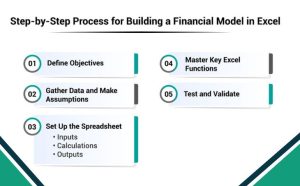
Build Financial Model in Excel

#1 Define Objectives
When creating the model, it is important to mention why it is formed. Do you need your model to provide a cash flow forecast, a valuation, or a budgeting tool? With the purpose in mind, it becomes simple to formulate your assumptions and the structure you are going to apply.

#2 Collect Data and Assumptions
Get the relevant financial data, such as the past financial reports, market dynamics, and economic reports. State what your model is based upon, e.g., what are your growth rates, cost of capital, or margin.

#3 Set Up the Spreadsheet
Divide your model into three major parts:

  • Input: To facilitate replacement in case of changes in the model assumptions, all the assumptions and the inputs must be inputted in a single textbox.
  • Calculations: Carry out all possible operations in an adjacent section of the layout and tie them in with the inputs.
  • Outputs: The most optimal method in incorporating the conclusion section is to design a clean isolated section. Where financial projections or other vital findings like cash flows, profit margins or value ratios will be located.

#4 Master Key Excel Functions

Use Excel functions like:

  • Data is looked up using VLOOKUP/INDEX MATCH.
  • Vertical lookups (VLOOKUPs).
  • IF statements control the scenario analysis process.
  • PivotTables in which lots of data is displayed and processed.

#5 Test and Validate

Conducting sensitivity analyses on the model is a method of helping to verify the presence of errors in the model. By comparing the output or the results of the developed model and different base cases. Cross-check by comparing your results with the way you have done it or with the way the others in the same industry are doing it.

In this wide-method, you will be in a position to develop a solid financial model which is quite useful as well.

Get Now: Financial Model for BPO Company

Ready-to-Use Financial Model Templates

Excel is a very effective financial modeling tool, creating a model in a vacuum could be time-consuming, complex and confusing. Especially to those with multiple projects on their hands or new to the higher-order techniques of using excel. Hours of organising assumptions, connecting computations, and presenting results can slow down the decision-making process, even for experienced analysts.

To solve this issue, you can take advantage of investor-accepted financial model templates. The templates are also professionally written and simple to comprehend and can be customised completely. Users can rapidly adapt the templates to the financial data of the company or the project. Not only save time but they minimise the risk of error. Also assure that your model reflects the industry best practices and investor expectations.

saas financial model

How to use them effectively:

  • Go to the FundTQ web site – a reliable source of financial model templates.
  • Search using financial model templates or industry.
  • Choose the most suitable model based on your type of business e.g. startups, SMEs, or corporate finance case.
  • Get a template and fill it in with your financial information, assumptions, and forecasts.
  • Check and confirm the results to see that it is based on your situation and business goals.

With such templates, you will be able to spend more time on analysis, strategy and decision making than on building a spreadsheet which will take a lot of time. They offer a professional, organised and credible system that saves time in the financial planning and impresses investors or stakeholders.

Top Excel Techniques to Enhance Your Financial Models Effectively

In order to master your financial modeling skills in Excel. Then you should concentrate on the critical methods that make your models more effective. Basic Excel functions are useful in the analysis of data but are simple in nature. Whereas complicated functions are invaluable especially in financial organizations.

The most applicable is a scenario analysis which allows considering various results under some assumptions. Goal Seek and Solver of Excel are also significant as far as financial model generation is concerned. As they offer a way to obtain the level of input that will give specific output.

Also, use of Macros and VBA (Visual Base of Applications) automate the processes. Thereby lowering the time used in repetitive processes and giving uniformity to the models.

These are the three advanced techniques that are critical to apply:

  • Scenario Analysis: Compare various financial outcomes based on the variation of some assumptions.
  • Goal Seeker and Solver: Optimise performance of the company using math to achieve a specific level of performance based on financial performance.
  • Macros and VBA: To become more effective and help avoid mistakes in financial modeling.

The use of these techniques will make your models more accurate and the usability of the results three times better.

Bottom Line

Any hopeful who wants to succeed in the investment banking skills must have knowledge of financial modeling in Excel. Recognize financial modeling and improve your technical ability in excel functions. Which will make you more viable in the business world. Training is also imperative in the development of a particular career. As it fines the skills and informs the concerned person of the market trends. Acquire and practice the skills required to operate under the complex environment in the field of finance and to be a successful person in it.

business valuation software

fintech investment banking

Partner with the Right FinTech Investment Banking Firm for Success

Fintech is changing the world of finance – digital payments, online lending, blockchain, and wealth management technology. Nonetheless, there is an effective financial plan with highly qualified consultants behind each successful fin-tech company. Fintech investment banking comes into play here. These specialised companies bridge innovation and capital, assisting financial technology companies to raise finance, grow, merge, and succeed in a competitive environment.

This guide will take you through all the things you should know as a fintech founder, CEO, or investor to the best investment banking firm in the fintech sector to invest with in the future, including what they can and cannot do as well as how to select the appropriate partner.

What Is FinTech Investment Banking?

Fintech investment banking is a niche investment banking service that solely concentrates on the financial technology business. Fintech investment banks have a specialisation in digital finance, unlike conventional investment banks that serve a wide industry. They integrate financial knowledge, technological knowledge, and strategic knowledge to make fintech firms grow and prosper.

Core functions include:

  • Capital raising: Assistance in attracting venture capital, private equity, or strategic investors to finance the startup as well as an existing company.
  • Mergers and acquisitions (M&A): Counselling businesses to acquire, dispose, or merge with other fintech companies to increase competencies.
  • IPO advisory: Counselings companies that are going public by assisting them in valuation, compliance and investor relationships.
  • Valuation and growth strategy: This would be giving detailed market analysis to provide accurate valuation and eventual success.

To put it in simple terms, fintech investment banking assists innovative businesses to acquire the financial resources and business strategy to grow in a sustainable manner.

Why FinTech Companies Need Specialised Investment Banking Partners

The fintech industry is a rapidly developing industry. New technologies appear every month, laws change and become stricter every day, and the competition rises day after day. These complexities are not totally understood by a conventional investment bank – but they are by a dedicated fintech investment banking firm.

That is why it is important to have the right partner:

1. Deep Industry Knowledge
Fintech bankers know how to appreciate digital assets such as APIs, data algorithms, mobile platforms, which are often overlooked by the traditional banks. This provides a realistic and appealing company valuation in raising capital or a merger.

2. Access to FinTech Investors
The leading fintech investment banks are connected with the venture capitalists, family offices and fintech-focused private equity firms. They directly link you with investors that understand your technology and market potential.

3. Regulatory Insight
Regulations play a large role in the fintech industry, be it compliance with the KYC and AML regulations or privacy regulations. Fitech-based investment bankers will make sure that deals are in line with fintech and data protection standards.

4. Global Market Reach
Scalability across regions is also frequently the driver of fintech success. A well-developed investment banking partner gives availability to foreign investors, partners and targets of acquisition.

5. Strategic Growth Support
The right company is not only that one that can assist you in raising the money, it is also your long-term counsellor who can see new opportunities, new collaborations and new development courses, as the market changes.

free pitch deck templates
Top Services FinTech Investment Banks Provide to Clients

When you work with an investment banking company that is fintech-oriented, you will have access to a package of financial and strategic services optimally tailored to your company:

1. Raising of Capital and Structuring of funds.

Investment bankers also assist fintech companies to raise funds at any of their capital stages, such as seed round, Series A, Series B, or pre-IPO. They come up with financial models, pitch decks and deal structuring to get the appropriate investors.

Example:
An investment bank can help a digital payment startup that is in need of Series B financing to find those investors who focus on payment infrastructure that will help the company to get business funding for small business that aligns with the long-term vision of the company.

2. Mergers and Acquisitions Advisory.

You can use fintech investment bankers to run each phase of the acquisition of a smaller startup, or merger with a strategic partner, including valuation, negotiation, due diligence, and deal execution.

Example:
A neobank can purchase a regtech start-up to improve automation of compliance. The banker will make certain that there is financial and strategic alignment to have a smooth merger.

3. IPO and Public Market Advice.

Investment bankers assist in preparing IPOs when fintech companies have reached maturity to ensure there is transparency, compliance, and preparedness of the investors. These are financial reporting, roadshows and positioning of the stock market.

4. Strategic Consulting and Valuation.

The assets of fintech companies are often intangible such as intellectual property or algorithmic data. The high valuation models applied by specialised investment bankers are used to measure the values properly and make strategic decisions.

5. Financial Restructuring

In companies that have financial difficulties or during market crashes, investment banks formulate restructuring strategies to help them stabilise operations, earn investor trust, and reignite the growth process.

How to Choose the Right FinTech Investment Banking Firm?

The right partner can make or break the way your company grows. These are the key factors that you must take into account when choosing your fintech investment banking advisory services company:

1. Proven Track Record
Review previous fintech transactions by the firm with your business. Have they funded rounds or M&As in your niche (such as payments, insurtech or blockchain)?

Also Read About: How to Raise Series A Funding in India?

2. Investor Network
Connection with a good network of investors is a speedy way of getting capital. Make sure that the company has built cooperations with fintech-oriented investors and international financial organizations.

3. Customized Strategy
One-size-fits-all solutions are to be avoided. The top fintech investment bankers develop unique plans that fit your objectives, be it fundraising, market expansion, or IPO.

4. Knowledge on Emerging Technologies
Your investment banking partner must know how new trends such as AI in finance, digital wallets, Web3, and open banking impact on your business model.

5. Transparency and Integrity
Effective communication, adequate fee frameworks, and practices are essential. A suitable company believes in relationships with the long term, as opposed to the short term.

Key Advantages of Choosing a FinTech Investment Banking Firm

Collaborating with a special fintech investment bank has more than mere access to funds:

  • Accelerated Fundraising: Access to investors that really know fintech faster.
  • Improved Valuation: Reflect the worth of your technology and development opportunities.
  • Global Expansion Opportunities: Get into new markets with confidence by strategic alliances.
  • Increase Deal Efficiency: Decrease the time of closing sophisticated financing or acquisition deals.
  • Professional Advice: Trust experts that foresee difficulties and overcome market uncertainty.

business valuation software
Key Innovations Shaping the Future of FinTech in Investment Banking

To remain competitive, fintech companies and investment banks have to respond to industry trends defining the financial services in the modern world:

1. AI-Driven Deal Analytics
DAV and risk assessment Artificial Intelligence and machine learning are changing how deals are discovered, evaluated and assessed risk.

2. ESG-Based Financing emergence.
ESG-oriented investors are willing to invest in fintech companies that implement sustainability, inclusion, and ethical finance. These measures have been incorporated by investment banks as part of deal strategies.

3. Expanding Cross-Border M&A.
With the increase in fintech solutions around the world, investment banks trade cross-border transactions, particularly in North America, Europe, and Asia.

4. Financing with Blockchains and Tokenization.
As blockchain goes mainstream, fintech investment banks are considering tokenized assets, DeFi (decentralized finance), and fundraising approaches based on blockchain.

5. Strategic Consolidation
Mergers of payment processors, neobanks, and lending platforms are also happening in the fintech market – an indication that the industry is moving towards the consolidation of the ecosystem. Investment banks are very important in the structuring of these transactions.

When Should You Partner with a FinTech Investment Banking Firm?

It is important to know when to seek the services of an investment banking partner. The following are the most appropriate moments to consult them:

  • You are about to launch a large funding round (Series B or later).
  • You are thinking of strategic merger, acquisition or exit.
  • You are thinking of an IPO or are thinking of going public.
  • You require an investment or strategic map.
  • You are looking to get international and need cross-border financial advice.

Early engagement can make your fintech company competitively position itself with regard to investors by planning in advance.

Learn About: Startup Funding in India

Conclusion:

The financial landscape of the fintech industry is changing more rapidly than ever — so should your financial strategy. An expert fintech-focused investment banking company does not just make you meet money, but allows you to make better choices in business, achieve long-term expansions, and outperform competitors.

Regardless of whether you are climbing the ladder of a digital lending solution, opening a payment gateway, or going through an IPO, finding the appropriate fintech investment banking partner will determine the success of your company.

Wise investment in both technology and strategic partners.

technology investment banking services

What is Technology Investment Banking? Key Insights for Investors & Professionals

Technology investment banking services are essential in determining the growth paths of startups and scale-ups and established tech companies in the rapidly changing digital economy of the present times. You are an investor who needs to find opportunities with high returns, a tech entrepreneur who needs to evaluate capital sources, or you are a professional who needs to negotiate a deal in the field of M&A. The area of technology investment banking is crucial to your understanding.

The article is a detailed guide to technology venture capital services, including mergers and acquisitions (M&A), venture capital and strategic advisory among others. We also investigate the effect of these services on the stakeholders providing practical information on how to receive maximum value and reduce risks.

How Technology Investment Banking Drives Growth?

Technology investment banking services refer to a diversity of financial advisory and capital-raising services unique to the technology sector. technology investment banking for startups is centred on firms in the software, hardware, cloud computing, artificial intelligence, cyber-security, fin-tech, biotech and other high-growth technology sectors unlike traditional investment banking that provides service to many industries.

Key services typically include:

1. Mergers & Acquisitions (M&A) Advisory

  • Technology investment banks provide advice to companies on how they should buy, sell or merge with other tech firms.
  • Services involve valuation analysis, due diligence, deal structuring and negotiation support.
  • Scenario: A Cloud-computing startup that wishes to be acquired by a larger enterprise software company would use the services of M&A advisory to help in giving a fair valuation and smooth deal.

2. Venture Capital & Private Equity Placement

  • These banks assist the technology firms in seeking financing through venture capital (VC) founders or/and private equity (PE) founders.
  • They design investment rounds, develop pitch materials, and match the entrepreneurs with the applicable investors.
  • Examples: A fin-tech startup raising Series B could hire one of the technology investment banks in order to attract strategic investors and good terms of the deal.

3. Strategic Advisory & Corporate Finance Services

  • In addition to deals, technology investment banks offer long-term strategic planning, such as capital structure planning, positioning in the market, and growth planning.
  • They help in financial modelling, risk analysis and strategic decision making of start ups and mature technology companies.

4. Debt & Equity Capital Markets Services

  • Technology investment banks help companies to access capital markets in case they are planning to issue stocks or bonds.
  • They provide advice on IPO preparation, secondary issues, and issuing convertible debt and making sure it complies with regulations and investor trust.

business valuation software

Why Tech Companies Need Investment Banking Expertise

Any investment or expansion of a technology business presents a high risk since markets are dynamic, innovations are cyclic, and competition is intense. The investment banking services alleviate these risks by offering:

  • Valuation Experience: Tech firms frequently possess intangible resources (such as IP, proprietary algorithms and software platforms). The correct valuation of these cannot be done without expert knowledge.
  • Availability of Capital: Banks introduce firms to investors who are knowledgeable of the peculiarities of technology markets.
  • Strategic Guidance: Senior bankers provide market trends, market positioning and exit strategies.
  • Regulatory Compliance: Tech transactions can comprise cross border transactions, data privacy, and IP. Investment banks will make sure that all the legal and regulatory frameworks are followed.

Leading Technology Investment Banks Shaping the Industry

A number of the upper-end investment banks and boutique firms are focused on transactions in technology:

  • Goldman Sachs and Morgan Stanley: Multinational technology M&A advisory and public offerings.
  • FundTQ – Investment Banking Services: Specialises in technology deals with, advising on growth capital, mergers and acquisitions and strategic equity.
  • Qatalyst Partners & Allen & Company: Boutique firms that have intense emphasis on high-growth technology deals.
  • SVB Securities (previously Silicon Valley Bank): Provides venture capital and growth equity advisory services to tech startups.

Every company has a distinct set of industry knowledge, investor links and deal experience, and they are important collaborators to technology firms desiring to pursue a strategy of growth.

How Technology Firms Leverage M&A for Growth

A fundamental service of technology investment banking is mergers and acquisition. They help companies to increase market share, purchase new technologies, or merge with each other.

Key M&A trends in tech include:

  • Consolidation of Cloud Computing (SaaS): There is a trend of merging of many SaaS companies to expand their product and grow in a very short period.
  • Acquisitions of AI and Machine Learning: Bigger companies tend to purchase startups that have sophisticated AI to increase innovation rate.
  • Cross-Border Deals: Technology companies are becoming more eager to engage in international M&A as a way of finding new markets and new sources of revenue.

A technology investment bank is used to package these transactions in the best interest of value creation and risk reduction, fair valuations, and complex negotiations.

Venture Capital and Technology Investment Banking

Venture capital is a saviour to new technical firms. VC funding is achieved through tech investment banking consultants which:

  • Finding the right investors in line with the vision of the company.
  • Organising investment rounds to make the most out of capital.
  • Working out conditions that will ensure we have an equitable control of the business by the founders and investors.

To investors, the technology investment banks offer deal flow, due diligence and market intelligence and aid in determining which startups have a high growth potential.

How Technology Investment Banks Boost Client Profitability

Investment banking services offered in technology have the effect of creating value in that they:

  • Market Intelligence: Data analytics, industry reports, and networks allow banks to discover opportunities to grow and competitive threats.
  • Financial Engineering: Deal structuring by the experts is efficient on tax and optimal allocation of capital as well as risk reduction.
  • Investor Confidence: Credible advisory will improve investor confidence which will make fundraising easier and more successful.
  • Exit Optimization: In the case of startups; banks recommend IPOs, secondary sales, or strategic acquisitions to make the most out of the shareholders.

free pitch deck templates

Questions to Ask Potential Technology Investment Banks Before Signing

The choice of a technology investment bank is an important issue. Key factors include:

  • Experience in Industry: You wish to find companies that have substantial experience in your technology line.
  • Track Record: Assess previous transactions, values realised and successful fund-raises.
  • Network Access: The network of investor and strategic partners of a bank can break or make a deal.
  • Advice Quality: Sound advice in valuation, deal structuring and negotiation is essential.

The involvement of an appropriate partner may make a huge difference in terms of growth, startup funding results, and market position.

Future of Technology Investment Banking

Investment banking technology is changing at a very fast rate:

  • AI-based Deal Analysis: Artificial intelligence is now employed in valuation modeling, risk, and trend prediction on the market.
  • Emergence of SPACs: Special Purpose Acquisition Companies are offering other ways in order to take tech companies public.
  • Cross-Border Digital Ecosystems: World technology convergence is creating sophisticated M&A and investment prospects.
  • Sustainable and Impact Investing: Investors are giving preference to ESG-complaint technological companies and this is changing the practices of banking advisors.

These trends indicate that technology investment banking is going to be a high-value dynamic sector that is constantly evolving according to innovation and market changes.

Conclusion

Tech companies, investors, and professionals in the modern complex digital economy cannot do without technology M&A advisory services. Whether it is M&A advisory and venture capital placement, or strategic corporate finance and capital market services. These banks are the providers of the expertise, networks and guidance that lead to growth, finance and optimisation of the exits.

To investors, engaging an experienced technology investment bank would open up high growth opportunities and risk avoidance. It guarantees business people strategic direction, ideal valuation as well as effective raising of capital. This is because with the ever-evolving technology in the industries. The role technology funding and advisory services plays in the future of innovation and investment will be even more vital.

Investment Banking Advisory Services

Top Investment Banking Advisory Services for Mid-Market Businesses

Investment banking advisory services are very important in opening up business growth opportunities to mid-market businesses interested in growth through expansion or merging, as well as raising capital. These services are not just another form of financial advice – they fill the gap between business vision and action with expert advice on how to raise capital, mergers and acquisitions (M&A), valuation, and strategic restructuring.

Simply put, an investment bank advisory business assists companies to make sound financial decisions through a combination of market knowledge, valuation skills, and deal execution business.

What Are Investment Banking Advisory Services?

The investment banking advisory services can be defined as a set of professional consulting services which help business enterprises to realise major financial goals. Such services are normally:

  • Mergers & Acquisitions (M&A): Assisting companies to find, negotiate and implement an acquisition or merger that supports long-term objectives.
  • Capital Raising: Helping businesses to obtain financing by investors, venture capitalists, or private equity firms either in equity or debt.
  • Valuation & Financial Modeling: The company will also offer a detailed business valuation, projection, and financial model to inform an investment decision.
  • Restructuring Advisory: Assistance to businesses in dealing with their financial difficulties, debt restructuring, or performance enhancement plans.

You are a start-up or are raising a new round of funding, or you are a growing company looking to be strategically invested in either way. Investment banking services will help you have all the steps in line with your business goals.

Why Mid-Market Businesses Need Capital raising advisory

The challenges encountered by mid-market companies are usually specific: insufficient access to capital, valuation difference, and uncertainty in strategy when growing. All these complexities can be avoided by engaging the services of professionals providing financial advisory services in investment banking.

Here’s why it matters:

  • Availability of Capital and Investors Advisors introduce mid-sized companies to additional sources of funding, such as private equity investors, venture capital funds, and strategic partners.
  • True business Valuation: The financial modeling and informed suggestions allow advisors to calculate a fair market valuation, which is critical in negotiation and investment rounds.
  • Strategic Decision Support: Advisory firms provide advice on decision-making during M&A, diversification or restructuring with professional expert analysis and knowledge of the market.
  • Effective Deal Delivery: Experienced investment banking advisors make everything easy, the due diligence, and completion of deals.

business valuation software
Transaction advisory services and investment banking are two terms that are frequently compared in the modern fluctuating financial ecosystem. Although both provide advice on corporate transactions, investment banking goes a notch higher. It deals with deal origination, structuring, and underwriting. hence it is essential in the mid-market companies.

Types of Investment Bank Advisory Services

A detailed investment banking advisory services agreement generally encompasses a variety of niche services, which include:

  • Equity and Debt Advisory – Organising business fundraising rounds by way of public or private placements.
  • Underwriting and Capitals Markets Support- Assisting businesses to raise funds by IPOs or private equity.
  • M&A and Divestiture Advisory – Executing acquisitions, mergers or business sales end-to end.
  • Strategic and Financial Consulting – Providing custom guidance to sustainable business development.

These services are constructed on trust, experience and thorough market analysis, which are fundamental values that define top investment banking firms all over the world.

Investment Banking: A Guide to Underwriting and Advisory Services

Two pillars of investment banking are underwriting and advisory.

  1. Underwriting is the evaluation of risk and the provision of capital towards corporate financing or IPOs.
  2. Advisory services, however, are those services that give strategic and financial advice on a transaction to make it a success.

By working together they assist companies to realise the best results which is risk and returns and long term value creation.

Read More: What’s the Best Way to business funding for small business in India?

The Future of Investment Banking Financial Advisory for Mid-Market Firms

The mid-market firms have access to data-driven corporate finance advisory like never before due to the emergence of digital transformation and AI in the financial sector. In automated financial modelling to predictive analytics in valuation, technology is changing the nature of advisory decision making.

Companies that adopt such an evolution, with the use of the experience of the human kind and the intelligent financial tools are in a better position to grow in scale and also be in a position to make investments.

free pitch deck templates
Final Thoughts

Big corporations are no longer the only ones to engage in corporate finance advisory. As in the case of mid-market enterprises, they are growth drivers, monetary illumination, as well as strategic guidance. It could be capital raise, M and A, better valuation accuracy. The correct advisory partner can make you see financial vision in action.

When informed about the fundamental principles of investment banking financial advisory service. The mid-sized businesses will be assured of their competitiveness in the fast-paced business environment.

FAQ – Investment Banking Advisory Services

1. What are investment banking advisory services?
Answer: Investment bank advisory services will guide the business in raising funds, acquisition, mergers, and financial planning and valuation. The services will assist businesses to make wise financial choices and reach the appropriate investors.

2. How do mid-market businesses benefit from investment banking advisory services?
Answer: Mid-market firms gain access to capital, expert M&A execution, accurate business valuations, and strategic financial insights, enabling growth and investment readiness.

3. What is the difference between transaction advisory services and investment banking?
Answer: The transaction advisory services are dedicated to the due diligence and deal structuring, and investment bank advisory services are dedicated to the fundraising, underwriting, and complete execution of the M&A in the long-term development.

4. What is included in an investment banking advisory services agreement?
Answer: An agreement of investment banking advisory services specifies the range of advisory services. Such as capital raising, M&A advisory services, valuation, financial modelling, and compensation and deliverables compensation and deliverables terms.

5. How can investment banking financial advisory services help with fundraising?
Answer: Financial advisory services guide businesses to create investors-ready financial models, pitch-decks, and valuations, and match them with the appropriate investors and promote an effective fund raising round.

6. What is the role of underwriting in investment bank advisory services?
Answer: Underwriting refers to risk evaluation and provision of capital to finance corporate or IPOs. It will guarantee that businesses get funding with the lowest financial risk combined with advisory services.


Get Business Funding for Small Business

What’s the Best Way to Get Funding for a Small Business in India?

To open or grow a business, passion alone is not enough but the proper financial aid is needed. Small business funding opportunities are higher than ever before in 2026. Whether it is a new idea or expansion of an already formed business, understanding how to raise funds to start a small business or grow an existing one is the difference between success and failure.

Here in this guide we are going to discuss the most effective methods of acquiring funding of small business, primary sources, government programs, and intelligent methods of obtaining the correct kind of capital to suit your requirements.

Understanding Small Business Funding in 2026

It is important to first define what small business financing is before we plunge into the specific sources of funding.

Small business funding is any financial support to start ups or small business ventures to meet costs including:

  • Inventory or product development.
  • Hiring employees
  • Marketing and technological advancement.
  • Current assets or working capital.

As the global startup ecosystem is thriving, the need for funding assistance to small enterprises has never been greater. Governments, banks and individuals who just want to invest their money are all providing resources on how to support small funding to an idea of business that has potential.

Why Funding Matters for Small Businesses?

Securing capital early can:

  • Increase cash flow and maintain business.
  • Grow faster by making investment in tools, talent and marketing possible.
  • Grow popularity among suppliers and customers.
  • Less risk through the diversification of sources of financial support.

To put it in a nutshell, the idea of starting a small business can become a successful company with the knowledge of how to raise funds.

Top 10 Ways to Get Funding for Small Business in 2026

1. Government Grants and Schemes

Governments of all countries, such as small business or startup funding in India, provide grants, subsidies and low-interest loans to entrepreneurs.

Examples include:

  • MSME Loan Schemes in India
  • Startup India Seed Fund Scheme (SISFS).
  • Pradhan Mantri Mudra Yojana (PMMY) – small business micro-loans.
  • Small Business Administration (SBA) Loans of the U.S.

It is among the most suitable funding sources of a small business as it is usually associated with lower repayment.

2. Bank Loans

The traditional banks have still continued to be a trusted provider of loans to the small business. 

You can apply for:

  • Term loans (used to pay in installments over time).
  • Working capital loans (to cover cash flow)
  • Equipment financing

To increase approval, a well-developed business plan demonstrating profitability, market analysis, and ability to repay should be prepared.

3. Microfinance and NBFCs

Microfinance institutions and Non-Banking Financial Companies (NBFCs) will provide assistance in the event that you do not have collateral or a good credit history. They issue small financing business loans on flexible conditions, particularly in the developing markets.

This suits those entrepreneurs who want to get financial assistance to develop small businesses in the rural or semi-urban environment.

4. Angel Investors

Angel investors are also individual investors who risk using their personal funds in startups that have potential. By 2026, it is only a few clicks to find investors that focus on your industry by using digital platforms such as LetsVenture, AngelList, and SeedInvest.This is among the most effective small business funding choices in the case of a startup.

5. Venture Capital (VC)

In case your business has high growth potential, VC firms can provide huge funding rounds. They usually invest in the areas of technology, fintech, healthcare, and sustainability.

Although it implies relinquishing part of the ownership, the mentorship and exposure VCs will offer may accelerate the process of growth, and it is one of the most effective methods of obtaining funds to run a small business with scalability in mind.

6. Crowdfunding Platforms

Crowdfunding is a popular alternative source of funding. There are platforms such as Kickstarter, Indiegogo or GoFundMe that enable you to fundraise through the crowd.

You can provide first-time availability of products or benefits to supporters. It is a creative and democratic method of securing small funding business assistance without conventional loans or investors.

free pitch deck templates
7. Business Incubators and Accelerators

There are numerous incubators and accelerators that provide funding assistance to the small business ventures as well as mentoring, network, and space. Cash-based investor programs such as Y Combinator, Techstars, and Startup India Hub are business development programs.

Becoming an accelerator may be a game-changer to startups that want to obtain small business financing and develop.

8. Corporate Partnerships and Mutual Funds

Investment programs or small business mutual funds are managed by some large corporations to foster innovation. As an example, businesses can invest in startups that do not cannibalize their product ecosystem.

Not only can these partnerships provide funding to small businesses, they can also include technical expertise and market access.

9. Trade Credit and Supplier Financing

In case your business is dependent on suppliers, you can enter into a trade credit agreement which will enable you to pay after selling goods. It is a less known but efficient source of small business funds that can be used to handle stock without the initial expenses.

10. Bootstrapping

Bootstrapping refers to funding your business with personal savings / revenue. Though it restricts start-up capital, it provides complete control and eliminates debt.

This is an ideal choice in small business entrepreneurs that would wish to remain lean and autonomous and only seek outside business capital later.

Types of Funding for Small Businesses

Understanding the types of funding for small businesses helps you choose the right one:

Types of Funding for Small Businesses

Choosing the right type depends on your stage, risk tolerance, and repayment capacity.

How to Prepare Before Applying for Funding?

These are the main steps to follow before you can apply any type of small business funding:

  • Develop a powerful business strategy- Prepare your vision, market size, competition and financial predictions.
  • Develop your credit history- Good credit increases your loan chances.
  • Prepare financial records – Have tax returns, invoices and bank statements on hand.
  • Find the appropriate source of funds to use- You cannot use any blindly; you must find what suits you.
  • Show traction Evidence of customers, revenue/social proof increases investor confidence.

With proper preparation, you will be the best among the applicants who are in need of business finance to start small businesses.

Small Business Funding in India: 2026 Outlook

The startup environment in India is still booming amidst a boom in financing small business in India.

Key trends include:

  • E-loan services that have immediate approval.
  • Innovation grants and seed funds that are supported by the government.
  • The emergence of new fintech lenders, such as Razorpay Capital and KredX.

These advancements have rendered funding of small business easier than ever before with or without the conventional banking relations.

Challenges in Securing Funding

The opportunities are high but the entrepreneurs encounter struggles like:

  • Limited credit history
  • Insufficient collateral
  • Strong competition in terms of grants and VC funding.
  • Complex documentation

To overcome these, it needs to be persistent, have a network and learn the language of investors. Keep in mind, however, that it is not only about securing funds, but securing the right kind of funds to your small business.

business valuation software
Tips to Increase Funding Success

  • Network: Partake business and pitch events.
  • Use social proof: Focus on testimonials or awards.
  • Small and Big: Firstly get microfunding, and then grow.
  • Expand digital capabilities: Razorpay, ClearTax, Khatabook will assist in financial management and credit development.

As much as you might be starting afresh, these tips can help in streamlining your small funding business venture.

Conclusion: Choose Smart, Start Strong

It is not that there is a single best way of funding a small business in 2026; it is all based on what you want to achieve and the industry you are in and the level of risk you are ready to undertake. There are dozens of options of small business funding, starting with government grants and mutual funds and going to crowdfunding and angel investment. It is all about preparation: create a great plan, network, and strategize. And with the proper strategy, you will be able to attract business funding to grow your small business and make your dream of becoming an entrepreneur a real thing.

Learn about 9 Ways of Fundraising for Startups in India

Key Takeaway

Funding your small business is no longer about luck — it’s about strategy, research, and choosing the right mix of financing sources.

Funding Readiness Checklist

Funding Readiness Checklist: Prepare Your Business for Investment in 2025 & Beyond

One of the most transforming moves that a business can make is the act of raising capital. Yet the brutal truth is: most of the startups and middle market businesses do not raise funding not because their idea is not a good idea but because they are not an investable company. It is here that the funding readiness checklist comes in. It is a step by step guide that will make your business ready to impress investors, raise funds effectively, and grow successfully not just in 2025 but in 2026.

You will find a realistic, practical checklist in this guide, which includes financials, legal preparedness, team, market strategy, fundraising planning, and others. You will have just the answer to know how to get your business ready to be invested in without fear.

Why a Funding Readiness Checklist Critical?

Hundreds of pitch decks are received by investors on a monthly basis. It is the matter of preparation that is the difference between success and rejection.

A Funding Readiness Checklist can assist you:

  • State your business professionally.
  • Present all the required documents and information investors require.
  • Don’t make expensive errors to cripple funding.
  • Develop investor confidence and trust.

Imagine it as a pre-flight checklist – one step will result in postponement or risk of funding.

Pro Tip: Start preparing early. Investors notice when founders are proactive about 2025–2026 funding

business valuation software
Key Sections of a Funding Readiness Checklist

There are six important areas that a solid Funding Readiness Checklist must cover. Let’s break them down:

1. Financial Preparedness

Numbers are important to investors. Your finances should also be correct, open as well as proactive.

Checklist items:

  • Financial statements ( Income Statement, Balance Sheet, Cash Flow) audited or reviewed.
  • Projections and forecasts of 2025 and 2026.
  • Unit economics and burn rate (startups).
  • Equity structure and cap table.
  • Debt obligations and liabilities.

Why it is important: Clean and well-organised finances are a source of confidence and show that your business is able to grow sustainably.

2. Business Model Clarity

Shareholders would like to know how your company generates value.

Checklist items:

  • Clear value proposition
  • Pricing strategy and revenue model.
  • Market and customer acquisition.
  • Differentiation and competitive landscape.
  • Potential to expand threefold between 2025 and beyond.

3. Legal & Compliance Readiness

No other thing can destroy the confidence of the investors as much as the legal or regulatory problem.

Checklist items:

  • Registration and licenses of businesses. (Check Now)
  • Ownership of intellectual property and patent.
  • Hiring agreements and contracts.
  • Impending litigation or regulation issues.

4. Management Team & Governance

Investors are not investing in ideas only.

Checklist items:

  • Relevant experienced key team members.
  • Advisory board or mentors
  • Governance structure
  • Clearly defined roles and responsibilities.

Tip: Spotlight accomplishments, past exits or industry experience – this develops competence and power.

5. Market & Growth Strategy

Investors desire to see that your business can grow.

Checklist items:

  • Total Addressable Market (TAM) and Serviceable Available Market (SAM).
  • Go-to-market (GTM) strategy for 2025–2026
  • Customer Acquisition Cost (CAC) and Lifetime Value (LTV).
  • New markets, or new product lines expansion.

6. Fundraising Strategy

Lastly, your checklist must describe your fundraising strategy.

Checklist items:

  • Type and amount of targeted investment (equity, debt, convertible notes)
  • Optimal types of investors (VC, angel, PE, strategic)
  • Investor pitch and investor presentation.
  • Timeline and milestones
  • Contingency plans

Common Mistakes Founders Make

Founders are known to trip even with a checklist.

Avoid these pitfalls:

  • Unfinished or dishevelled financials – destroys credibility.
  • Excessive projecting of market size – investors like real projections.
  • Ignoring legal preparation IP or compliance can come to a halt.
  • Overlooking deadlines -The raising of funds will consume more time than anticipated.
  • Poor team presentation- investors emphasise on how things are done rather than what is said.

Hint: Your checklist will help you to cover every area and avoid such mistakes when approaching investors.

Read About: How to Raise Series A Funding in India (2025 Guide)

How to Use Your Funding Readiness Checklist Effectively

  • Timing is everything – Now preparing 20252026 funding rounds.
  • Check all the parts- Do not omit any part.
  • Seek professional consultation – It may be advisable to seek professional advice such as FundTQ to figure out the gaps.
  • Communicate frequently – Markets, finances and strategy change; revisit on a quarterly basis.
  • Get your team in line – distribute the checklist across the team and make sure everyone is on board.

free pitch deck templates
Bonus Tips for 2025–2026 Funding Success

  • Storytelling with data: Investors are obsessed with graphs and numbers.
  • Online presence: Have a professional LinkedIn and Web site.
  • Scenario planning: “Make best-case and worst-case funding estimates.
  • Know your numbers: Be prepared to tell financials in a comprehensive fashion.
  • Regular follow-ups: Reflective follow-up messages are a sign of professionalism.

Learn About: 9 Ways of Fundraising for Startups in India

FAQs

Q1: What is a Funding Readiness Checklist?

A: It is a guide on how founders should make their business investable, including financials, legal preparation, team, market plan, and fundraising.

Q2: At what time do I begin preparing a funding round?

A: 6-12 months before you are having the fundraising. This checklist will be useful in 20252026 planning.

Q3: Is it possible to operate with the same checklist with equity and debt financing?

A: Yes, the core readiness items are applicable to both, however, your section of fundraising strategy can vary.

Q4: What is the frequency of checking the checklist?

A: Quarterly changes will be recommended to capture financial changes, market trends and staff growth.

Bottom Line

Like in business, relying on raising capital, it is preparation and not a matter of luck. A Funding Readiness Checklist is a way to make sure that your business is organized, believable and that it is investor-ready by 2025 and 2026. This guide will help you minimise risks, speed up your startup funding process, and come out as a confident, credible founder before investors.

Next Step: Download our complete Funding Readiness Checklist (2025-2026) and determine your company investor readiness in the present.

Get Your Funding Readiness Checklist

Raise Series A Funding

How to Raise Series A Funding in India (2025 Guide)

The Raise Series A Funding is an important step in the life of a startup that wants to grow beyond its initial momentum. Although seed funding assists to prove the fit of your product-market, Series A is regarding growth through expansion, gaining more customers, and maintaining sustainability.

The Indian startup ecosystem is also very competitive and data-driven in 2025. The investors are not just focusing on revenue anymore, they desire scale business models, clear unit economics, strong leadership teams, and robust growth strategies.

Composing a detailed FundTQ (one of the leading investment banking and fundraising advisory firms in India) guide takes founders through the preparation process to close off your Series A round, trends, important documents and timelines.

What Is Series A Funding?

The initial major institutional round of venture capital is Series A financing that a start-up company receives following demonstration of a sound concept and momentum.

Investors in Series A expect:

  • A clear problem-solution fit
  • Existence of market demand and traction.
  • A repeatable and scalable business model.
  • An effective and creative founding team.

Purpose of Series A funding:

  • Hire and scale your team
  • Expand products or services
  • Enter new markets
  • Improve operational abilities.

Concisely, Series A converts an idea that has been tested into a business that is ready to grow.

Series A Funding Size and Valuation in India

Series A funding amounts vary by sector, traction, and investor appetite. Typical ranges are:

Series A Funding Size

Tip: FundTQ helps startups determine realistic Raise Series A Funding amounts and optimal valuations using data-driven financial modeling.

Step-by-Step Guide to Raising Series A Funding

Step 1: Strengthen Your Business Foundation
Make sure your fundamentals are good before approaching investors:

  • Market Opportunity: Identify your TAM, SAM, and SOM.
  • Business Model Clarity: Show how to make money and keep it going.
  • Traction Metrics: User growth, revenue, retention rates, CAC, LTV, engagement metrics.
  • Unit Economics: Focus on gross margins, burn rate and profitability potential.

FundTQ optimises financial forecasts and business models to fulfil the expectations of investors.

Step 2: Build a Comprehensive Business Plan

Your business plan must narrate the facts about your startup story:

  • Executive summary & vision
  • Problem-solution analysis
  • Market research/competitive environment.
  • Business model & revenue plan.
  • Financial estimates (35 years)
  • Risk analysis & mitigation
  • Scaling and expansion road-map.

FundTQ prepares investor-ready business plans that are in line with VC and PE requirements.

business valuation software

Step 3: Create a Winning Pitch Deck

The first thing people see is your pitch deck. Essential slides include:

  • Issue and marketing need.
  • Solution (product/service)
  • Product demo or screenshots
  • Traction & milestones
  • Market Strategy and Competitive Advantage.
  • Financials & projections
  • Team and advisors
  • Financing needs and expenditure.

The FundTQ produces brief, attractive decks that are compliant with the international VC standards.

pitch deck templates for Raise Series A Funding
Step 4: Identify and Target the Right Investors

Not every investor fits so perfectly. Focus on:

  • Venture Capital Firms: Accel, Sequoia, Nexus, Chiratae.
  • Corporate Investors: Google for start-ups, Reliance Ventures.
  • Family Offices & HNIs: Best in niche and first mover.
  • Impact Funds: climate tech, healthtech and education ESG funds.

FundTQ offers selective access to investors in India and elsewhere in the world.

Step 5: Prepare for Due Diligence
Investors will verify:

  • Legal documents and registration of the company.
  • Tax filing and financial statements.
  • Cap table and equity structure.
  • IP ownership & customer contracts.
  • Regulatory compliance.

In order to facilitate due diligence, FundTQ performs pre-investment audits and establishes a virtual data room to facilitate the audit.

Step 6: Outreach and Investor Meetings

  • Provide a brief preview or summary.
  • Deliver your pitch deck through safe links.
  • Organize schedule and product demos.
  • Track follow-ups using a CRM

FundTQ deals with investor outreach and meetings in order to optimize interaction.

Step 7: Term Sheet Negotiation

A term sheet outlines:

  • Valuation and dilution of equity.
  • Board organization and control.
  • Rights & obligations
  • Exit terms

FundTQ gets good terms while ensuring that the founders maintain control.

Step 8: Investor-Led Due Diligence

Investors carry out intensive audits:

  • Card-related reviews and revenue recognition.
  • IP validation and legal audits.
  • Customer & vendor references
  • Compliance checks

FundTQ manages the coordination of all the teams in smooth due diligence.

Step 9: Closing the Round

Final steps:

  • Sign definitive agreements
  • Transfer of funds and allocation of shares.
  • Regulatory filings
  • Public announcement

FundTQ warrants conformity and smooth integration of post-funding.

Key Documents Required for Series A

Key Documents Required for Series A

Timeline to Close Series A

Timeline to Close Series A


Trends in Series A Funding (2025 & Beyond)

  • AI-based Startups: AI and automation have high investor interest.
  • Profitability & Sustainable Growth: Healthy unit economics a priority.
  • Alternative Financing Models: Equity + Debt or revenue based financing.
  • International Investment Preference: US and SE Asian VCs are making more investments in India.
  • Corporate Governance & Transparency: Clean cap tables and reporting is compulsory.

 Why Partner with FundTQ

FundTQ provides the entire ecosystem of startups in need of funding:

  • End-to-end fundraising consultancy (Series A to and past)
  • Investment banking services (valuation, deal structuring, due diligence)
  • M&A advisory (sell side and buy side)
  • Support of pitch deck and financial modeling.
  • Investor relations and introductions.

Why FundTQ?

  • Successful history of Series A funding.
  • Availability of the best investors in India and around the world.
  • Professional financial and legal consultation of the closures.
  • Evidence-based decision-making and valuation.

FundTQ enables the founders to work on growth and handle the complexities of fundraising.

Ready to Raise Series A Funding?

For founders scaling their business in 2025, FundTQ makes the fundraising journey seamless. From financial modeling and pitch deck creation to curated investor introductions and deal closure, FundTQ provides end-to-end fundraising and investment banking support.

Contact us