Top Indian Startups

Top 100 Indian Startups in 2026

India is home to some of the world’s fastest-growing startup companies. From fintech and SaaS to healthcare, ecommerce, AI, and consumer brands, Indian startups are creating billion-dollar businesses and transforming industries. This guide covers the top Indian startups in 2026, including their founders, funding raised, business models, valuations, and the key lessons entrepreneurs can learn from their growth journeys.

Whether you are an investor, founder, student, or startup enthusiast, this list provides a comprehensive overview of India’s most successful startup companies.

.
Top Indian StartupsQuick Answer: Which Are the Top Indian Startups in 2026?

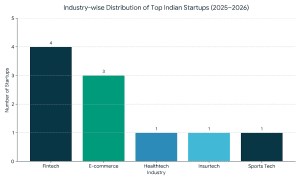
Some of the top startups in India include CRED, Groww, Razorpay, Zerodha, Zepto, Meesho, Nykaa, Dream11, Udaan, PharmEasy, Lenskart, and PhysicsWallah. These companies are among the most successful startups in India because they have achieved strong customer growth, significant funding, scalable business models, and leadership positions in their respective industries. India’s startup ecosystem now includes more than 100 unicorns across fintech, ecommerce, SaaS, healthtech, AI, logistics, and consumer technology sectors.

Top Startup Companies in India at a Glance

The table below highlights some of the most successful startups in India based on market presence, funding, innovation, and growth.

Startup Sector Founder
Zerodha Fintech Nithin Kamath
Razorpay Fintech Harshil Mathur
CRED Fintech Kunal Shah
Groww WealthTech Lalit Keshre
PhonePe Fintech Sameer Nigam
Jupiter Fintech Jitendra Gupta
Slice Fintech Rajan Bajaj
Navi Fintech Sachin Bansal
Open Fintech Anish Achuthan
BharatPe Fintech Ashneer Grover
Nykaa Beauty Commerce Falguni Nayar
Meesho Social Commerce Vidit Aatrey
Zepto Quick Commerce Aadit Palicha
Lenskart Eyewear Commerce Peyush Bansal
FirstCry Baby Products Supam Maheshwari
Purplle Beauty Commerce Manish Taneja
boAt Consumer Electronics Aman Gupta
Blinkit Quick Commerce Albinder Dhindsa
Udaan B2B Commerce Sujeet Kumar
ElasticRun Logistics Saurabh Nigam
Freshworks SaaS Girish Mathrubootham
Zoho SaaS Sridhar Vembu
Chargebee SaaS Krish Subramanian
BrowserStack SaaS Ritesh Arora
Postman SaaS Abhinav Asthana
CleverTap SaaS Sunil Thomas
Uniphore AI & SaaS Umesh Sachdev
Yellow.ai Conversational AI Raghu Ravinutala
Sarvam AI Artificial Intelligence Vivek Raghavan
Krutrim Artificial Intelligence Bhavish Aggarwal
PharmEasy HealthTech Dharmil Sheth
Tata 1mg HealthTech Prashant Tandon
Practo HealthTech Shashank ND
MediBuddy HealthTech Satish Kannan
Niramai HealthTech AI Geetha Manjunath
Dream11 SportsTech Harsh Jain
MPL Gaming Sai Srinivas
PhysicsWallah EdTech Alakh Pandey
Unacademy EdTech Gaurav Munjal
Vedantu EdTech Vamsi Krishna
Ola Mobility Bhavish Aggarwal
Ather Energy EV Tarun Mehta
BluSmart EV Mobility Anmol Singh Jaggi
Skyroot Aerospace SpaceTech Pawan Kumar Chandana
Agnikul Cosmos SpaceTech Srinath Ravichandran
The Good Glamm Group D2C Darpan Sanghvi
Noise Wearables Gaurav Khatri
Wakefit D2C Furniture Ankit Garg
Country Delight FoodTech Chakradhar Gade
Rebel Foods Cloud Kitchen Jaydeep Barman

Top 50 Indian Startups in 2026 by Sector

India’s startup ecosystem is one of the largest in the world, with companies operating across fintech, SaaS, ecommerce, healthcare, artificial intelligence, mobility, logistics, and consumer technology. The startups listed below are among the most influential and fastest-growing companies in India based on innovation, market adoption, funding activity, and long-term growth potential.

Fintech Startups

  • Razorpay

  • Zerodha

  • CRED

  • Groww

  • PhonePe

  • BharatPe

  • Jupiter

  • Slice

  • Navi

  • Open

SaaS & Enterprise Technology Startups

  • Zoho

  • Freshworks

  • Chargebee

  • BrowserStack

  • Postman

  • CleverTap

  • Whatfix

  • Kissflow

  • LeadSquared

  • Druva

Ecommerce & Consumer Startups

  • Nykaa

  • Meesho

  • Zepto

  • Lenskart

  • FirstCry

  • Purplle

  • boAt

  • Wakefit

  • The Good Glamm Group

  • Country Delight

Healthcare & HealthTech Startups

  • PharmEasy

  • Tata 1mg

  • Practo

  • MediBuddy

  • Niramai

  • HealthifyMe

  • Redcliffe Labs

AI & DeepTech Startups

  • Sarvam AI

  • Krutrim

  • Uniphore

  • Yellow.ai

  • Mad Street Den

  • Gnani.ai

EdTech Startups

  • PhysicsWallah

  • Unacademy

  • Vedantu

  • upGrad

  • Teachmint

Mobility, Logistics & SpaceTech Startups

  • Ola

  • Ather Energy

  • BluSmart

  • Udaan

  • ElasticRun

  • Skyroot Aerospace

  • Agnikul Cosmos

These startups represent some of the best startup companies in India and continue to attract attention from founders, investors, venture capital firms, and strategic acquirers. Their growth stories offer valuable lessons in fundraising, customer acquisition, product innovation, market expansion, and long-term business building.

Why Successful Indian Startups Are Built Differently

India’s startup ecosystem is being shaped by UPI-led digital infrastructure, affordable mobile internet, a young digital consumer base, and a deeper investor network across angels, family offices, venture capital, private equity, and strategic acquirers. As of 2026, India has more than 2 lakh DPIIT-recognised startups, making the ecosystem broader and more competitive than ever. The best Indian startups are no longer judged only by valuation or growth-at-any-cost metrics. Investors are now paying closer attention to revenue quality, contribution margins, customer retention, governance, compliance, and the ability to build a sustainable path to profitability. 

Government initiatives such as Startup India have supported the ecosystem through recognition, tax benefits, easier compliance, and access to startup-focused schemes. But the larger driver is the rise of experienced operators, second-time founders, domain specialists, and finance-aware entrepreneurs who understand both execution and capital markets.

Snapshot: Top Indian Startups at a Glance in 2026
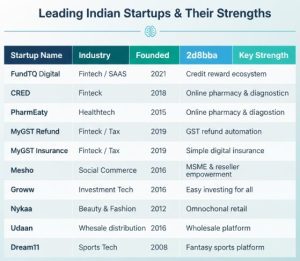
Top Indian Startups

Approximate Funding Raised by Top Indian Startups (in USD)

Funding Raised by Top Indian StartupsWhat These Startups Have in Common — and What Founders Can Borrow
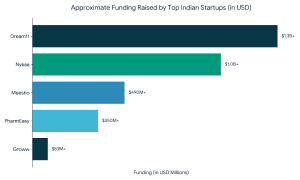
Each company below solved a real market gap, built trust at scale, and used capital as a strategic tool. The strongest patterns are clear: category focus, sharp customer insight, strong distribution, clean cap tables, sector-specific investors, and founders who treated fundraising as a structured process rather than a last-minute activity.

Building a Startup and Planning Your Next Fundraise?

Many of India’s fastest-growing startups prepared for fundraising long before approaching investors. Strong financial models, investor-ready pitch decks, clean cap tables, and a clear growth story often make the difference between a successful raise and months of wasted outreach.

Explore FundTQ’s Startup Fundraising Advisory, Valuation Support, and Pitch Deck Services to understand how investors evaluate growing companies.

get funding for startup

Top 10 Startups in India

1. CRED
2. Groww
3. Zerodha
4. Razorpay
5. Zepto
6. Nykaa
7. Meesho
8. Udaan
9. Lenskart
10. Dream11

Most Successful Startups in India

The most successful startups in India are companies that have achieved large-scale adoption, sustainable revenue growth, and strong investor confidence. Examples include Zerodha, Nykaa, Groww, Razorpay, and CRED.

Startup Companies in Bangalore

Bangalore remains India’s startup capital. Leading startup companies in Bangalore include:

– Razorpay
– Groww
– CRED
– Zerodha
– Udaan
– PhonePe
– Slice
– Jupiter

Emerging Startups in India to Watch

Alongside established unicorns, several emerging startups are attracting attention from investors, customers, and strategic acquirers.

Some notable emerging Indian startups include:

  • Sarvam AI

  • Krutrim

  • Skyroot Aerospace

  • Agnikul Cosmos

  • BluSmart

  • Juspay

  • Niramai

  • The Good Glamm Group

These startups operate in high-growth sectors such as artificial intelligence, climate technology, space technology, fintech infrastructure, and digital healthcare. Many are expected to play a significant role in shaping India’s next generation of innovation.

Successful Startup Founders in India

Many of India’s leading startups are built by founders who identified large market opportunities and executed consistently over long periods.

Some of the most influential startup founders in India include:

  • Nithin Kamath (Zerodha)

  • Falguni Nayar (Nykaa)

  • Kunal Shah (CRED)

  • Harshil Mathur (Razorpay)

  • Aadit Palicha (Zepto)

  • Peyush Bansal (Lenskart)

  • Bhavish Aggarwal (Ola)

  • Lalit Keshre (Groww)

These founders are frequently studied by entrepreneurs because of their ability to scale businesses, attract investment, and create long-term enterprise value.

FAQs – Frequently Asked Questions

1.Which startup is number 1 in India?
There is no single number one startup in India. Companies such as Zerodha, Razorpay, CRED, Groww, Nykaa, and Zepto are considered among the most successful startups based on revenue, market leadership, innovation, and customer adoption.

2. What are the top 10 startups in India?
Some of the top startups in India include CRED, Groww, Zerodha, Razorpay, Zepto, Nykaa, Meesho, Udaan, Lenskart, and Dream11.

3. Which startup sectors are growing fastest in India?
Artificial intelligence, fintech, SaaS, healthtech, climate technology, electric vehicles, and quick commerce are among the fastest-growing startup sectors in India.

4. Which city is known as the startup capital of India?
Bangalore is widely considered the startup capital of India because it hosts thousands of startups, venture capital firms, accelerators, and technology companies.

5. How do Indian startups raise funding?
Indian startups typically raise capital through angel investors, venture capital firms, family offices, strategic investors, government schemes, and private equity funds.

6. What makes a startup successful?
Successful startups usually combine strong product-market fit, scalable business models, effective customer acquisition, financial discipline, and strong leadership teams.
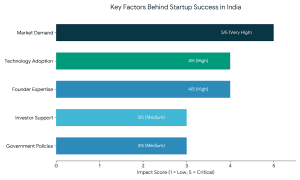
 
Startup Success in India

Raising Capital for Your Startup?

The startups featured in this guide did not grow through funding alone. They combined strong execution with the right capital strategy.

If you’re preparing for a seed round, Series A, growth capital raise, acquisition, or strategic partnership, FundTQ helps founders with:

✓ Investor readiness assessment
✓ Startup valuation
✓ Financial modelling
✓ Pitch deck preparation
✓ Investor outreach strategy
✓ Fundraising and M&A advisory

Speak with the FundTQ team to understand the most suitable funding path for your business stage.

get startup funding
Summary

What these startups have in common isn’t just scale — it’s intentionality. They raised smart, built defensible businesses, and treated capital as a tool rather than a goal. The startups above didn’t get there by accident. Behind almost every successful raise or exit is a team that understood the capital markets, ran a tight process, and walked into investor conversations fully prepared.

——————————————-
If you’re a founder thinking about your next equity raise, acquisition, or strategic exit — FundTQ’s advisory team has structured 200+ transactions across consumer, healthcare, and industrial sectors.
Talk to our team about what the right process looks like for your business.

CONTACT US

funding for D2C Beauty Brands

Funding for D2C Beauty Brands: What Founders and Investors Need to Know in 2026–2027

By the FundTQ Advisory Team : Ranked among India’s Top 5 investment banks by Venture Intelligence, with partners from IIT Delhi, KPMG, PwC, and EY. We’ve advised consumer brands across beauty, wellness, and FMCG on equity raises from ₹35 Cr to ₹300 Cr.

Bottom Line Up Front:
Capital is available for D2C beauty brands in 2026–2027 — but only for founders who demonstrate financial discipline, authentic differentiation, and unit economics that actually work. This guide cuts through the noise and tells you exactly what investors want to see, what metrics matter, and how to raise successfully at every stage.

The State of D2C Beauty Funding Right Now

The global beauty and personal care market is projected to reach $800 billion by 2028. Therein, direct-to-consumer beauty is among the most vigorously financed consumer verticals but the regulations have changed since the 2019-2022 funding craze.

global beauty market growth projection to 800 billion by 2028Post-ZIRP reality check:

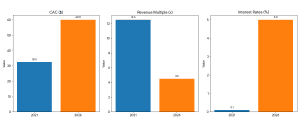
  • CAC on Meta and Google doubled or tripled following iOS 14.5 privacy alterations.
  • Interest rates had risen to 5%+, making inventory financing costly.
  • Investors abandoned growth-at-all costs to unit economics discipline.
  • Compression of revenue multiples – the 10x-15x ARR values of 2021 have disappeared.

venture capital shift from growth at all costs to profitability after 2021The brands in the closing round today have three characteristics in common: a brand story that can be defended, a healthy repeat customer, and a founder who can discuss their numbers fluently. In that case, capital is at your disposal.
Funding Stages: What’s Expected at Each Level

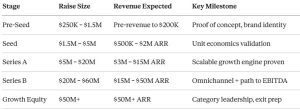
Funding Stages

The honest truth about seed in 2026: It is hard to find pre-revenue beauty brands that raise institutional seed capital. Investors desire 6-12 months of sales information that portrays that actual customers purchase, re-buy and refer. A beautiful brand with no customers would be more fundable than even 300K in revenue with a 35 percent 60-day repurchase rate.

The 5 Metrics That Make or Break Your Fundraise

1. Customer Acquisition Cost (CAC)
Formula: Total Sales & Marketing Spend ÷ New Customers Acquired

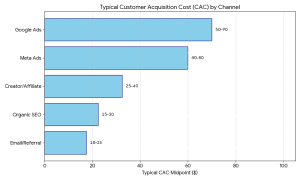
For a product with ₹40–80 AOV, a defensible CAC is ₹30–80. In case of beauty brands on Meta/Google in 2026. Above $100 CAC on sub-$50 AOV? That’s a structural red flag. The highest-ranking brands also exhibit a decreasing blended CAC with organic channels (creator affiliate, email, referral, SEO) increasing in the size of the acquisition.

d2c beauty customer acquisition cost by marketing channel2. Customer Lifetime Value (LTV)
Formula: AOV × Purchase Frequency × Customer Lifespan × Gross Margin

Don’t show projected LTV. Display real cohort data – how customers who got 6,12 and 18 months ago are really performing. Investors do not put much trust in modeled LTV; cohort evidence is what gets deals to get done.

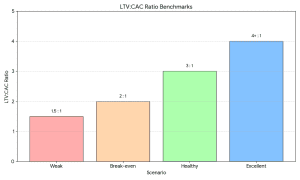
3. LTV:CAC Ratio — The North Star

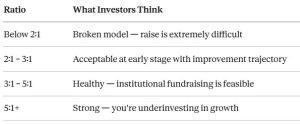
LTV:CAC Ratio

ideal ltv cac ratio benchmark for d2c brands4. Gross Margin
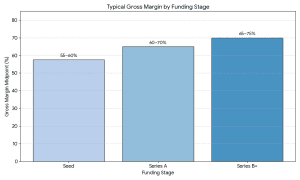
Beauty brands should target:

  1. Seed stage: 55–60%
  2. Series A: 60–70%
  3. Series B+: 65–75%

gross margin benchmarks for venture backed beauty brandsThe automatic pass of most institutional investors is below 50% gross margin. It is no longer possible to have the room to finance acquisition, overhead and profitability at the same time.

5. Contribution Margin
Formula: Revenue – COGS – Variable Marketing – Variable Fulfillment

This is the most honest signal of economic health. A brand can show 65% gross margin but negative contribution margin if CAC and fulfillment are excessive. Series A investors in 2026 expect contribution margin positivity — ideally 15–25% per order.

—————————————————-

Not sure how your metrics stack up against investor benchmarks?
FundTQ’s team has reviewed hundreds of D2C beauty pitch decks.

CONTACT US
What Investors Actually Evaluate: The 4-Pillar Framework

Pillar 1: Brand Differentiation
The most widespread investor pass of all: “Why should this brand exist, and why can we have it in 18 months at Sephora as the house brand? What forms a genuine moat: proprietary formulation, clinical efficacy information, the genuine founder-to-consumer relationship, and an owned (email, SMS, subscription) rather than rented (Instagram followers) community.

Pillar 2: Unit Economics Health
Covered above. The brief one: you cannot march through your CAC, LTV, gross margin, and contribution margin without memorizing it, cohort data to support it, then you are not prepared to have an institutional conversation.

Pillar 3: Team and Operational Capability
Beauty is an operations company. Brands that have been developed through marketing are killed by supply chain failures, stockouts and 3PL disasters. Investors seek founders which have real CPG or beauty operating experience, or a team that fulfill those gaps in a credible way.

Pillar 4: Market Size and Exit Optionality
No VC would be investing in a brand that is a peak of 15M in revenue. Investors are underwriting a journey to strategic purchase (L’Oréal, Unilever, Shiseido, Estee Lauder, P&G) or category leadership at scale. The question your pitch should respond to is: Who will be buying this brand, and at what price, in 5-7 years?

Skincare Pitch Deck
Funding Sources: Matching Capital to Your Stage

1. Angel Investors and Pre-Seed

The most outstanding beauty angels are former beauty executives, CPG operators, and founders that have already left. They come with capital and distribution relationship, introduction of retail and formulation credibility.

Location: Cosmoprof North America, CEW events, BeautyMatter NEXT, AngelList syndicates, warm LinkedIn introductions with current portfolio founders.

2. Seed VCs Active in Beauty

At seed, Forerunner Ventures, CircleUp Growth Partners, XRC Labs, and consumer-themed micro-funds are the most active. The trick here is to reach investors with a current portfolio consisting of brands adjacent to yours – evidence that they have a thesis consistent with yours.

3. Series A/B Funds

The active Series A/B investors in beauty and personal care include Prelude Growth Partners, Alliance Consumer Growth, Stripes Group, General Catalyst (consumer), and New Enterprise Associates.

4. Strategic Corporate Investors

Various conglomerates have venture arms, which invest and open doors:

  1. Unilever Ventures personal care and wellness, seed to growth.
  2. L’Oréal BOLD – disruptive brand innovation and beauty technology.
  3. Shiseido Ventures (SBVC)skincare startup and beauty innovation.
  4. LVMH Luxury Ventures – high and luxury beauty positioning.

A major warning: Strategic investment with L’Oréal could dilute your alternatives with other acquirers such as Estée Lauder or Unilever. Know the strategic implications prior to signing.

Also Read: Startup Funding in India: A Complete Guide

5. Non-Dilutive Alternatives Worth Knowing

Revenue-Based Financing (RBF): Clearco, Wayflyer, Pipe, and Capchase are offering $100K-5M at a percentage of monthly revenue. Ideally applicable to inventory financing and performance marketing scale-up not general working capital. APR must be effective greater than 60; it should only be deployed in high-ROI, short-payback applications.

Purchase Order Financing: PO financing is offered to brands launching in Sephora, Ulta or Target with a substantial initial PO so that you can fund production along a confirmed purchase order and still the equity is not diluted. One of the most important tools beauty founders realize when it is too late.

A Note for Indian D2C beauty founders:

The investor landscape in India has its own layer. Funds like Fireside Ventures, Sixth Sense Ventures, Sauce.vc, and Sharrp Ventures are actively backing Indian beauty and personal care brands at seed to Series A. Strategic acquirers like Emami, Marico, Dabur, and HUL are also increasingly pursuing acquisition-led growth in the BPC category — as seen in transactions like Emami’s acquisition of Axiom Ayurveda (advised by FundTQ). If you’re raising ₹5 Cr to ₹100 Cr, the playbook looks slightly different — and that’s where a sector-focused advisory firm adds real value.

get startup funding
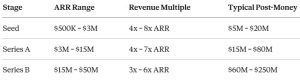
Valuation Reality Check: 2026–2027 Benchmarks

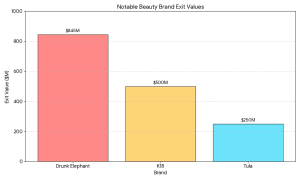
major beauty brand acquisitions drunk elephant k18 tulaLTV:CAC Ratio

Valuation premium drivers: Subscription revenue of above 30% of mix, gross margin of above 65, proprietary formulation or IP, founder exit history, and omnichannel presence have significant multiple premiums.

Contextual exits Similar exits in the recent past:

  1. K18 → Unilever (2023): $500M+ -disciplined unit economics, scale quickly.
  2. Tula → Procter & Gamble (2022): ~$250M+
  3. Drunk Elephant→ Shiseido (2019):~845M, 10x revenue.

It is these that the investors are simulating when they consider your brand.

What This Looks Like in Practice: FundTQ-Advised Deals

We don’t just advise on beauty fundraises — we’ve closed them.

Secret Alchemist — Growth Capital Raise Secret Alchemist: The clean beauty brand co-founded by actor Samantha Ruth Prabhu, successfully raised growth capital with FundTQ as advisory partner. The round was backed by Unilever Ventures and DSG Consumer Partners — two of the most respected consumer-focused funds globally. This deal reflects exactly what institutional investors reward: a founder-driven brand with authentic differentiation, credible clinical positioning, and a defensible community.

Emami × Axiom Ayurveda — Majority Stake Acquisition: FundTQ advised on Emami’s majority stake acquisition in Axiom Ayurveda, a fast-growing ayurvedic personal care brand. This transaction is a textbook example of strategic exit optionality — a founder-built brand becoming acquisition-ready for a listed FMCG major within a few years of scale.

———————————-
If you’re building a beauty or personal care brand and thinking about your next capital raise — or eventual exit.

CONTACT US
The Fundraising Playbook: 3 Things That Separate Closers from Pitchers

1. Prepare for 90 Days Before Your First Investor Conversation
People who put in the effort to close rounds fast are founders who are planning to raise money like a product launch, and not improvisation.

  • Recalculate P&L with contribution margin visibility.
  • Create tables of cohort analysis (by month of acquisition, 6/12/18 months out)
  • Calculate CAC channel by channel rather than blended.
  • Prepare a 24-month cash flow base/bull/bear.
  • Diligence Prepare genuine responses to the 10 most difficult questions.

2. Target Investors With Thesis Precision

The quickest way to 60 rejections and a de-motivated founder is a spray-and-pray approach to reaching out to investors. Each outreach should respond: Does this fund have a consumer thesis? Have they made previous investments in beauty? Is the amount and level of my stage and check size appropriate to their fund? Half the number of targeted warm-introduction outreaches will beat 200 cold emails every time.

3. Create Competitive Dynamics — Don’t Negotiate in a Vacuum
Investors act when they are in a hurry. Organize a process with a set-out date. Get several investors interested at the same time, not in different stages. Be open concerning competitive interest. The commitment by a lead investor promotes all the subsequent conversations between co-investors.

5 Fundraising Mistakes That Kill Beauty Rounds

  1. Starting investor conversations before your data is ready. First impressions in venture are durable. Wait until your traction is undeniable.
  2. Raising at 2021-era valuations. Investors know the comps. Overpriced rounds stall or die.
  3. 90%+ paid acquisition dependency. If your entire growth engine is Meta/Google, one algorithm change ends the business. Investors model this risk heavily.
  4. No cohort analysis. Asking for a Series A without cohort data is like asking for a mortgage without a credit score.
  5. Underestimating the timeline. Seed rounds take 3–6 months. Series A takes 4–9 months. Founders running on 60 days of runway negotiate from desperation — and investors know it.

————————————————————-

Raising in the next 6–12 months? Most founders reach out too late.
If you’re building a D2C beauty or personal care brand and targeting ₹5 Cr to ₹100 Cr,
let’s have an early conversation — no pitch deck required to start.

CONTACT USQuick-Reference FAQ

Q. How much should I raise at seed?
1.5M to 5M, in size to allow you 18-24 months to achieve Series A-ready performance (5M-10M ARR, 3:1+ LTV:CAC, 60-percent gross margin).

Q. Do I need retail before raising a Series A?
No – but a signed retail term sheet makes the story count in a real sense. Retail growth that is unplanned and places stress on working capital is a warning as opposed to a qualification.

Q. What gross margin do I need for institutional investors?
55% to be in conversation; 60% needs to be taken seriously at Series A.

Q. How do investors evaluate a beauty brand’s moat?
There are four dimensions, which include: formulation defensibility, brand equity depth (owned community, not rented followers), distribution advantage, and founder authenticity.

Q. Should I use a placement agent for my raise?
For seed and Series A, run it yourself with strong advisors. Placement agents impose some real value on Series B+ ($25M+) where process complexity warrants the fee of 3-5%.

The Bottom Line

D2C beauty is among the most attractive consumer investment categories in 2026-2027 – the fundraising environment rewards preparation, financial fluent, and genuine differentiation. Investors will find capital founders who have a command of their unit economics as well as brand narrative, who create owned communities and not rented audiences and who come to investors with conviction supported by data.

——————————————-

The ones who do not will realize that a beautiful brand and an excellent founder story is no longer sufficient.
If you’re ready to raise the right way, FundTQ is ready to help.

get funding for startuo

funding for e commerce business

Funding for eCommerce Business: A Complete Guide from an Investment Banking Perspective

The global eCommerce industry is expanding rapidly. With worldwide online retail sales projected to cross trillions annually, entrepreneurs are rushing to build digital-first brands. However, the biggest challenge most founders face is funding for e commerce business growth.

My experience of 8+ years working in an investment banking organization that advises startups, investors, and corporate clients has provided me with insights on how the proper funding plan can make a small eCommerce startup a scalable brand. Conversely, I have also witnessed some good businesses that failed just because they selected the wrong funding structure.

Global eCommerce industry growthThe following is a comprehensive guide on how to raise capital on an eCommerce business, which entails the sources of funds, the expectation of investors, strategies of valuation, and steps that can be taken to raise capital effectively.
Understanding Funding for eCommerce Business

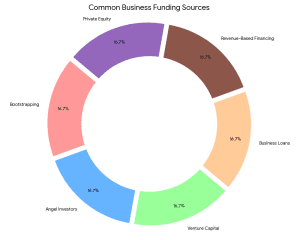
ECommerce Funding refers to the process of raising funds to initiate, run or expand an online store. The sources of this funding might include:

  1. Bootstrapping
  2. Venture capital
  3. Angel investors
  4. Startup business loans
  5. Revenue-based financing
  6. Private equity
  7. Strategic acquisitions

The eCommerce business, as opposed to the traditional retail, needs capital on digital marketing, inventory, logistics, technological infrastructure, and customer acquisition.

In investment banking terms, the three most fundable eCommerce startups have exhibited the following aspects:

  • Scalable business model
  • Strong unit economics
  • Clear growth strategy

Investors would like to know the rate at which a business can transition between acquiring customers and becoming profitable.

Why eCommerce Businesses Need Funding

Funding marketing, software tools, branding is also necessary even in dropshipping business.

Major Areas of Funding Application.

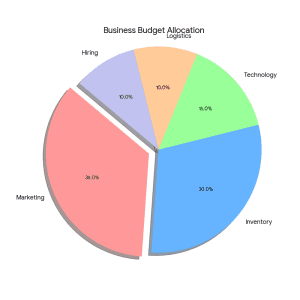
eCommerce startup cost breakdown1. Inventory Procurement

The majority of eCommerce companies demand initial capital on suppliers and manufacturers.

2. Digital Marketing

Customers acquisition in terms of:

  • Paid ads
  • Influencer marketing
  • SEO
  • Social media campaigns

Frequently constitutes 30-40% of start up expenses.

3. Technology Infrastructure

This includes:

  • Development of eCommerce platform.
  • Payment gateways
  • CRM systems
  • Analytics tools

4. Logistics & Fulfillment

Warehousing, packaging and shipping systems need operational capital.

5. Hiring & Team Expansion

Scaling needs experts in:

  • Marketing
  • Operations
  • Product development
  • Customer support

Most eCommerce startups find it difficult to grow past initial traction unless adequately funded.

Types of Funding for eCommerce Businesses

different funding sources for eCommerce startupsUnderstanding the different funding sources for eCommerce startups helps founders choose the right capital strategy.

1. Bootstrapping (Self-Funding)

Bootstrapping refers to the process of using personal savings or initial revenue to build your business.

Advantages:

  • Full ownership
  • No investor pressure
  • Financial discipline

Disadvantages:

  • Limited scalability
  • Slower growth

Bootstrapping is most effective with low inventory eCommerce or digital product models.

2. Angel Investors

Angel investors are wealthy individuals who invest in startups.

They typically invest: $25,000 – $500,000

eCommerce startups usually start with first external financing by the angel investors.

What Angels Look For

  • Strong founder story
  • Product-market fit
  • Scalable business model
  • Clear growth strategy

Free Pitch Deck Templates can be extremely helpful when founders are going to pitch their business to angel investors.

3. Venture Capital for eCommerce Startups

Venture capital firms make investments in the high growth eCommerce companies that have big market potential.

Typical VC investments: $500K – $10M+

VCs focus on businesses with:

  • Rapid customer growth
  • High lifetime value (LTV)
  • Strong brand positioning

It is important to have an organized startup fundraising plan and investor-ready pitch deck in order to attract venture capital.

4. Startup Business Loans

Another funding source is business loans.

These include:

  1. Bank loans
  2. SBA loans
  3. Fintech lending platforms
  4. Working capital loans

Advantages

  • Retain equity
  • Predictable repayment

Disadvantages

  • Interest payments
  • Documents and rigorous eligibility.

ECommerce models that are inventory-intensive and with predictable revenue benefit well with business loans.

5. Revenue-Based Financing

Revenue based financing is a method that enables startups to pay investors a percentage of the monthly revenue.

Benefits include:

  • No equity dilution
  • Flexible repayment

This model is used in the popular DTC (Direct-to-Consumer) brands.

6. Private Equity Funding

PE firms invest in the existing eCommerce firms that have a proven revenue base.

Typical requirements:

  • $5M+ revenue
  • Strong EBITDA margins
  • Scalable infrastructure

Such companies tend to offer funds and strategic direction and operational enhancements.

7. Mergers & Acquisitions

Most successful eCommerce brands ultimately attract capital by means of strategic acquisition or mergers.

Merger and acquisition services to founders assist:

  • Identify buyers
  • Negotiate deal structures
  • Maximize company valuation

It is typical of brands that are sold on Amazon, Shopify, or DTC.

How Investors Evaluate eCommerce Startups

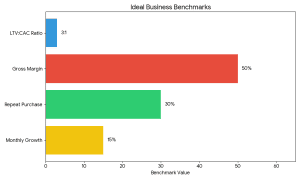
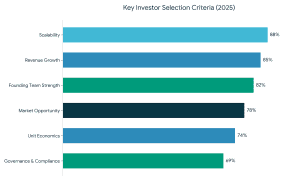
investors evaluate in eCommerce startupsAs someone involved in investment banking services, I can confirm that investors evaluate startups using several critical metrics.

  1. Customer Acquisition Cost (CAC).
    CAC is an indicator of the cost of a customer.
    Reduced CAC enhances profitability and investor confidence.
  2. Lifetime Value (LTV)
    LTV represents all the revenue made by a customer.
    Investors would like businesses that have:
    LTV : CAC ratio ≥ 3
  3. Gross Margin
    Startups can reinvest because of high margins. Ideally, 50%+ gross margins in eCommerce businesses are desired by most investors.
  4. Repeat Purchase Rate
    Good brand loyalty enhances sustainability of business.
  5. Market Opportunity
    The TAM is analyzed by the investors when it comes to long-term scalability.

How to Prepare for eCommerce Startup Fundraising

Successful startup fundraising requires preparation and strategic positioning.

Step 1: Build a Financial Model

An effective financial model must have:

  1. Revenue projections
  2. Cost structure
  3. Cash flow forecasts
  4. Unit economics

Business valuation software can be used to enable founders to estimate company value appropriately.

Step 2: Design an Attractive Pitch Deck.

A good pitch deck must consist of:

  1. Problem & solution
  2. Market opportunity
  3. Business model
  4. Traction
  5. Financial projections
  6. Funding requirements

A great number of founders begin with free pitch deck templates and edit them to suit investors.

Step 3: Find the Valuation of Your Business.

Valuation depends on:

  1. Revenue growth
  2. Market potential
  3. Profit margins
  4. Competitive advantage

Start up eCommerce ventures are normally assessed at:

  • Revenue multiples
  • Similar analysis of the company.
  • Discounted cash flow models

Step 4: Find the Right Investors.

All investors do not invest in eCommerce.
Target investors that specialize in:

  • DTC brands
  • Retail tech
  • Consumer startups

The advisors in investment banking usually assist founders to meet with the relevant investors.

Step 5: Establish Investor Relationships.

Fundraising is not a pitching thing only.
Effective founders are concerned with:

  • Developing investor relations.
  • Consistent traction is shown.
  • Reporting progress on a periodic basis.

Common Mistakes eCommerce Founders Make While Raising Funds

Over the years, I have seen many startups fail in the fundraising process due to avoidable mistakes.

  1. Overvaluing the Business
    Delusional valuations drive away the investors.
  2. Weak Financial Projections
    Investors will not accept guesses but projections based on data.
  3. Poor Pitch Deck
    With an ineffective pitch deck, it may be rejected at the first sight.
  4. Ignoring Unit Economics
    Most founders are driven by their revenues without paying attention to profitability measures.
  5. Attacking the wrong Investors.
    One of the least considered factors of start-up fundraising is investor targeting.

Expert Tips for Raising Funding for an eCommerce Business

Based on my experience advising founders and investors, here are practical strategies:

1. Target Brand Differentiation.
Investors are rarely interested in generic stores.
Create a good brand story and product differentiation.

2. Demonstrate Early Traction
Even small metrics help:

  1. 5,000+ customers
  2. $10K monthly revenue
  3. Strong repeat purchase rate

3. Optimize Unit Economics
Demonstrate to the investors that you have a business that can be scaled and profitable.

4. Leverage Strategic Advisors.
Cooperation with companies that provide investment banking services can assist startups:

  1. Structure deals
  2. Negotiate valuation
  3. Access investor networks

The Future of eCommerce Funding

The funding landscape for eCommerce startups is evolving rapidly.

Key trends include:

  • Emergence of revenue-based financing.
  • Greater emphasis on profitable expansion.
  • Expansion of Amazon brand aggregators.
  • Artificial intelligence business valuation software.
  • Investment in cross-border eCommerce.

Modern investors focus on sustainable growth rather than aggressive growth.

Conclusion

Funding an eCommerce business is not just about raising capital — it is about choosing the right financial strategy to support long-term growth. Entrepreneurs who prepare strong financial models, create compelling pitch decks, and demonstrate solid unit economics significantly improve their chances of securing investment.
From my experience in investment banking services and startup advisory, the most successful founders treat fundraising as a strategic process rather than a one-time event. By combining the right funding sources with strong execution, eCommerce entrepreneurs can build scalable, high-value digital brands.

Get business Funding
Frequently Asked Questions (FAQ)

Q. How do I get funding for an eCommerce startup?
You may raise funds by:

  1. Angel investors
  2. Venture capital firms
  3. Startup business loans
  4. Revenue-based financing
  5. Crowdfunding

An excellent startup funding plan and pitch deck will greatly enhance the chances of being funded.

Q. Can I get a business loan for an eCommerce business?
Yes. Most of the banks and fintech lenders provide startup business loans to eCommerce based businesses, particularly where a company has consistent revenue or inventory assets.

Q. What do investors look for in an eCommerce startup?
Investors usually consider:

  1. Customer acquisition cost (CAC)
  2. Lifetime value (LTV)
  3. Gross margins
  4. Market size
  5. Growth potential
  6. Brand differentiation

Q. How much funding do eCommerce startups need?

The start-up eCommerce ventures generally raise between:
Between 50,000 and 2 million dollars based on inventory needs and marketing costs.

Q. What is the best funding option for eCommerce businesses?

The best funding option depends on your business stage:

  • Bootstrapping → early stage
  • Angel investors → product validation
  • Venture capital → scaling
  • Business loans → inventory expansion
  • Private equity → large-scale growth

Q. How do I value my eCommerce startup?

You can calculate valuation based on:

  1. Revenue multiples
  2. Similar company profile.
  3. Discounted cash flow models
  4. High-end business valuation software.

Investment Banking Firm in Mumbai

Expert Investment Banking Services in Mumbai for Growing Businesses [2026]

When growth is no longer optional but essential, choosing the right Investment Banking Firm in Mumbai can redefine your company’s trajectory. Whether you’re a high-growth startup, an established SME, or a mid-market enterprise preparing for expansion, structured capital advisory and strategic financial planning are critical. Mumbai, being the financial capital of India, is home to some of the most sophisticated deal-makers, institutional investors, private equity firms, venture capital networks, and corporate strategists. But real value lies not in access — it lies in execution.

As professionals with 8+ years of experience in investment banking advisory, capital structuring, and transaction execution, we understand what investors evaluate, how valuations are negotiated, and what makes a deal close successfully.

key investor evaluation criteria for funding
Why Choose an Investment Banking Firm in Mumbai?

A well known Investment Banking Firm in Mumbai has much more than fundraising to offer. It delivers:

  • Strategic capital advisory
  • Organisational investor access.
  • Transaction structuring
  • Compliance and regulatory advice.
  • Support of risk mitigation and due diligence.
  • Correlation of long-term financial strategies.

In the current competitive funding environment, founders and promoters require more than introductions, they require positioning, credibility and bargaining skills.

Comprehensive Investment Banking Services

Modern businesses require multidimensional advisory. Our structured investment banking services.

1. Capital Raising (Equity & Debt)

We help businesses secure:

  • Venture Capital funding
  • Private Equity investments
  • Growth capital
  • Structured debt
  • Mezzanine financing
  • Bridge funding

It is not only about pitching in capital raising.
It involves:

  • Investor targeting strategy.
  • Financial modelling
  • Valuation positioning
  • Negotiation management
  • Term sheet structuring

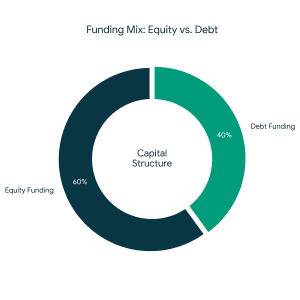
equity funding and debt funding options for businesses in Mumbai2. Startup Fundraising Advisory

The Mumbai startup ecosystem is thriving in the fintech, SaaS, healthtech, D2C, and manufacturing fields. Startup fundraising under professional advice will secure:

  • Powerful financial narration.
  • Investor-ready documentation
  • Moderate expectations on valuation.
  • Clean cap table structuring
  • Data room preparation

Investors do not finance ideas, business they finance are scalable, defensible and well positioned.

3. Business Valuation & Financial Modeling

A reliable business valuation generates credibility and confidence in the process of negotiation. We apply globally methods:

  • Discounted Cash Flow (DCF)
  • Similar Company Analysis.
  • Precedent Transactions
  • Asset-based valuation
  • Multiple bench-marking of revenue.

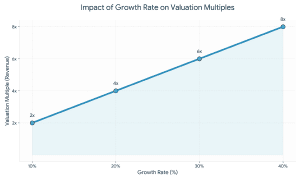
Valuation is science and strategy. Overvaluation kills deals. Under-valuation watered down founders. Precision matters.

revenue growth rate and business valuation multiple4. Investor-Ready Pitch Deck Strategy

The investor presentation will be a deciding factor as to whether you have a second meeting. Professionally created pitch deck designs. And traditional storytelling models assist in the expression of:

  • Market opportunity
  • Unique value proposition
  • Financial projections
  • Competitive advantage
  • Scalability roadmap
  • Exit strategy

Transparency generates investor confidence.

Mumbai Advantage: Strategic Financial Hub

The Investment Banking Firm is based in Mumbai and is an operating organisation:

  • Close access to institutional investors.
  • Direct access to the entities that are regulated by SEBI.
  • Strong PE & VC networks
  • M&A advisory ecosystem
  • Corporate legal expertise

Mumbai is not a place, it is a competitive edge.

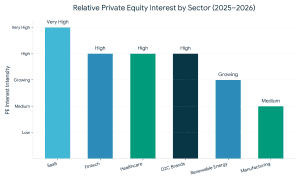
Industries We Serve

We work with high-growth sectors including:

  1. Fintech & NBFC
  2. SaaS & Technology
  3. Healthcare & Pharma
  4. Manufacturing & Engineering
  5. Consumer Brands & D2C
  6. Infrastructure & Real Estate
  7. Renewable Energy

high growth sectors attracting private equity investment in MumbaiEach sector demands specialized financial structuring, risk assessment, and investor mapping.

Our Capital Raising Process

Our approach is characterized by transparency and structure:

1: Strategic Assessment
We assess business model feasibility, scalability, and financial preparedness.

2: Financial Structuring
Valuation modeling, capital structuring and projections.

3: Documentation and Data Room.
Investment memo, pitch deck, financial model and compliance documents.

4: Investor Outreach
Specific focus on harmonized investors.

5: Negotiation & Closure
Review of term sheet, valuation adjustment, management of due diligence, and closing of deals.

The implementation discipline divides between successful and unsuccessful raises.

What Makes Us a Leading Investment Banking Firm in Mumbai?

  • Deep Market Insight
    Knowing the investor psychology and capital trends.
  • Transaction Experience
    Practical implementation at primorial, growth and pre-IPO financing
  • Structured Approach
    Evidence-based, risk-handicapped guidance.
  • Long-Term Strategic Thinking.
    We focus funding strategy on a 3 to 5 year vision of growth.
  • E-E-A-T Driven Advisory
    The buzzwords do not include Experience, Expertise, Authoritativeness or Trustworthiness but they are deal-critical.

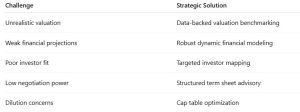
Common Challenges in Fundraising (And How We Solve Them)

Challenges in Fundraising

Capital raising is not transactional — it is transformational.

When Should You Approach an Investment Banking Firm?

Advisory support should be considered when:

  • Series A / Series B funding planning.
  • Diversifying operations across India or the world.
  • Getting ready to fund with private equity.
  • Assessing mergers or acquisitions.
  • Restructuring debt
  • Preparing for IPO roadmap

Planning ahead will go a long way in enhancing funding performance.

Future of Investment Banking in Mumbai

As India emerges as a global growth powerhouse, the financial ecosystem of Mumbai is experiencing:

  • Increase in international transactions.
  • More inflows of private equity.
  • Growth of the ecosystem of startups.
  • Venture funds that are sector-oriented.
  • Strategic M&A consolidation

trend of private equity and venture capital investments in MumbaiIt will not be any ordinary Investment Banking Firm in Mumbai that will simply raise capital, but will instead place your business in a position to achieve long-term enterprise value creation.
Final Thoughts

Growth capital is fuel — but strategic advisory is the engine.
By having an established Investment Banking Firm in Mumbai, you are not merely raising money, but creating valuation, good governance and scaling up in the long term. When you are about to plan your next round of growth, institutional financing, or strategic growth, then it is the correct moment to plan your capital journey in a professional manner.

Need more capital, or want to value your business? Collaborate with specialists with number, negotiating, and creating long-term value expertise.

Get business Funding

Frequently Asked Questions (FAQs)

1. What does an Investment Banking Firm in Mumbai actually do?
A Mumbai based Investment Banking Firm assists businesses to raise capital (equity or debt), manage mergers and acquisitions, business valuation, structure deals and introduce businesses to institutional investors such as VCs, PE funds and NBFCs.

2. When should I hire an investment banking firm?
When you are planning, you ought to hire one:

  • Startup fundraising
  • Growth capital raise
  • Private equity funding
  • Debt restructuring
  • M&A transactions
  • Pre-IPO preparation

Pre-due diligence enhances the negotiation and valuation.

3. How long does it take to raise funds?
Normally 3-6 months, based on:

  • Business readiness
  • Financial documentation
  • Valuation expectations
  • Market conditions
  • Investor alignment

Estimates with timelines that have been properly prepared are also a large saving of time.

4. How is business valuation calculated?
The methods used in professional business valuation include:

  • Discounted Cash Flow (DCF)
  • Similar analysis of the company.
  • Revenue or EBITDA multiples
  • Asset-based valuation

Valuation will be based on the potential to grow, profitability, industry standards, and the risk factors.

5. What documents are required for fundraising?
Key documents include:

  1. Financial forecast (3-5 years)
  2. Investor-ready pitch deck
  3. Cap table
  4. Compliance records
  5. Detailed business plan
  6. Data room documentation

Well-organized documentation develops trust in the investors.

funding-for-edtech-startup

Funding for EdTech Startup in India: How Founders Can Raise Capital in 2026

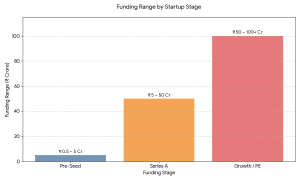
EdTech startup funding in India is the process of raising capital from angel investors, venture capital firms, and private equity to scale technology, marketing, and student acquisition for online learning or coaching platforms. In 2026, EdTech funding is disciplined. Investors reward profitability, sustainable customer acquisition cost (CAC), and retention metrics over vanity growth. Funding ranges from ₹50 lakh (pre-seed) to ₹100+ crore (growth stage) depending on revenue, traction, and EBITDA margins.

At FundTQ, we’ve structured 200+ EdTech fundraising transactions—from early-stage coaching institutes to acquisition-stage learning platforms. Our recent advisory on Emami’s ₹200 crore acquisition of Axiom Ayurveda demonstrates how disciplined EdTech platforms command premium valuations. This guide reflects real market dynamics and investor expectations from our deal experience.

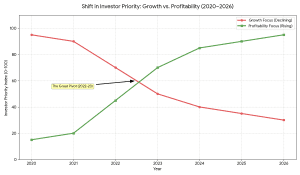
Why EdTech Funding in India Is Rebounding in 2026

EdTech investor trend India 2020 to 2026

The education technology market in India has reached a disciplined development phase. Following the aggressive growth era of Byju’s, Unacademy, and PhysicsWallah—where investors chased growth-at-all-costs—institutional capital has fundamentally shifted priorities.

Investors in 2026 now evaluate EdTech platforms on:

  • Sustainable profitability (not just user acquisition)
  • Healthy CAC economics (Customer Acquisition Cost < ₹2,000)
  • Durable retention (60%+ month-over-month retention)
  • Hybrid learning models (online + offline = defensible against pure-play competition)
  • AI-powered personalization (value prop in crowded market)

This reset opens the door for serious coaching institutes, organized online learning startups, and regional EdTech platforms to raise capital at favorable terms. Investors now reward discipline over hype.

How Much Funding Can an EdTech Startup Raise in India?

EdTech Startup Funding Stages in India 2026Early Stage (Pre-seed / Seed)
₹50 lakh – ₹5 crore
Focus: MVP, first traction, content creation.

Series A
₹5 crore – ₹50 crore
Focus: Tech + marketing up-scaling.

Growth / PE Stage
₹50 crore – ₹100+ crore
Focus: Growth, buy-overs, profitability.

How Investors Evaluate EdTech Startups: The 2026 Framework

Investor criteria for EdTech startup funding India

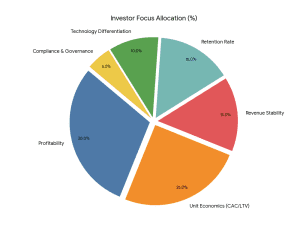
Before committing capital, institutional investors use a standardized 8-point evaluation framework. These metrics separate fundable EdTech startups from those that struggle to raise.

The 8 Core Investor Evaluation Metrics:

  1. Revenue Model Stability – Demonstrable, repeatable revenue with 3+ months of consistent data
  2. Student Acquisition Cost (CAC) – Cost to acquire one paying student; target is ₹500–₹2,000 depending on platform type
  3. Lifetime Value (LTV) – Total revenue per student over their lifetime; target is 3–5x CAC ratio
  4. Monthly Recurring Revenue (MRR) – Predictable, subscription-based revenue indicating sustainable unit economics
  5. EBITDA Margins – Operational profitability; investors target 20%+ for growth stage (vs. 40%+ for mature platforms)
  6. Retention Rate – Percentage of students continuing after month 1; industry benchmark is 60%+ (strong = 75%+)
  7. Technology Differentiation – Proprietary IP, AI-powered learning, unique pedagogy, or platform advantage competitors can’t replicate
  8. Regulatory & Governance Compliance – SEBI compliance for investment structures, data protection (DPDP Act), and consumer protection frameworks

EdTech Valuation Multiples: How Investors Price Your Platform

Understanding EdTech Valuation: Revenue Multiples vs. Profitability-Based Pricing

EdTech startup valuations in India hinge on two metrics:

For Pre-Revenue or Early Traction (0–₹1 Crore Revenue): Valuation = Investors’ discounted cash flow (DCF) projection at exit (typically 5-year horizon)

For Growth Stage (₹1–₹10 Crore Revenue): Valuation = 4x–6x annual recurring revenue (ARR)

For Profitability Stage (₹10+ Crore Revenue): Valuation = 6x–10x EBITDA (or 8x–15x ARR if EBITDA margin > 20%)
Example: ₹10 Cr EBITDA platform → ₹60–100 Cr valuation

The Axiom Ayurveda Case Study:

Emami’s ₹200 crore acquisition of Axiom Ayurveda reflects how disciplined EdTech platforms with:

  • 3-year profitability track record
  • 40%+ EBITDA margins
  • 70%+ customer retention
  • Clear exit synergies

…command premium multiples that exceed pure growth-stage expectations.

Why Investment Banking Services Matter for Valuation:

Founders often anchor to friendly comparables or benchmark themselves against loss-making unicorns. Our investment bankers conduct:

  1. Discounted cash flow (DCF) analysis calibrated to your growth stage
  2. Comparable transaction analysis (peer EdTech exits in last 24 months)
  3. Revenue multiple benchmarking (by geography, content type, audience)
  4. Cap table optimization to maximize founder ownership post-funding

The difference between a founder’s “expectation” and a market-backed valuation often costs 3–6 months and 10–20% ownership dilution.

Not sure if your valuation is market-backed? FundTQ’s free valuation tool gives you a quick benchmark in minutes. If you need a deeper dive—comparable analysis, DCF modeling, investor prep—our banking advisors can structure your raise for 15–30% better valuations.

Business Valuation Advisory for mid-market companies

EdTech startup investmentBuilding Your EdTech Pitch Deck: The 10 Essential Slides Investors Demand

Your pitch deck is your single most important fundraising asset. The best EdTech decks convert investor interest at 40%+ rate because they’re precise, data-driven, and emotionally compelling.

The Institutional-Grade EdTech Pitch Deck Structure:

  1. Cover Slide – Company name, mission, your name/title, date
  2. Problem & Market Opportunity – Why EdTech? Which segment (K–12, competitive exams, professional skills)? Market size validation
  3. Your Solution & Differentiation – What makes your platform different? (Pedagogy, technology, content, community model)
  4. Market Size (TAM/SAM/SOM) – Total addressable market, serviceable market, and YOUR realistic serviceable obtainable market
  5. Traction Metrics – Student count, monthly active users, revenue (if any), retention rate, NPS
  6. Unit Economics & CAC/LTV – Cost to acquire one student; lifetime value per student; blended CAC payback period
  7. Revenue Model & Growth – Subscription, per-course, blended pricing? Subscription ARR growth trajectory
  8. Technology Stack & Competitive Positioning – Why your tech matters; how you beat Byju’s, Unacademy, PhysicsWallah in your niche
  9. Financial Projections (3–5 Year) – Revenue, CAC, LTV, burn rate, path to profitability
  10. Fund Utilization Plan – How you’ll deploy capital (% to product, marketing, team, working capital)

Pro Tip: Institutions expect deck updates every 3 months as your traction evolves. Decks that don’t update signal stalled momentum.

Use FundTQ’s institutional pitch deck templates to ensure your 10-slide deck meets Wall Street formatting standards. Our templates include financial model integration and investor memo templates.

Role of Investment Banking Services in Startup Funding in India

Self-equity raises dilute valuation and slows down the process. Structured investment banking services include:

  1. Identification of strategic investors.
  2. Valuation advisory
  3. Financial modeling
  4. Term sheet negotiation
  5. Due diligence management
  6. Deal closure execution

It usually leads to valuation increase and accelerated funding cycles (3-6 months).

Who Should Raise Funding?

You should consider funding when:

  1. You are an online-expanding coaching institute.
  2. You are earning 1 crore and above in a year.
  3. You are EBITDA positive
  4. You want to scale nationally
  5. It is a LMS constructed using AI.
  6. You plan acquisitions

7-Step Process to Secure EdTech Funding in India

The EdTech fundraising process typically takes 3–6 months with structured advisors (vs. 8–14 months for founders solo). Here’s exactly how it works:

Step 1: Financial Structuring & Audit (Week 1–2)
Clean your financials. Prepare 36-month projections with realistic assumptions. Run an internal audit. Investors demand clean, audited accounts—this signals operational maturity.

Step 2: Valuation Strategy & Positioning (Week 2–3)
Determine your ask: ₹5 Cr? ₹25 Cr? ₹100 Cr? Your valuation isn’t what YOU think—it’s what investors believe your 5-year exit can support.

Step 3: Investor Identification & Targeting (Week 3–4)
Who funds EdTech at your stage?
Seed/Series A: Tiger Global, Sequoia India, Bessemer Venture Partners
Series B/Growth: Accel, Matrix Partners, Tiger Global follow-ons
PE/Growth Stage: Educap, Nexus Venture Partners, Bain Capital

We maintain real-time investor deployment data from 200+ completed EdTech transactions—this is where insider knowledge compounds your odds.

Step 4: Data Room Preparation (Week 4–5)
Organize everything investors will ask for in a secure, indexed data room:

  • Financial statements (P&L, balance sheet, cash flow, last 2 years + projections)
  • Cap table (fully diluted + options pool)
  • Board minutes & governance docs
  • Customer contracts & MSAs
  • IP ownership documents
  • KPI dashboard (monthly metrics for 24+ months)

Step 5: Investor Pitching (Week 5–8)
Pitch to 15–25 targeted investors. Expect 1–2 LOIs (Letters of Intent) for every 10 pitches.

Step 6: Term Sheet Negotiation (Week 8–10)
Investor makes you an offer. Negotiate valuation, board seats, liquidation preferences, anti-dilution clauses, and voting rights.

Step 7: Due Diligence & Closing (Week 10–12)
Investor’s lawyers verify everything. Then: wiring, stock transfers, board insertion. Funding hits your bank account.

Timeline: 12 weeks with structured advisors vs. 8–14 months for solo founder attempts.
Wondering which step your startup is at right now? Many founders skip Step 1 (financial structuring) and regret it later—messy numbers kill momentum at investor meetings. A quick 30-min roadmap call with our team clarifies your next move and realistic timeline.

get funding for startuo

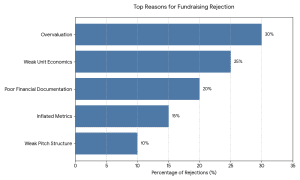
Common Mistakes EdTech Founders Make


Common mistakes in EdTech startup funding India

  • Overvaluation expectations
  • Weak unit economics
  • Inflated user metrics
  • Poor pitch structure
  • There was no distinct roadmap of profitability.

The investors in 2026 are more interested in cash flow discipline than vanity growth.

Caught yourself in one of these mistakes? You’re not alone. Founders we’ve advised often discover valuation errors or unit economics red flags during our first conversation—and fix them before pitching. A quick call costs nothing; missing them costs months.

GET BUSINESS FUNDING

FAQs: EdTech Startup Funding in India

Q. At what revenue stage should I start raising funding?
Most EdTech platforms begin formal raises at ₹50 lakh annual revenue with 30%+ month-over-month growth. If you’re EBITDA-positive at ₹1 Cr+, you’re in the prime Series A window.

Q. How long does EdTech fundraising typically take?
3–6 months with investment banking advisors; 8–14 months for founder-led raises. The difference: advisor-led processes have pre-qualified investor networks and structured timelines.

Q. What’s the difference between angel investors and VCs for EdTech?
Angels: Invest ₹50 lakh–₹2 Cr; expect mentorship from founder; slower decisions
VCs: Invest ₹5–₹50 Cr; demand growth 3x+ YoY; move faster with term sheets
PE: Invest ₹50 Cr+; focus on profitability + EBITDA margins; demand governance

Q. Can EdTech coaching institutes raise PE funding?
Yes. PE funds like Educap and Nexus Venture Partners focus on profitable coaching institutes with 40%+ EBITDA margins, scalable hybrid models, and clear acquisition exit paths.

Q. Is EdTech startup valuation negotiable?
Somewhat. Valuation anchors to comparable transactions (similar revenue, stage, geography). Growth rate, profitability, and investor demand create a 15–20% negotiation band.

Q. What are the biggest EdTech funding red flags investors avoid?

  1. Inflated user metrics without revenue proof
  2. CAC > LTV (unsustainable unit economics)
  3. Retention rates below 40% (churn = red flag)
  4. Messy cap tables with unclear founder control
  5. Weak financial records or unaudited accounts

Q. Should I bootstrap or raise funding for my EdTech startup?
Bootstrap if you’re pre-product or lifestyle business. Raise funding if you want to scale nationally, compete with well-funded platforms, or achieve 10x+ growth in 3 years.

Q. How much equity should I expect to give up in a Series A?
Typical Series A dilution = 15–30% (founder balance post-funding: 60–70% fully diluted). If an investor demands >40% of your company, walk away unless they’re leading at exceptional valuation.

Why 2026 Is the Right Time to Raise EdTech Funding

  • Attention to sustainable models by investors.
  • Valuation augmented with AI.
  • Acquisition exits are formed through consolidation.
  • Better regulatory transparency.

India is also among the most dynamic markets in digital education in the world.

Final Strategic Insight

Being investment banking advisors in the education and digital platform business in India, we see that investors have today begun to reward profitability, disciplined growth, and well-organized governance. The founders of EdTech that develop institutional grade financial models and strategy positioning get much more favorable funding conditions.

Secure Premium EdTech Funding with Advisors Who’ve Closed 200+ Deals

Raising EdTech capital alone means leaving 10–20% on the table in valuation. Founder-led fundraising averages 8–14 months and 40–50% equity dilution. Investment banking advisors compress timelines to 3–6 months and improve valuations by 15–30%.

FundTQ has structured funding for:
– Early-stage coaching institutes (₹50 Lakh to ₹5 Crore)
– Growth-stage EdTech platforms (₹5–₹50 Crore)
– PE-backed platforms targeting exits (₹50+ Crore)

Our advisors—with IIT Delhi, KPMG, PwC, and EY backgrounds—navigate investor psychology, comparable valuations, and term sheet pitfalls. We’ve advised Emami’s ₹200 crore acquisition of Axiom Ayurveda.

Your next step: Get a free valuation & 30-min investor roadmap call.

CONTACT US

Funding For Food Sector

Food Startup Funding: A Complete Guide to Raising Capital for Growth-Stage Food Businesses

Food Startup Funding: A Guide to Raising Capital for Growth-Stage Food Businesses

Food and beverage companies continue to attract investor interest because of their resilient demand, evolving consumer preferences, and opportunities for brand-led growth. Segments such as functional snacks, clean-label products, protein brands, food processing businesses, supply chain innovation, and food logistics platforms have seen growing interest from strategic investors, private equity funds, and institutional capital providers. However, investors increasingly favors in Funding For Food Sector businesses with proven revenue models, strong unit economics, scalable distribution networks, and clear competitive positioning rather than early-stage concepts. Businesses that demonstrate repeat purchase behavior, healthy margins, and operational discipline are generally better positioned to raise capital.

At FundTQ, we regularly work with growth-stage companies across food processing, consumer brands, agribusiness, and FoodTech sectors. One common observation across successful transactions is that capital follows fundamentals. Strong businesses attract investors; capital itself is rarely the primary challenge.

This guide explains the different funding options available to food businesses, how investors evaluate opportunities, key metrics that influence valuation, and how companies can prepare for institutional fundraising and strategic growth.

Why Investors Continue to Back Food and Beverage Businesses

The food and beverage industry benefits from long-term consumer demand, changing dietary preferences, and increasing spending on premium and health-oriented products. Investors are particularly interested in businesses operating in categories with strong growth potential and scalable business models.

Areas attracting capital include:

  • Functional snacks and healthy packaged foods
  • Organic and clean-label brands
  • Protein and nutrition products
  • Food processing and manufacturing businesses
  • FoodTech platforms
  • Supply chain innovation companies
  • Cold chain and food logistics businesses
  • D2C food brands with strong customer retention

Apart from revenue growth, investors are attracted to the sector because it offers multiple exit opportunities through acquisitions, strategic partnerships, and public markets. Businesses with differentiated products, efficient supply chains, and sustainable margins are generally able to command higher valuations and attract long-term capital.

This complete guide will walk you through:

  • Types of funding available
  • How investors evaluate food businesses
  • Strategic startup fundraising process
  • Documents you must prepare
  • Common mistakes to avoid
  • Expert insights on valuation & scaling

Types of Funding Available

What Is Strategic Funding for Food Businesses?

Strategic funding refers to capital provided by investors who contribute more than financial resources. These investors bring industry expertise, market access, operational support, distribution capabilities, and long-term strategic guidance. Unlike traditional loans, strategic capital focuses on value creation and business expansion. Depending on the stage and objectives of the company, strategic investors may include private equity firms, family offices, institutional investors, corporate groups, or industry participants seeking long-term partnerships.

For growth-stage food businesses, strategic capital often helps accelerate geographic expansion, strengthen supply chains, improve manufacturing capacity, and build stronger brands.

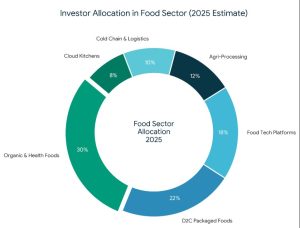
Investor Interest by Food Segment


Types of Capital Available for Food Businesses

# Private Equity

Private equity investors typically focus on businesses with established revenues, strong operating metrics, and scalable growth opportunities. Capital is often used for capacity expansion, acquisitions, distribution growth, and international expansion.

# Strategic Investors

Strategic investors bring industry expertise, market access, and operational support in addition to capital. Their involvement can accelerate growth and improve competitive positioning.

# Debt Financing

Debt capital may be suitable for working capital requirements, machinery purchases, warehouse expansion, and manufacturing capacity enhancement. Companies with stable cash flows are generally better positioned to access debt financing.

# Structured Capital

Structured financing solutions allow companies to balance growth objectives while minimizing excessive equity dilution.

# Pre-IPO and Growth Capital

Larger businesses with significant scale may explore growth capital or pre-IPO financing to support expansion and prepare for future public market opportunities.

How to Find Investors for a Food Business

Finding investors requires more than sending pitch decks to hundreds of contacts. Institutional investors evaluate companies based on fundamentals, scalability, and market positioning.

Potential sources of capital include:

– Private Equity Firms
Suitable for mature companies seeking expansion capital.

– Family Offices
Family offices often prefer businesses with strong cash flows and differentiated products.

– Strategic Investors
Corporate groups and industry participants can provide both capital and operational support.

– Institutional Investors
Institutional capital providers focus heavily on financial discipline, profitability, and growth visibility.

– Debt Providers
Debt financing can complement equity and reduce dilution.

The quality of the business often determines the quality of investor conversations. Strong unit economics, distribution capabilities, and clear growth strategies significantly improve fundraising outcomes.

How to Prepare Your Food Business for Institutional Capital

Step 1: Validate Commercial Scalability

Before approaching investors, businesses should demonstrate:

  • Repeat purchases
  • Healthy gross margins
  • Distribution scalability
  • Efficient working capital management

Capital cannot compensate for weak fundamentals. Investors generally back businesses with proven demand and predictable economics.

Step 2: Build Robust Financial Projections

Institutional investors expect clarity around:

  • Revenue growth assumptions
  • EBITDA margin expansion
  • Working capital requirements
  • Capital deployment plans
  • Cash flow projections

Strong financial models improve credibility and valuation discussions.

Step 3: Develop an Investor-Ready Pitch Deck

The pitch deck should explain:

  • Market opportunity
  • Business model
  • Revenue traction
  • Unit economics
  • Competitive positioning
  • Growth strategy
  • Capital requirements
  • Use of proceeds

Step 4: Prepare for Due Diligence

Investors usually review:

  • Financial statements
  • Regulatory compliance
  • FSSAI licenses
  • Vendor agreements
  • Tax records
  • Supply chain arrangements

Companies that prepare early typically experience smoother transactions.

FoodTech and Supply Chain Businesses Attracting Investor Interest

Investor interest extends beyond consumer brands. Capital providers are actively evaluating businesses operating in:

  • Food processing technologies
  • Supply chain optimisation
  • Cold-chain infrastructure
  • Food logistics platforms
  • Traceability solutions
  • Automation technologies
  • B2B food distribution platforms
  • Alternative protein and ingredient businesses

Investors generally focus on scalability, recurring revenue visibility, operational efficiency, and market size when evaluating FoodTech businesses.

How Investors Evaluate Food BusinessesHow Investors Evaluate Food Businesses

Investors generally focus on a combination of financial performance, operational efficiency, and market positioning.

– Gross Margins
Healthy gross margins indicate pricing power and scalability.

– Repeat Purchase Behaviour

What Do Investors Look For Before Investing in Food Businesses?

Investors typically evaluate:

Factor Importance
Revenue growth High
Gross margins High
Distribution reach High
Working capital efficiency High
Customer retention High
Supply chain resilience Medium
Brand differentiation High
Profitability visibility High


Strong customer retention demonstrates product acceptance and brand strength.

– Distribution Strength
A diversified distribution strategy across retail, modern trade, marketplaces, and D2C channels improves scalability.

– Supply Chain Efficiency
Reliable sourcing and efficient inventory management reduce operational risks.

– Unit Economics
Contribution margins, customer acquisition costs, and working capital cycles play an important role in valuation discussions.

– Brand Differentiation
Businesses with strong positioning and defensible categories often command premium valuations.

What Is the Best Financing Option for Food Brand Growth?

The ideal capital structure depends on the stage and objectives of the business.

  • Debt financing may support manufacturing expansion.
  • Private equity can accelerate distribution and acquisitions.
  • Strategic investors may provide market access and operational expertise.
  • Structured capital can reduce excessive dilution.
  • Growth capital may support international expansion and product diversification.

The right solution is rarely one-size-fits-all. Companies often combine debt and equity to optimize growth while maintaining ownership flexibility.

Examples of Food Businesses That Successfully Raised Capital

Several food and beverage companies have attracted institutional and strategic capital by combining strong brands with scalable business models.

– Country Delight
Built a vertically integrated fresh food platform and expanded through institutional funding.

– The Whole Truth
Focused on clean-label products and consumer trust to attract growth capital.

– Yoga Bar
Scaled its healthy snacks portfolio and strengthened distribution before raising funding.

– Slurrp Farm
Created differentiated products focused on children’s nutrition and expanded through strategic investment.

– Licious
Built supply chain capabilities and premium positioning to become one of India’s largest consumer brands.

These examples illustrate that investors generally reward businesses with strong execution, differentiated positioning, and scalable operations.

Common Mistakes Food Businesses Make During Fundraising

  • Overestimating valuation expectations
  • Weak unit economics
  • Poor inventory management
  • Inadequate working capital planning
  • Generic investor presentations
  • Approaching investors before achieving business readiness
  • Lack of financial reporting discipline

How Investment Banking Services Add Value

Professional investment banking can:

  • Plan the fundraising process.
  • Prepare financial models
  • Conduct valuation analysis
  • Find the suitable investor type.
  • Negotiate term sheets
  • Deal execution.

Food sector fundraising is relationship based. Strategic positioning and targeted investor relationships are often more important than mass investor outreach.

Key Metrics You Must Track Before Fundraising

The most important metrics that you should monitor prior to fundraising.

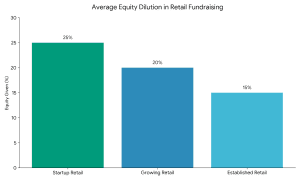
How Much Equity Should You Dilute?Even the most effective startup fundraising will not work without a powerful grip on these numbers. A business valuation calculator is a tool to consider with care so as not to over dilute the company to the point that future funding round is restricted.
Final Thoughts:

You should raise funding if:

  • You have validated demand
  • Margins are scalable
  • You want rapid expansion
  • You must have strategic alliances.

Avoid funding if:

  • Unit economics are broken
  • You have no operational control.
  • Cash flow is unstable
Conclusion:

Raising capital for food sector companies is rarely straightforward.

It demands:

  • Financial discipline
  • Market validation
  • Strategic positioning
  • Professional documentation
  • Strong negotiation

As more people are interested in Funding in Organic Food Companies and scalable D2C food brands, it is a good moment to raise capital now, assuming your fundamentals are sound.

When you go about the startup fundraising process in a strategic manner, utilise investment banking services appropriately, and make all the necessary preparation in terms of proper valuation tools and pitch deck templates, your food business will be able to attract the right investors and grow in a sustainable manner.

Key Characteristics of Fundable Food Businesses

From our experience working with growth-stage companies, businesses that attract institutional capital often share certain characteristics:

  • Strong unit economics
  • Consistent revenue growth
  • Scalable distribution channels
  • Efficient supply chains
  • Clear brand positioning
  • Healthy gross margins
  • Strong governance and reporting practices

While every transaction is unique, investors generally priorities businesses with operational discipline and long-term growth visibility.

Looking for Strategic Capital for Your Food Business?

FundTQ works with growth-stage companies seeking institutional and strategic capital.

Our support includes:

– Fundraising strategy
Financial modelling
– Valuation analysis
– Investor readiness assessment
– Pitch deck preparation
– Debt and equity advisory
– Investor outreach support

If your company is preparing for expansion, acquisitions, or institutional fundraising, connecting with experienced advisors can improve transaction readiness and help align capital with long-term business goals.

Frequently Asked Questions About Food Business Funding

1. How do I find investors for a food business?
Investors can be approached through private equity firms, family offices, strategic investors, institutional capital providers, and industry networks. Companies with strong fundamentals and scalable business models typically attract better investor interest.

2. What is food startup funding?
Food startup funding refers to equity, debt, or strategic capital used by food businesses to expand operations, distribution, manufacturing capacity, or product portfolios.

3. What is the best financing option for food brand growth?
The right financing structure depends on growth objectives. Many businesses combine debt and equity capital to support expansion while managing dilution.

4. Can food businesses raise private equity funding?
Private equity firms often invest in businesses with established revenues, healthy margins, and clear expansion opportunities.

5. How much capital is required to scale a food business?
Private equity firms often invest in businesses with established revenues, healthy margins, and clear expansion opportunities.

6. What do investors look for in food businesses?
Investors evaluate:

  • Revenue growth
  • Gross margins
  • Distribution strength
  • Working capital efficiency
  • Brand positioning
  • Customer retention
  • Unit economics

7. Who invests in food businesses?
Private equity firms, family offices, strategic investors, institutional funds, and debt providers.

Get business Funding

Equity Funding For Retail Business

Struggling With Retail Business Funding? Here’s How Equity Funding Really Works

Retail firms do not fail due to bad ideas but they fail due to the pressure of cash flow and lack of growth capital. Increasing rent, inventory expenses, marketing expenses, and expansion plans require financing that conventional loans are usually incapable of financing.

Equity funding of the retail business comes into play here.

Rather than worrying about EMIs, equity funding enables retail founders to attract strategic investors who invest to grow the business, distribute risk, and can commonly accelerate the brand growth. This is the guide that will guide you through the process of getting the funding to grow your small business without debt in a step-by-step manner.

What Is Equity Funding for Retail Business?

Equity funding refers to selling a part of retail business ownership to investors. You are not repaying a loan, instead you share in future profits and growth.

Key Highlights:

  • No monthly repayments
  • Reduced financial cost than loans.
  • Availability of investor experience and relationships.
  • Perfect for growth in retail companies.

Investment banking services and fundraising advisory services usually aid the equity funding by matching the retail founders to the appropriate investors.

Why Do Retail Businesses Choose Equity Funding?

Retail is capital-intensive. Inventory, rentals, marketing and staff costs increase rapidly. Numerous founders prefer equity financing since equity financing is associated with long-term expansion and not short-term survival.

Benefits of Equity Funding:

  • Small business funding is provided.
  • Enables faster expansion
  • Enhances the stability of cash flow.
  • Establishes a reputation with business associates and suppliers.

When Is Equity Funding the Right Choice?

Equity funding is suitable where:

  • You have consistent revenue
  • Your business model can be scaled.
  • You are expanding (new stores, omnichannel, franchising)
  • You do not require money only, but strategic investors.

Types of Equity Investors for Retail Businesses

retail investor landscape

This is where business fundraising expertise becomes crucial—matching your retail brand with the right investor type.

What Investors Look for in Retail Businesses?

Investors do not just finance ideas, they finance implementation.

Core Evaluation Criteria:

  • Strong revenue traction
  • Healthy gross margins
  • Repeat customers
  • Clear expansion strategy
  • Experienced founding team
  • Unit economics (store level profitability)

Investors Look for in Retail Businesses

Step-by-Step Process to Get Equity Funding for Retail Business:

Step 1: Get Your Business Investment Ready.

  • Clean financial statements
  • Clear growth roadmap
  • Defined use of funds

Step 2: Develop a Retail-Centric Pitch Deck.

Include:

  • Business overview
  • Market opportunity
  • Store economics
  • Growth strategy
  • Financial projections

Step 3:Select the Appropriate Fundraising Path.

You can:

  • Get to the investors directly.
  • Experience with fundraising advisory services.
  • Formal deals should be done using investment banking services.

The professional advisors play a significant role in increasing the success rates of funding.

How Much Equity Should You Give Away?

The usual methods of raising capital used by most retail businesses include:

  • 10%–25% equity in early rounds
  • 15%–30% equity in growth stages

The idea is to make an adequate amount of capital without losing control.

raising capital for retail business

Common Mistakes Retail Founders Make

  • Overvaluing the business
  • Weak financial reporting.
  • No clear expansion plan
  • Selecting the wrong investors.
  • Bypassing professional advice on fundraising.

This is the reason why most successful founders use business fundraising agencies and investment banks.

Equity Funding vs Loan Funding (Quick Comparison)

Common Mistakes Retail Founders Make

Final Thoughts:

Equity funding of retail business can be the most cunning decision to make in case you want to grow faster, build a strong brand, and remove the financial pressure. Having the appropriate plan, definite figures, and the assistance of a reliable fundraising consultancy, you will easily have funds to develop small businesses and create value over time.

Get business Funding
Quick FAQ [Frequently Asked Questions]

Q: Will small retail businesses receive equity funding?

Yes. Numerous investors make active investments in small retail outlets that have good unit economics and grow.

Q: Am I required to make profits to raise equity funding?

Not always. What is more important is revenue traction and scalability.

Q: Is the employment of a fundraising advisor justified?

Yes. Statistics indicate a lot more success with professional advisory support.

funding for ai startup

AI Startup Fundraising in India: Institutional Capital Guide for Growth-Stage Founders

Raising Capital for Your AI Startup?

India’s AI startup ecosystem raised over $1.5 billion during 2024–25, but most founders still face the same challenge: no warm investor introductions, no structured fundraising process, and VCs who disappear after the first meeting. The problem usually isn’t the technology in the process  of funding for ai startup. It’s positioning, preparation, and getting in front of the right investors.

At FundTQ, we’ve advised on 50+ transactions across technology, healthcare, and consumer sectors. After speaking with 50 investors across venture capital, fintech investment banking, and technology investment banking, one theme emerged repeatedly:

“The founders who raise capital are rarely the ones with the best technology. They are the founders who are best prepared.”

How to Get Funding for AI Startup

Who This Guide Is For

This guide is designed for:

  • AI SaaS companies
  • Enterprise AI startups
  • HealthTech AI businesses
  • Revenue-generating startups
  • Founders preparing for Series A and growth capital raises
  • Companies seeking ₹35 Cr+ capital

Not a Fit If:

  • You’re raising a small angel round
  • You’re seeking seed funding
  • You’re still validating an idea
  • You’re pre-revenue

FundTQ does not work with seed-stage mandates.

Major AI funding rounds

Why Most AI Startups Fail to Raise Funding

After interviewing investors and transaction advisors, we found that most AI startups struggle because of:

  • Weak pitch decks
  • No investor relationships
  • Poor financial storytelling
  • Lack of traction
  • Generic AI products without defensible moats
  • Constant VC rejections

Investors aren’t rejecting AI. They’re rejecting unprepared businesses.

Understanding AI Startup Funding Stages

Before approaching investors, founders need to understand where they fit.

# Pre-Seed Funding

Capital used to validate an idea or build an MVP.
Typically raised from:

  • Angel investors
  • Friends and family
  • Incubators

# Seed Funding

Focused on product-market fit and early traction.
Typical investors include:

  • Seed VCs
  • Angel syndicates
  • Accelerators

# Series A Funding

Designed for scaling.
Investors look for:

  • Revenue growth
  • Strong unit economics
  • Product-market fit
  • Market expansion opportunities

# Growth Capital

Growth equity and strategic investors provide capital to accelerate expansion and acquisitions.

What Investors Really Want From AI Startups in 2026

AI hype alone no longer attracts capital. Investors are looking for four things.

1. Defensibility

AI products are easy to copy.
Investors want:

  • Proprietary datasets
  • Network effects
  • Distribution advantages
  • Unique customer access

2. Strong Unit Economics

Founders must understand:

  • CAC
  • LTV
  • Gross margin
  • Burn multiple
  • Customer retention

Nothing kills investor confidence faster than weak financial understanding.

3. Proof of Market Demand

Traction matters more than presentations.

Examples include:

  • Paying customers
  • Pilot programs
  • Revenue growth
  • Enterprise contracts
  • Retention metrics

4. A Large Market Opportunity

Investors want to know:

  • How big is the market?
  • Why now?
  • Why your team?
Late-stage rounds dominated AI funding in 2025

Late-stage rounds dominated AI funding in 2025

——————————
Not sure if your current traction is investor-ready?

get startup funding

7 Proven Ways AI Startups Raise Capital

1. Build an Investor-Ready Pitch Deck

A strong pitch deck should explain:

– Market Opportunity
What problem are you solving?

– Product Differentiation
Why can’t competitors easily replicate your AI solution?

– Business Model
How do you make money?

– Traction
What proof exists that customers want the product?

– Financial Projections
How will capital accelerate growth?

2. Use Online Platforms and Communities

Founders no longer need warm introductions.
Platforms like:

allow startups to connect with investors and build visibility. Investors increasingly research founders before meetings.

3. Work With Technology Investment Banking Advisors

Professional advisors help founders with:

  • Investor mapping
  • Fundraising strategy
  • Valuation positioning
  • Deal structuring
  • Due diligence preparation
  • Negotiation support

According to deal advisors, founders who start investor targeting and transaction structuring simultaneously often close rounds 40–60% faster.

Case Study: Structured Deals Create Better Outcomes

FundTQ advised on the acquisition of Axiom Ayurveda by Emami Limited through a ₹200 Cr majority stake transaction.

The process involved:

  • Deal structuring
  • Investor mapping
  • Negotiation support

FundTQ also advised StepOut’s fundraise backed by Rainmatter, Zerodha‘s investment arm.

Although sectors differ, the process remains similar:

  • Positioning
  • Valuation strategy
  • Investor targeting
  • Deal execution

4. Build Strategic Partnerships

Strategic relationships with:

  • Technology accelerators
  • Corporate venture arms
  • Fintech investment banks
  • Industry ecosystems

can create opportunities that cold outreach cannot.

5. Show Traction Early

Investors care about results.

Examples include:

– Revenue Growth
Monthly recurring revenue growth.

– Customer Adoption
Enterprise customers and pilot programs.

– AI Performance Metrics
Model accuracy and customer outcomes.

– User Retention
Evidence that customers stay.

A startup with three paying customers is usually more attractive than one with a beautiful deck.

6. Apply to Accelerators

Programs like:

  • Y Combinator
  • Techstars

offer:

  • Capital
  • Mentorship
  • Credibility
  • Investor access

Acceptance itself acts as validation.

7. Become a Thought Leader

Investors often research founders before taking meetings.

Publishing:

  • Technical blogs
  • AI insights
  • Market commentary
  • Customer case studies

helps build trust and authority.

AI startups dominated investment

U.S. AI startups dominated investment flows in 2025 — capturing the majority of global funding.

Why Investment Banking Advisory Matters

Fundraising isn’t simply about introductions. Experienced advisors help founders:

  1. Structure the Round
    Optimizing dilution and capital allocation.
  2. Improve Valuation
    Positioning affects pricing.
  3. Manage Due Diligence
    Reducing surprises during the process.
  4. Negotiate Better Terms
    Protecting founder ownership.
  5. Access High-Quality Investors
    Targeting investors aligned with your business.

Insights From 50 Investors

Here are the recurring themes we heard.

“Show us a moat, not just a demo.”
AI products are easy to replicate. Defensibility matters.

“Know your numbers.”
Investors expect founders to understand:

  • CAC
  • LTV
  • Burn rate
  • Margins

“Traction beats pitch quality.”
Three paying customers are worth more than forty slides.

“Good advisory support signals quality.”
Institutional investors appreciate professionally prepared opportunities.

AI Startup Investor Readiness Checklist

Before raising capital, ask yourself:

Product

– Working product
– Clear differentiation
– Defensible moat

Financial Metrics

– Gross margins
– CAC
– LTV
– Burn rate

Market

– Paying customers
– Repeatability
– Growth opportunity

Story

– Clear vision
– Capital utilization plan
– Expansion roadmap

Frequently Asked  Questions – FAQs

1. Can I raise funding without investor connections?
Yes. Platforms, accelerators, and professional advisors help founders access investors. Ultimately, traction and positioning matter more than relationships.

2. What metrics do investors look at?
Investors commonly evaluate:

  • Revenue growth
  • CAC
  • LTV
  • Gross margins
  • Burn multiple
  • Retention

3. What does an investment banker do for an AI startup?

Investment bankers help with:

  • Investor targeting
  • Deal structuring
  • Valuation strategy
  • Due diligence
  • Negotiation support

4. What traction should I have before raising Series A?
Investors typically expect:

  • Product-market fit
  • Paying customers
  • Revenue visibility
  • Customer retention

5. Does FundTQ provide seed funding?
No. FundTQ focuses on growth-stage transactions and mandates generally above ₹35 Cr.

Final Thoughts

Raising capital for an AI startup isn’t a lottery. The founders who successfully close rounds are rarely those with the most impressive technology. They’re the founders who prepare early, understand their numbers, and approach investors with a structured process. Fundraising is ultimately about trust. And trust is built long before the first investor meeting.

——————————

FundTQ has advised on 50+ transactions across technology, healthcare, and consumer sectors.

If you’re preparing for a ₹35 Cr+ raise, our team can help you evaluate whether you’re institutionally ready—and what gaps need to be addressed before approaching investors.

Request an Investor Readiness Assessment

We’ll tell you honestly:

  • Whether you’re ready
  • What investors will expect
  • What needs improvement
  • Whether a mandate makes sense

get funding for startuo

Tech Startup Funding

How to Get Tech Startup Funding: A Practical Guide for Founders

Launching a tech start up is fun- but to bring an idea into a successful business needs funding. Be it a new AI tool or SaaS solution, or a hardware solution, funding is necessary to grow operations, recruit talent, and roll out your product. This manual demonstrates how to raise money through tech startup funding, and has steps to follow that are relevant to the current tech ecosystem.

Startup Funding Statistics

  • Over 70% of startups rely on bootstrapping in early stages
  • Venture capital investments exceeded $600B globally in recent years
  • Startups with traction raise 3x more funding

Why Tech Startups Need Funding?

budget allocation for tech startupsTechnology startups have a higher initial expense than traditional businesses because of:
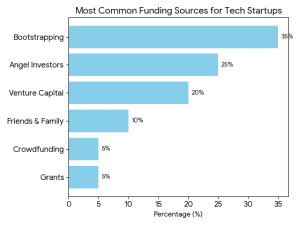
  • Software development, hardware development, AI development.
  • Cloud infrastructure or servers.
  • Recruiting engineers, designers and marketing staff.
  • Regulatory and compliance standards.

Even the best technological ideas may come to a halt without adequate funding. That is the reason why any founder needs to know how the funding can be made and what the investors expect.

#1 Step: Identify the Right Type of Funding

The initial step in raising tech startup funding is to understand what type of funding suits your startup and its objectives:

  1. Bootstrapping: Financing operations with own savings or revenue. Ideal for early-stage ideas.
  2. Friends and Family: Minimal investments made by immediate acquaintances. Useful in development of proof-of-concept or prototype.
  3. Angel Investors: Seasoned investors that contribute investments in the form of equity. Often provide mentorship.
  4. Venture Capital (VC): Investments in startups of high potential growth. VCs will fund high amounts but with high equity and quick returns.
  5. Government Grants and Programs Non-dilutive funding to encourage innovation.
  6. Crowdfunding: Seek direct financing of potential clients via such platforms as Kickstarter or Indiegogo.
  7. Corporate Partnerships: Resources or investment by well-known companies in order to collaborate or get early access.

common funding sources for tech startupsAI Insight: The new AI can assist the founders to find out potential investors, fund raise trends, and even pitch deck optimization to predict what will attract investors according to previous funding records.

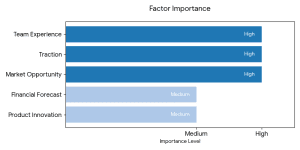
#2 Step: Build a Strong Business Plan

Investors desire to have a road map. The following things should be included in your business plan:

  • Problem & Solution: What is your tech a solution to, and why is it special?
  • Market Opportunity: Growth trends, competitors and total addressable market.
  • Model: How are you going to make money with your startup? Subscription, licensing, free-mium, etc.
  • Product Roadmap: Product development milestones and schedules.
  • Team Credentials: Why your team can create the vision.
  • Financial Projections: Financing requirements, expenses and revenue.

Pro Tip: AI tools such as business plan generators can assist you to organise your plan in the most effective way and can simulate growth conditions to investors.

Learn About: Technology investment banking services

#3 Step: Craft a Winning Pitch Deck

Your startup’s first impression is a pitch deck. An AI-intensive solution will be able to study the existing successful pitches in order to maximise content and visuals. Key slides include:

  • Introduction and Problem: Straight forward and clear.
  • Solution: The value positioning of your product.
  • Market Opportunity: Factual and valid.
  • Traction: Start-user, revenue, partnerships.
  • Business Model: How you raise money.
  • Team & Advisors: Be competent and reliable.
  • Funding Ask Finance: Be clear as to how the funding will expedite growth.

Tip: Keep it under 15 slides. Your deck can also be automatically generated by AI tools into graphs, charts and competitor analysis.

free pitch deck templates
#4 Step: Demonstrate Traction

Startups with the potential of success are invested in by investors. Traction can include:

  • The increase or the usage metrics of the users.
  • Revenue or pre-orders
  • Beta program success
  • Joint ventures or alliances.

Small, initial traction can do major wonders to investor confidence. AI analytics can monitor user behaviour, growth patterns, and retention, and thus it is simpler to provide definite displays of traction.

key factors investors consider before funding a tech startup#5 Step: Leverage Networks and Platforms

Funding is a matter of who you have connections with rather than what you have accomplished. Network expansion strategies:

  • Startup Incubators and Accelerators: Y Combinator, Techstars and others offer mentorship and funds.
  • Angel Networks VC Platforms: AngelList, Crunchbase, and LinkedIn may help you find investors.
  • Tech Conferences and Meetups: Pitch events, Hackathons, and workshops are also good in terms of exposure.

AI Insight: AI-powered tools will assist to find investors best suited to your startup business, location, and funding round and save time and chances of success.

#6 Step: Choose the Right Funding Option

Here’s how to match funding types with startup stages:

match funding types with startup stages

Choosing the right option prevents unnecessary equity loss and aligns your growth trajectory with investor expectations.

#7 Step: Avoid Common Pitfalls

  • VC too soon: Prioritise traction.
  • Failure to take legal and financial structuring: Unambiguous contracts and equity arrangements will avoid conflicts.
  • Disregard of investor feedback: Relevant ideas, although financial assistance may not be as timely.
  • Weak story telling: The investors must relate to your vision both emotionally and logically.

#8 Step: Leverage AI to Boost Funding Success

Artificial intelligence will be able to assist where conventional technology fails:

  • Investor Research: AI is used to conduct a scan of databases with investors who are likely to finance your industry.
  • Pitch Deck Optimisation: Predictive technology proposes slides, images, and messages that resonate.
  • Financial Forecasting: AI thinks over various scenarios to reinforce predictions.
  • Market validation: AI software processes user response, trends, and sentiment to justify market demand.

AI can be used strategically to save time and reduce risk and enhance investor credibility.

Final Thoughts

Funding tech startups is not a random event. Focus on:

  • Competence in your stage of start-up.
  • Selecting the appropriate financing sources.
  • Developing an effective business strategy and traction measures.
  • Preparing a persuasive pitch deck.
  • Using AI and networks to their advantage.

This is an efficient and confidence-based way for founders to get tech startup funding in order to transform innovative ideas into scalable and successful businesses.

Get business Funding

Funding Readiness Checklist

Funding Readiness Checklist: Prepare Your Business for Investment in 2025 & Beyond

One of the most transforming moves that a business can make is the act of raising capital. Yet the brutal truth is: most of the startups and middle market businesses do not raise funding not because their idea is not a good idea but because they are not an investable company. It is here that the funding readiness checklist comes in. It is a step by step guide that will make your business ready to impress investors, raise funds effectively, and grow successfully not just in 2025 but in 2026.

You will find a realistic, practical checklist in this guide, which includes financials, legal preparedness, team, market strategy, fundraising planning, and others. You will have just the answer to know how to get your business ready to be invested in without fear.

Why a Funding Readiness Checklist Critical?

Hundreds of pitch decks are received by investors on a monthly basis. It is the matter of preparation that is the difference between success and rejection.

A Funding Readiness Checklist can assist you:

  • State your business professionally.
  • Present all the required documents and information investors require.
  • Don’t make expensive errors to cripple funding.
  • Develop investor confidence and trust.

Imagine it as a pre-flight checklist – one step will result in postponement or risk of funding.

Pro Tip: Start preparing early. Investors notice when founders are proactive about 2025–2026 funding

business valuation software
Key Sections of a Funding Readiness Checklist

There are six important areas that a solid Funding Readiness Checklist must cover. Let’s break them down:

1. Financial Preparedness

Numbers are important to investors. Your finances should also be correct, open as well as proactive.

Checklist items:

  • Financial statements ( Income Statement, Balance Sheet, Cash Flow) audited or reviewed.
  • Projections and forecasts of 2025 and 2026.
  • Unit economics and burn rate (startups).
  • Equity structure and cap table.
  • Debt obligations and liabilities.

Why it is important: Clean and well-organised finances are a source of confidence and show that your business is able to grow sustainably.

2. Business Model Clarity

Shareholders would like to know how your company generates value.

Checklist items:

  • Clear value proposition
  • Pricing strategy and revenue model.
  • Market and customer acquisition.
  • Differentiation and competitive landscape.
  • Potential to expand threefold between 2025 and beyond.

3. Legal & Compliance Readiness

No other thing can destroy the confidence of the investors as much as the legal or regulatory problem.

Checklist items:

  • Registration and licenses of businesses. (Check Now)
  • Ownership of intellectual property and patent.
  • Hiring agreements and contracts.
  • Impending litigation or regulation issues.

4. Management Team & Governance

Investors are not investing in ideas only.

Checklist items:

  • Relevant experienced key team members.
  • Advisory board or mentors
  • Governance structure
  • Clearly defined roles and responsibilities.

Tip: Spotlight accomplishments, past exits or industry experience – this develops competence and power.

5. Market & Growth Strategy

Investors desire to see that your business can grow.

Checklist items:

  • Total Addressable Market (TAM) and Serviceable Available Market (SAM).
  • Go-to-market (GTM) strategy for 2025–2026
  • Customer Acquisition Cost (CAC) and Lifetime Value (LTV).
  • New markets, or new product lines expansion.

6. Fundraising Strategy

Lastly, your checklist must describe your fundraising strategy.

Checklist items:

  • Type and amount of targeted investment (equity, debt, convertible notes)
  • Optimal types of investors (VC, angel, PE, strategic)
  • Investor pitch and investor presentation.
  • Timeline and milestones
  • Contingency plans

Common Mistakes Founders Make

Founders are known to trip even with a checklist.

Avoid these pitfalls:

  • Unfinished or dishevelled financials – destroys credibility.
  • Excessive projecting of market size – investors like real projections.
  • Ignoring legal preparation IP or compliance can come to a halt.
  • Overlooking deadlines -The raising of funds will consume more time than anticipated.
  • Poor team presentation- investors emphasise on how things are done rather than what is said.

Hint: Your checklist will help you to cover every area and avoid such mistakes when approaching investors.

Read About: How to Raise Series A Funding in India (2025 Guide)

How to Use Your Funding Readiness Checklist Effectively

  • Timing is everything – Now preparing 20252026 funding rounds.
  • Check all the parts- Do not omit any part.
  • Seek professional consultation – It may be advisable to seek professional advice such as FundTQ to figure out the gaps.
  • Communicate frequently – Markets, finances and strategy change; revisit on a quarterly basis.
  • Get your team in line – distribute the checklist across the team and make sure everyone is on board.

free pitch deck templates
Bonus Tips for 2025–2026 Funding Success

  • Storytelling with data: Investors are obsessed with graphs and numbers.
  • Online presence: Have a professional LinkedIn and Web site.
  • Scenario planning: “Make best-case and worst-case funding estimates.
  • Know your numbers: Be prepared to tell financials in a comprehensive fashion.
  • Regular follow-ups: Reflective follow-up messages are a sign of professionalism.

Learn About: 9 Ways of Fundraising for Startups in India

FAQs

Q1: What is a Funding Readiness Checklist?

A: It is a guide on how founders should make their business investable, including financials, legal preparation, team, market plan, and fundraising.

Q2: At what time do I begin preparing a funding round?

A: 6-12 months before you are having the fundraising. This checklist will be useful in 20252026 planning.

Q3: Is it possible to operate with the same checklist with equity and debt financing?

A: Yes, the core readiness items are applicable to both, however, your section of fundraising strategy can vary.

Q4: What is the frequency of checking the checklist?

A: Quarterly changes will be recommended to capture financial changes, market trends and staff growth.

Bottom Line

Like in business, relying on raising capital, it is preparation and not a matter of luck. A Funding Readiness Checklist is a way to make sure that your business is organized, believable and that it is investor-ready by 2025 and 2026. This guide will help you minimise risks, speed up your startup funding process, and come out as a confident, credible founder before investors.

Next Step: Download our complete Funding Readiness Checklist (2025-2026) and determine your company investor readiness in the present.

Get Your Funding Readiness Checklist