Swiggy shareholder approval

Swiggy to Raise ₹10,000 Crore Through QIP After Shareholder Approval

The Swiggy has also gotten shareholder consent to elevate 10,000 crore via a Qualified Institutional Placement (QIP), which is yet another significant progress within the food delivery and quick-commerce ecosystem in India. This action is a good one in the history of the company because it is about to solidify its financial base, increase its operations, and enhance their competitiveness. The Swiggy shareholder approval is an indicator of investor confidence and preconditions for one of the largest equity raises of an internet-first company in India.

Image Source: The Economic Times

What Does the Swiggy Shareholder Approval Mean?

Shareholders officially approved the fundraising proposal at an Extraordinary General Meeting (EGM) on December 8, with 99.47% of votes in favor. The board had cleared the plan on November 7, allowing for its swift execution. Swiggy can now afford the nod and proceed with the QIP as soon as this week depending on the market conditions.

A QIP enables businesses to access capital raised by institutional investors and the 10,000 crore amount that Swiggy is proposing makes this one of the largest equity raises in the current internet-economy environment.

This capital sourcing is timely when Swiggy is escalating its operations in food delivery and quick commerce- two areas experiencing high growth and intense rivalry.

Why Swiggy Needs ₹10,000 Crore – Growth & Competition

Swiggy will use the new capital to boost its core business and its rapidly expanding quick-commerce business, Instamart. As Blinkit and Zepto continue to aggressively grow their dark stores and customer base, Swiggy needs massive investment to match.

The QIP funds are likely to fund:

  • Dark stores and warehouses scaling Instamart.
  • Improving logistics, delivery fleet, and technology infrastructure.
  • Acquisition and retention of customers.
  • Increasing capital to sustain long-term expansion.

It is worth noting that Swiggy reported that the revenue of Instamart increased twice in Q2 FY26, indicating high consumer demand. In the meantime, Swiggy has seen a total increase in operating revenue, 23% to 3,760 crore, as a result of the rising speed of orders and the growing use of quick-commerce.

Also Learn: Free Pitch Deck Templates for Startups

Financial Impact on Investors

The QIP has high growth potential, but with it, there would be anticipated equity dilution. According to prevailing market values, the new issue would water down the current shareholding by more than 10%. This can be met with mixed feelings by the retail investor, but dilution in a capital expansion is an ordinary practice which can short-term impact on share price sentiment.

It is the first major round of Swiggy to raise funds since its IPO in 2024, when it raised approximately 4500 crores. Nonetheless, the company losses increased by 74 percent on an annual basis to 1,092 crore in Q2 FY26. The company could be in need of better capitalisation to gain profitability.

To its financial approach, Swiggy has also exited its investment with Rapido, receiving 2399.5 crore and making 2.5X return in less than four years- a move that gives it better liquidity.

Conclusion

Swiggy shareholder authorization on the 10,000 crore QIP is a strategic move capable of transforming the company’s growth path. With Swiggy about to pursue rapid growth in both food delivery and instant commerce, the capital may become a desperately needed booster.

Nonetheless, the QIP will be successful once the market sentiment and the appetite of the institutional investors. When properly done, it would provide Swiggy with the financial power necessary to grow fast, compete. Take a step toward profitability, entering a new stage of growth in the history of the digital commerce giant in India.Get business Funding

Nexus Venture Partners eighth fund

Nexus Venture Partners Expands Investment Portfolio With New $700 Million Early-Stage Fund

Nexus venture capital, which is one of the most successful venture capital firms in India, has announced that its eighth fund has closed at an astounding amount of 700 million to support start ups at an early stage. This relocation coincides with the period when the whole venture capital activity in the world is slowly returning to normal, and the interest in AI-centred and technology-oriented startups is greater than ever.

Nexus Venture Partners eighth fund

Image Source: The Economic Times

The new fund highlights the interest of Nexus Venture Partners in supporting visionary founders who are developing artificial intelligence (AI), enterprise software, consumer, and fintech solutions in India and the US. Having a successful record of over 130 investments and over 30 successful exits, Nexus is still going to define the future of global innovation.

A Growing Thirst for AI and Early-Stage Investments

Over the last few years, the technology environment has experienced impressive changes, especially in generative AI and enterprise software. Innovations in these sectors are receiving more investors than ever at an early stage. The past several years have been surreal to the technology sector, as the world has seen the pioneering innovations in generative AI, as well as the record speed of AI adoption among consumers and businesses alike, Nexus Venture Partners spokesperson said in a recent statement.

Venture funds around the globe have been building new capital that they are willing to invest in startups that promise. The Indian market alone is estimated to have up to 12-15 billion worth of venture capital ready to be deployed as a result of it being the third-largest startup ecosystem in the world.

Nexus Venture Partners: A Legacy of Growth

Nexus Venture Partners, which started in 2006, has been able to build up its assets under management to 3.2 billion. The investment philosophy of the firm stresses on cultivating founders who are resolving complicated problems and building scalable solutions. It has such brands in its portfolio as Postman, Zepto, MiniO, Turtlemint, Delhivery, India Shelter, Rapido, and dozens of AI startups located in the US. Nexus has been able to raise several funds over the years beginning with the $100 million in 2007 and subsequently to $485million in its sixth fund in 2021. 

In 2023, the company increased its capital through the seventh fund amounting. $700 million which it is currently balancing with its eighth fund. A sign that the company is confident in its investment plan amid market uncertainty. Strategic exits are also sources of returns to the firm as it has sold shares in companies such as OLX, Proptiger, Sedemac, Unicommerce, and WhiteHat Jr.

Fund VIII: Doubling Down on Visionary Entrepreneurs

Nexus Venture Partners will use Fund VIII to invest in inception, seed, and Series A rounds. It continues to support the next generation of innovation and who are working on hard problems by entrepreneurs. The fund is still supported by limited partners most of whom have been with Nexus since its initial years of existence. With Fund VIII, we are doubling up with opportunities of visionary entrepreneurs who are defining the next generation of global innovations, the firm pointed to.

This crowdfunding operation also puts Nexus in the same group of fundraising activities as other venture firms and includes Accel, A91 Partners, Fireside Ventures, and Silicon Valley-based Bessemer Venture Partners. The trend shows a revived investor interest in early-stage startups especially in AI, consumer tech and fintech.

The Bigger Picture: India’s Startup Ecosystem

The startup ecosystem in India has been expanding at an alarming rate in the last ten years and the venture capital activity has also indicated signs of recovery. Recent other large fundraises to drive early-stage innovation have also been made by other firms such as A91 Partners ($665M), Accel ($650M), Bessemer ($350M), Cornerstone VC ($200M) and Prime Venture Partners ($100M).

Having raised $700 million in Fund VIII, Nexus Venture Partners is in a good position to cash in the trends that have emerged and not only make investments in startups but also offer strategic advice to startups that are destined to join the pantheon of global leaders.

Conclusion

The eighth fund of Nexus Venture Partners supports its traditional image of an innovator in the field of AI, technology, and fintech. Through small business funding early-stage founders both in terms of capital and mentoring coupled with international exposure. The company remains a key player in the building of the next generation of startups in India and beyond.

The Nexus Venture Partners story is a sign of the strength of strategic investment. Vision and timing- a combination that drives entrepreneurial success and transformational technological developments.

Get business Funding

Yoodli Raises $40 Mn

Yoodli Attracts $40 Mn Series B Funding with WestBridge at the Helm

Yoodli, an AI roleplay and experiential learning platform, has raised 40 million in its Series B round, which was led by WestBridge Capital, including Neotribe Ventures and Madrona. This funding gives Yoodli an approximate of 60 million dollars of total funding, after its Series A raise in May 2025.

Yoodli Raises $40 Mn

Image Source: Entrackr

The innovation business funding will sustain the growth of AI coaching technology, more analytic depth and custom learning capabilities. Yoodli will also invest in enhancing its enterprise learning capabilities. Such as sales enablement, leadership development, and professional training, and expanding its product. AI research, and customer success teams in international markets.

Building the Next Generation of AI-Based Communication Training

Yoodli is a company that was founded by Varun Puri and Esha Joshi in Seattle in 2021 and uses AI-driven tools. This enable users to simulate real communication situations in a non-judgmental and private setting. The platform aids in simulating as many workplace interactions as possible, including sales discussions, leadership conversations, interviews, and feedback. Providing customers with immediate AI feedback on how they might enhance their clarity, tone, confidence, and delivery.

Big companies such as Google, Snowflake, Databricks, RingCentral, and Sandler Sales already use Yoodli. Its blend of AI-crafted roleplays, coaching feedback, and progress tracking. Analytics can assist organizations to hasten the growth of communication skills among teams.

In contrast to the classic training methods that focus on the content taught. Yoodli focuses on adaptive practice, which allows the employees to practice in real-life situations. Learn the art of interpersonal interaction much more rapidly and efficiently.

Strong Backing from WestBridge Capital

The WestBridge Capital that has been investing in high-growth AI and enterprise technologies. That has been busy funding companies that are putting a new face on workplace performance. The company currently dominated FinBox in a 40 million Series B and invested in UnifyApps and SpeakX and had a secondary deal in Rapido to facilitate the exit of Swiggy.

Investment in Yoodli, the most recent, points to the belief that WestBridge has in the capability of the company to revolutionize communication training with AI-assisted experience learning on a massive scale.

Get business Funding

Iztri startup funding

Iztri Closes Rs 1.5 Cr Pre-Seed Funding Round with AJVC as Lead Investor

Iztri, a Bengaluru-based clothing-care startup, has already attracted a pre-seed round of Rs 1.5 crore with AJVC in the lead, which was a major milestone in startup funding of early-stage hyperlocal services startups in India. The round was led by the angel investment vehicle of Aviral Bhatnagar and highlights the growing confidence of investors in technology-based household services and empowerment of micro-entrepreneurs.

Image Source: Entrackr

The new capital will be strategically invested by the company to expand operations in Bengaluru, fortify its technology backbone, and improve the core supply chain infrastructures. Iztri will equally invest in automation of workflow, customer experience advancement, and layers of operational intelligence to have the demand pipeline to meet its demand growth.

A Structured Solution in an Unorganised Category

Iztri, which was co-founded by Rohit Ramesh and Ankit Choudhary, is an organised, technology-based ironing and clothes-care service- a sector that is very unstructured despite the huge consumer demand of ironing and laundry daily in Indian homes.

Iztri’s model focuses on:

  • Constant turnaround times.
  • Demand consolidation and route optimisation.
  • Consistent service quality
  • Increased incomes of ironing specialists.

The startup seeks to remove inefficiencies that pervade the informally structured traditionally informal ironing ecosystem by creating a hyper local network of services. Its model fosters standardisation, reliability, and safety, which offer consistent income and better working conditions to the local ironing employees.

Scaling Tech Infrastructure & Workforce Training

The investments will also serve new processing centres, staff development initiatives, and performance management systems. As Iztri expands further into Bengaluru. The tech backbone of the company functions to reduce the amount of idle time spent by workers. Maximising the order throughput a model that improves consumer convenience and worker productivity.

AJVC’s Continued Bet on High-Potential Indian Startups

The investment is timed with the increase in the portfolio of AJVC in the technology and consumer market in India. Recently, the company closed its maiden fund at an amount of more than Rs 200 crore. Which is more than twice its initial target. This allows the firm to support Indian startups which have high potential of growth.

New investments in AJVC are:

  • Jaagruk Bharat – civic-tech
  • GaadiMech.com- automobile service website.
  • Nuyug- festivous jewellery line.
  • Mithila Foods – Bihar based food culture based brand of the FMCG.

As Iztri becomes part of the portfolio, AJVC keeps asserting its desire to serve scalable businesses in the areas of consumer services, technology, and impact-driven businesses.

Summary

The successful Iztri round of startup funding demonstrates that more investors are interested in hyperlocal service innovations. Especially in formalisation of unorganised sectors that have high market demand. As the company keeps polishing its working prototype, industry observers think that Iztri might become one of the household names in the technological-based services industry in India.

The recent capital injection puts Iztri on a good growth curve, namely the trend that is consistent with general trends in startup capital, operational optimisation, and, even, other related areas, such as investment banking solutions, which are experiencing an upsurge in pre-emerging deal-making in India.

Get business Funding

Eternal investment in Blinkit

Eternal’s ₹600 Cr Investment Boosts Blinkit’s 2025 Funding to ₹2,600 Cr

Eternal Limited (previously Zomato Limited) has invested ₹600 crore in its booming subsidiary, Blinkit, in a significant step to the quick commerce industry in India. This makes Blinkit fund 2025 a total of 2600 crore, and it is clear that Eternal is still working on its non-food vertical, which is the primary growth engine of the company currently.

blinkit funding

Image Source: Entrackr

Eternal Investment in Blinkit Strengthens Quick Commerce Leadership

The new capital was through the issue of 3,733 equity shares at 16,07,161 apiece as per the filings of the Registrar of Companies (RoC). It is a continuation of earlier investments in 2025 of 500 crore in January and 1500 crore in February and an investment of 400 crore in mid 2024. The capital assists Blinkit in inventory-based model, dark stores growth, and improvement of the delivery infrastructure. Blinkit has increased revenue substantially by booking the full value of goods sold but profitability has been challenged because operating costs are high.

This strategic capital of Eternal indicates its belief in the ability of Blinkit to dominate the competitive Indian instant delivery sector, against its competitors like Swiggy Instamart, Zepto, and the BB Now of BigBasket, and new market entrants by the offline retail chains.

Blinkit Drives Revenue Growth Amid Profitability Pressure

The growth of Eternal support can be seen in Q2 FY26 outcomes. Eternal has posted an operating revenue of 13,590 crore which is almost three times less than that of the identical quarter of the previous year. Blinkit contributed 9,891 crore or approximately three-quarters of the revenues, and the food delivery segment contributed 2,485 crore. Although there was a good revenue, consolidated net profit decreased by 63 per cent every year to 65 crore. Growth expenses such as set up of dark stores, levels of inventory, and logistics of delivering the goods remain a strain to the bottom line.

Also Get: Free Pitch Deck Templates for Startups

The business environment is still capital intensive. The rivals are growing intensely: Swiggy has permission to increase up to 10,000 crore, BigBasket has been able to get a 200 crore debt and Zepto has been able to raise 450 million of funds led by CalPERS. Ongoing Eternal investment in Blinkit will enable the company to remain on the growth path and compete off competitors as well as enhance service and delivery efficiency.

Bottom Line

The investment by Eternal is an indication that it is strategically shifting its focus to non-food high-frequency products, which diversify its revenue and establish Blinkit on the market. The capital will enable Blinkit to expand business, improve customer experience, and maximize the speed of delivery, which are essential to achieve the success in the competitive market of instant commerce.

Although the issues associated with profitability include the cost of expansion, in the long term, it is quite possible that Blinkit will have a monopoly in the Indian quick commerce market. Long term investment will put the company in a growth, innovation and enhanced presence in the market that is fast evolving.

Get business Funding

Wealth-Tech Investment Trends: Wealthy Raises Rs 130 Cr for Rapid Expansion

Wealth-management firm Wealthy raises Rs 130 Cr ($14.5 million) in Series B financing, headed by Bertelsmann India Investments. Shepherd’s Hill Group and Alpha Wave Global, who are already investors in the company, also joined this round, which once again boosted investor confidence towards the growth path of the company.

Wealthy raises Rs 130 Cr

Image Source: Entrackr

This was the most recent funding to Wealthy, who has raised approximately 30 million in the past including a prior Series B round of Rs 45 crore 5.4 million) by the Alpha Wave Incubation Fund operated by Falcon Edge. The current round proceeds will be used to increase advisor network, improve product stack and expand into new markets of Wealthy. The funds will also enable the company to enhance its technology platform and compliance systems as its platform extends its product offerings.

About Wealthy and Its Growth

Wealthy was established in 2015 and is an online financial product marketplace and independent financial advisors distribution platform. Through the platform, advisors can sell a broad portfolio of wealth products, such as mutual funds, insurance, fixed deposits, bonds, and others, with the help of its powerful technology stack.

Wealthy has experienced a high growth in Assets Under Management (AUM) whereby over the last three years, the Assets Under Management (AUM) have increased three times to reach the current level of Rs 5,000 crore, which tells of a booming business. It has 20 offices in India currently, and dominates in major cities in India, including Bengaluru, Mumbai, Hyderabad, Ahmedabad, Surat, Jaipur, Gurugram, Delhi, Faridabad, Ghaziabad, Lucknow, Kanpur and Kolkata. The platform makes transactions of above Rs 300 crore monthly and collaborates with over 6000 mutual fund distributors to serve over 100,000 clients.

TheKredible, Wealthy raises Rs 130 Cr at a time when the company has increased its revenue, moving up to Rs 14.5 crore in FY24 to Rs 25 crore in FY25. Nonetheless, the company posted a net loss of Rs 35 crore last fiscal year, which is lower than the previous year, i.e., FY24 of 24 crore, indicating the current investment in scaling operations and broadening the reach.

Funding Trends in Wealth Management

India has recorded stable funding in the wealth management sector in 2025. Notable examples include:

  • Dezerv Raise $40M in a primary round co-leaded by Premji Invest and Accel Global Growth Fund.
  • Stable Money, a Bengaluru-based firm raised 20 million dollars under the leadership of Fundamentum Partnership.
  • Syfe raised a $80 million Series C round.
  • Neo in its last stages of equity share raising of $19m.

With this Series B round, Wealthy strengthens its market leadership, expands its advisor base, and advances its digital platform. The financing is a sign of investor confidence in the use of technology in managing wealth and rising demand of available financial products in India.

Finally, the news that Wealthy raises Rs 130 Cr reiterates that the firm is still on the ascent in the wealth-tech segment. With its ability to scale operations, enhance technology infrastructure and gain access to more cities in India, Wealthy is defining the future of digital wealth management, and financial planning and investment advice are now more accessible than ever.

Get business Funding

agrostar funding

AgroStar Raises $30 Million: What the New Funding Means for the Agritech Startup

AgroStar’s $30 Million Raise Signals Growth in India’s Agritech Sector

agrostar funding
AgroStar, which is among the top agritech startups in India, has been able to secure a funding of 30 million dollars through a round of agrostar funding by Just Climate involving both its old and new investors. AgroStar, which was established in 2013 by Sitanshu and Shardul Sheth, is a company that uses technology and data-driven solutions to assist farmers in obtaining high-quality seeds, fertilizers, and professional crop consultancy. It has a platform that operates in 11 states in India with a population of more than 9 million farmers and has recently branched out all over the world with the sale of INI Farms producing and exporting produce to over 25 countries. This financing achievement highlights the increased confidence of investors in the agritech sector of India and a greater focus on start-up capital, business financing, and investment banking services to high potential businesses.

Why This Funding Matters for Agritech and Investors

The recent capital inflow into AgroStar should enhance its supply chain, better digital advisory tools, and increase operations in India, as well as enhance its presence in other countries. AgroStar attracts investors by offering a scalable business model, leveraging technology solutions, and focusing on sustainable agriculture. This growth path places the company in the same category as other companies such as DeHaat, WayCool, and Ninjacart, and shows how properly managed agritech startups can raise substantial amounts of capital and positively change the lives of farmers.

A 30 million increase is not merely a financial marker, but it is also a strategic vision, leadership and credible implementation, making AgroStar a good example of a company that is able to integrate innovation, sustainability, and market potential. To investors, founders, and agritech fans, this round of startup funding can underscore how a proper approach and technology can spur growth and change a global agricultural ecosystem in India.

Get business Funding

LOHUM Pre-Series C

LOHUM Pre-Series C: How the Battery Recycling Startup Is Scaling Up

LOHUM Pre Series C Funding: $15M Raise

Battery recycling and sustainable energy-tech startup LOHUM is already preparing to enter its next stage of growth as it readies to raise Rs 131.4 crore (around 15 million dollars) in a pre-Series C round. Growth I9 Opportunity LLP will lead the LOHUM pre series C funding round, with the participation of other strong investors such as Baring Private Equity, Singularity Growth and Asiana Fund among others.

LOHUM Pre-Series C

Source: Entrackr

This new capital is only several months following the $54 million Series B funding earned by the company in March 2024, which indicates favorable investor belief in the business model and fast-growing business of LOHUM.

LOHUM’s board approved the issuance of 748 pre-Series C CCPS at an issue price of Rs 17,56,714 each. The growth i9 opportunity llp will come in with 31.8 crore, Baring private equity will come in with 25.12 crore, Samriddhi Sehgal will come in with 13.35 crore, Asiana fund will come in with 12.12 crore, Rainbow investments and a pool of 18 angel investors.

The company will use the new funds for capital expenditure, marketing, and other corporate purposes. Entrackr estimates LOHUM’s post-money valuation at Rs 4,265 crore (approximately $485 million).

Get Battery Recycle Sector Market Research:

Battery Recycle Sector Market ResearchLOHUM was founded in 2018 and creates next-gen lithium-ion mobility and energy solutions. Which provide batteries with several life cycles by way of repurposing and recycling. The company boasts of being among the biggest manufacturers of sustainable energy-transition materials. In India with its system of ecosystems of battery recycling, raw-material refining and reuse.

To date, LOHUM has already collected more than 120 million dollars. With the support of such large investors as Baring Equity, Singularity Growth, and Cactus Partners. The Delhi-based startup has also presented good financial results. The year-on-year growth in operating revenue reached 72 percent. Reaching a high of Rs 529 crore in FY 24, and profits increased. More than 3 times, reaching Rs 28 crore.

The recent pre-Series C infusion positions LOHUM to expand its recycling capacity, strengthen its supply chain, and accelerate India’s shift to cleaner energy.

Get business Funding

EaseMyTrip Q2 FY26 results

EaseMyTrip’s Revenue Slips to ₹118 Cr in Q2 FY26; Posts ₹36 Cr Loss

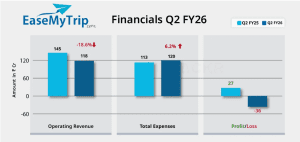
EaseMyTrip (EMT), the online travel agent, experienced a decrease in revenues during Q2 FY26, with ₹118 3 crore in operating revenue and a net loss of 36 3 crore. EaseMyTrip Q2 FY26 results show that the online travel agent (EMT) experienced a decrease in revenues during Q2 FY26, reporting ₹118.3 crore in operating revenue and a net loss of ₹36.3 crore. This marks a sharp contrast to the profit of ₹26.8 crore in the same quarter last year, highlighting the challenges the company faces in its core business amid rising costs.

easemytrip

Image Source: Entrackr

Revenue Decline Driven by Air Ticketing Drop

The air ticketing that generates most of the revenue of EaseMyTrip dropped to 72 crore, a year on year decline of 22 percent. Hotel and holiday packages also added 32 crore which is approximately 27% of the total revenue. The company made more money by other sources but made a total income of 126.5 crores during the quarter which was less than 150 crores in Q2 FY25.

Rising Costs Push Company Into Loss

EaseMyTrip had growth expenses of 67% YoY, largely as a result of increment in employee, service and advertisement costs. Spending on employees went up by a fixed margin of 24% to ₹31.crore. Another exceptional item of the company that also contributed to the quarterly loss was an exceptional item of 51 crore about a General Sales Agent (GSA) agreement with an airline under UDAAN scheme.

EaseMyTrip Q2 FY26 results Image Source: Entrackr

Non-Air and International Business Growth

Although the setback was experienced, certain segments reported encouraging growth:

  • Hotel and holiday bookings shot up by 93% YoY, which suggested good momentum with non-air verticals.
  • There was a 16 percent growth in the number of bookings of train, bus, and mobility services.
  • Global growth, particularly in Dubai, was a strength: gross booking income increased over 3 times to 361.7 decision-making.

This early success can be attributed to the fact that EaseMyTrip is successful in its EMT 2.0 strategy to diversify its revenue collected by flights.

Operational Resilience Shows Through EBITDA

Net profit became negative, EBITDA has increased sequentially by 76.3% to 12.1 crore (with a margin of 9.6). It means that its revenue pressures are not hurting its operational efficiency implying that it will become profitable provided cost management is maintained.

Strategic Moves and Leadership Changes

EaseMyTrip will keep investing in growth and infrastructure:

  • Purchased half of a hotel in London and 100 per cent of a Gurugram commercial property.
  • Enhanced management that has a new CTO and CMO.
  • Consented to a purchase of 514 crore of preferred equity shares by non-promoters.

These activities are in line with the vision of the company to develop a complete stack travel platform to cover hotels, holidays and international markets.

Looking Ahead

The Q2 FY26 performance of EaseMyTrip is a mixed story, with a decline in the core business and one-time losses counterbalanced by an increase in the non-air vertical and international market. In case the company is able to maintain these high-margin segments and control the expenses, the long-term prospects of profitability are still optimistic on the negative note.

Get business Funding

Startup Financial model

Startup Financial Model from 10+ Fast-Growing Companies

A startup financial model is essential to give a founder and investors an idea of what the business can grow to, how much capital they will require to start, and the profitability associated with the business. It is a well-organized financial model that will give you an idea of revenues, expenses, and cash flows and give you a clear map of how to scale. This guide will discuss startup financial models based on the examples of more than 10 rapidly expanding companies in various industries. We will also discuss such tools as Free Pitch Deck Templates, Financial Modeling in Excel, and the way to make Pitch Decks that will impress investors.

What is a Startup Financial Model?

It is important to know what financial modeling is before delving into illustrations. A financial model is a tool that anticipates the financial performance of a firm based on past data, and assumptions regarding future growth. In the case of startups, it is a mandatory possession of:

  • Budgeting and cash flow planning.
  • Knowledge of break-even levels.
  • Winning investors with achievable estimates.
  • Promoting fundraising by means of a catchy pitch deck.

Financial modeling in excel is the most popular one as it still gives enough flexibility to model various scenarios and growth strategies.

Quick access to our best Financial Model Templates:

  1. Beverage Company Financial Model
  2. Financial Model for BPO Company
  3. Financial Model for Car Repairing Company
  4. Financial Model for K-12 Edtech Company
  5. Financial Model for Kids Brand
  6. Financial Model for SaaS Company
  7. Retail Company Financial Model
  8. Sample Financial Model of Fintech Startup
  9. Sample Financial Model of FMCG Brand
  10. Travel & Tourism Financial Model
  11. Waste Management Financial Model

These are our best 10+ Startup Financial Model:

1. Beverage Company Financial Model

Beverage Company Financial Model is created to assist the start-up in the beverage industry across the world to predict sales, costs of production, expenditure on marketing, and the efficiency of the distribution channel. As the market of soft drinks worldwide is projected to grow to 1.9 trillion dollars by the year 2027, the model enables founders to predict the trends of demand, price management, and also cope with the seasonal changes in production and sales of the drink. It particularly comes in handy when the startup is releasing niche drinks, craft beverages, or health orientated products.

Industry: Food & Beverage

Business Model: Beverage (retail and wholesale) production and sale.

2. Financial Model for BPO Company

BPO Financial Model offers a model to startups to estimate employee expenses, client payment cycle and income per project. As the worldwide BPO market is estimated to expand to over $350billion by 2028, cost management and scalability are of high importance. The model assists founders to maximize labour utilization, monitor client profitability, and long-term expansion in service-based companies.

Industry: Business Process Outsourcing (BPO).

Business Model: Business Outsourcing.

3. Financial Model for Car Repairing Company

Car Repairing Company Financial Model helps in the startup predicting labor, parts inventory and service revenue. With the rising number of cars and cars getting old, the automotive repair industry is a global market worth almost 450 billion dollars in revenue. This model suits best to shops that seek to expand operations, implement subscription maintenance packages, or the multi-location services.

Industry: Automobile / Services.

Business Model: Car repair and maintenance services.

Startup Financial model 4. Financial Model for K-12 Edtech Company

K-12 Edtech Financial Model is concerned with subscription revenues, acquisition costs of students, and the profitability of courses. Online learning and hybrid classrooms will propel the global EdTech market to exceed 500 billion by 2030. The model can be used by startups to forecast student growth, retention, and lifetime value and direct investments in marketing and content development.

Industry: EdTech / Education

Business Model: Online K-12 business model.

5. Financial Model for Kids Brand

The Kids Brand Financial Model is designed to meet the needs of a start up that sells children products, predicts inventory, seasonal demand, and returns on marketing. The children products market in the world is estimated to reach 400 billion and the knowledge on unit economics is crucial towards competing with the already established brands. The model assists founders in the scaling of the product lines, supply chain management and pricing strategy optimization.

Market: Kids/ Consumer Products.

Business Model: Children toys, clothing and accessories.

6. Financial Model for SaaS Company

The SaaS Financial Model helps startups to monitor recurring revenues, churn, customer acquisition cost (CAC), and lifetime value (LTV). As the global SaaS market is estimated to amount to 307 billion dollars in 2026, subscription-based software enterprises must have precise forecasts to satisfy investors and achieve growth in the most efficient way. The model is critical in scenario planning, pricing strategies and presentation to investors.

Industry: Software / SaaS

Business Model: Software solutions, based on subscription.

Get Startup Financial model 7. Retail Company Financial Model

The Retail Company Financial Model enables startups to estimate the sales of a store, e-commerce sales, inventory, and the cost of operations. The retail market in the world will be higher than 30 trillion in the year 2030, hence effective financial planning is essential. The model assists startups to handle multi-channel business, plan store wideness, and control inventory among others to enhance cash flow and profitability.

Industry: Retail / E-commerce

Business Model: Online and brick and mortar retailing.

8. Sample Financial Model of Fintech Startup

The Fintech Financial Model estimates the volume of transactions, interest, and operating costs, which startups can use to realize the extent of scalability and profitability. As the global fintech market is estimated at 300 billion and continues to expand at a very high pace, proper financial modeling is necessary to navigate between regulatory compliance, operational expenses and investment opportunities.

Industry: FinTech / Finance

Business Model: Digital financial services and banking.

9. Sample Financial Model of FMCG Brand

FMCG Financial Model emphasizes on sales quantity of high volume, efficiency of the supply chain and ROI of the marketing. The global FMCG market is estimated to attain a size of above 15 trillion in the year 2027 and thus proper forecasting of production costs, distribution margins, and promotional expenditures is of paramount importance to new entrants intending to compete at the global level.

Industry: FMCG / Consumer Goods.

Business Model: Producing and selling of consumer goods.

Financial Model for startups10. Travel & Tourism Financial Model

The Travel & Tourism Financial Model is used to enable startups to estimate the booking volumes, seasons and partner revenues. The global travel and tourism market has a value of over 9 trillion and when the pandemic is over, there are opportunities of recovery and growth. The model aids in making decisions based on pricing, marketing, and capacity management of a startup that provides bookings, experience, or a travel package.

Industry: Travel & Tourism

Business Model: Travel booking and experiences.

11. Waste Management Financial Model

The Waste Management Financial Model is aimed at predicting logistics, equipment and investment, operational expenses and revenue of recycling waste management. As the global waste management market is estimated to be worth 530 billion by 2028, this model assists the startups to plan sustainable operations, routes, and analyse profitability on various service lines.

Industry: Waste and Environmental Management Industry.

Business Model: The collection, recycling and disposal of waste.

best Startup Financial ModelHow to Build a Startup Financial Model

Creating a financial model may seem daunting and it does not have to be. Focus on these steps:

  • Gather Past Data (where possible): revenues, costs and customer statistics of previous operations.
  • Define Assumptions: Growth rates, pricing, unit economics, market trends.
  • Construct Revenue Projections: Dis-aggregate by product, service or subscription plan.
  • Estimate Costs: This entails fixed, variable, and semi-variable costs.
  • Computing Cash Flow: It is important to always have the amount of money at hand to operate.
  • Add KPIs: KPIs such as CAC, LTV, gross margin, and burn rate to demonstrate startup health.
  • Scenario Planning: Develop various scenarios (best scenario, worst scenario, expected scenario) in order to predict risks.

Common FAQs About Startup Financial Models

1. What is a startup financial model?
It is a systematic tool that presents the financial performance of a company in terms of assumptions and data. It assists the founders in planning growth and investors assessing risk.

2. Why do startups need a financial model?

Financial models:

  • Display the profitability and cash flow.
  • Fundraising activities.
  • Budgeting and scaling assistance.
  • Give measures to monitor the performance.

3. How detailed should it be?

It must be comprehensive enough to provide confidence to the investors but easy enough to read immediately. Target important indicators, revenue, expenses, and cash flow.

4. Can I use templates?

Yes! Free Excel templates or pre-built models for specific industries (like SaaS, Retail, Edtech) can save time. You can customize assumptions to match your startup.

Why a Financial Model Matters

A strong financial model:

  • Make investors trust your forecasts.
  • Assists in strategist expansion.
  • Expects gaps in cash flow and financing requirements.
  • As a guide to your business milestones.
business valuation software
Takeaway

It does not require any major scramble to construct a startup financial model. In Beverages, SaaS, Retail, Edtech, or Waste Management, the correct model with the assistance of Free Pitch Deck Templates and Excel financial modeling can assist you in planning the growth, finding investors, and expanding your start-up successfully.

With knowledge gained via 10+ fast-growing companies, you can build a financial roadmap that is realistic and appealing enough to your business.