India’s AI startup ecosystem raised over $1.5B in 2024–25. But most early-stage AI founders are still stuck at the same wall — no warm investor intros, no structured pitch, and VCs who ghost after the first deck review. The challenge isn’t your technology. It’s knowing how to package it, price it, and put it in front of the right people. This guide breaks down exactly how Indian AI founders are raising pre-seed to Series A capital in 2026 — and what actually moves investors.
We interviewed 50 leading investors in the field of venture capital, technology investment banking services, and fintech investment banking. Their advice showed trends, approaches, and untapped opportunities that can significantly transform your success in raising funds.
“If you’re building an AI startup and struggling to raise funding, this guide will show you exactly how to secure pre-seed, seed, or VC funding—even if you’re at idea stage.”
Most AI founders struggle with funding because:
- No clear pitch deck
- No investor connections
- No traction or revenue
- Constant rejections from VCs
If you’re facing any of these, you’re not alone — but you’re also not ready for funding yet.

Understanding the Funding Landscape for AI Startups
It is important to know how AI startups are funded before immersing into the strategies:
- Seed Funding: Capital to be used in the initial stages to develop prototypes or test the market.
- Venture Capital: Greater funding of startups with scale and momentum.
- Strategic Investors: Investors are corporations and fintech companies seeking to invest in emerging AI technology.
- Government Grants and Incubators: This is often neglected but this type of funding may be non-dilute.
Founders who engage technology investment banking services early in the process close rounds 40–60% faster, according to deal advisors — because investor targeting and deal structuring happen in parallel, not sequentially.
Show Traction Early7 Proven Ways to Get Funding for Your AI Startup
With Zero Connections
 1. Pitch Your Pitch with Free Pitch Deck Templates.
Shareholders desire transparency, perspective, and expansiveness. A refined pitch deck can be the difference. Use AI- and tech startup-optimized templates of free pitch deck to describe:
- Market opportunity
- AI product differentiation
- Business model and monetisation strategy.
- Traction and milestones
2. Use the Power of Online Media and Community.
Platforms such as AngelList, LinkedIn, and Crunchbase enable startups to meet with investors even without any personal ties. Join AI-related communities, communicate your vision, and seek advice from experienced professionals.
3. Think about Investment Banking Advisory Services.
Investment banking services in the field of technology are able to assist in structuring your round of financing, identifying the right investors, and offering credibility. A large number of investors like startups that are guided by advisory services as they are signs of professionalism and minimisation of risk.
What this looks like in practice:
FundTQ recently advised on the acquisition of Axiom Ayurveda by Emami Limited — a ₹200 Cr majority stake deal. The advisory process — investor mapping, deal structuring, and negotiation support — is the same whether you’re raising for a consumer brand or an AI SaaS platform. What changes is the investor set and the valuation framework. Founders who come with a structured advisory mandate close faster and at better valuations.
More recently, FundTQ led advisory on StepOut’s fundraise, backed by Rainmatter (Zerodha’s investment arm) — a tech-first transaction that reflects our growing focus on digital and AI-adjacent mandates.
4. Cultivate Strategic Partnerships.
Connect with fintech investment bank companies or technology accelerators. They are able to open the doors to funding networks, which you could not otherwise access.
5. Show Traction Early
Investors are more concerned with outcomes more than relationships. Show early adoption, prototype success, or pilot programs. This may contain customer testimonials, AI model accuracy rates or small revenue streams.

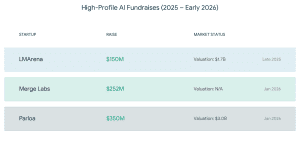
Late-stage rounds dominated AI funding in 2025
——————————
Not sure if your current traction is investor-ready?
 6. Pitch to AI & Tech Accelerators.
Funding and mentorship can be offered by such programs as Y Combinator, Techstars and AI-centered incubators. Getting into an accelerator also signals validation to future investors.
7. Take advantage of Content and Thought Leadership.
By posting AI insights, case studies, or technical blogs, you position your startup as a credible voice in the AI space — which investors notice before they ever take a meeting. Investors will be more willing to invest in startups that have apparent expertise.
How Investment Banking Can Amplify Your Fundraising
Working with technology investment banking services or fintech investment banking experts can: Even as an early-stage AI company, you can:
- Referrals to high-value investors.
- Maximize your valuation and term sheets.
- Grant due diligence support.
- Place your startup with strategic value within the AI investment ecosystem.
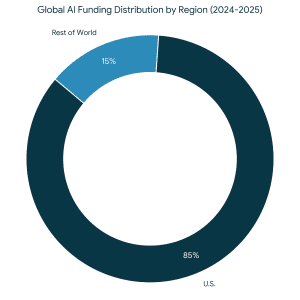
U.S. AI startups dominated investment flows in 2025 — capturing the majority of global funding.
Key Takeaways From 50 Investors
Here’s what we learned after interviewing multiple investors:
What investors actually told us (and what it means for you):
- Show us a defensible moat, not just a demo: AI products are easy to copy. Investors want to see proprietary data, unique distribution, or a network effect baked in.
- Founders who understand their numbers raise faster: Know your CAC, LTV, and burn rate cold. Vague financials kill deals.
- Traction beats pitch quality every time: A working pilot with 3 paying customers beats a 40-slide deck.
- Advisory support is a green flag: When a startup comes through a known investment banker, it signals the deal has already been pre-qualified.
FAQs – Frequently Asked Questions
Q1: Is this possible to raise money in an AI startup with no network?
Absolutely. Platforms, accelerators, and advisory services eliminate the need to make connections at the initial phase in case you are concentrating on traction and a good pitch.
Q2: What can investment banking do to assist an AI start-up?
The right investment banker does more than introduce you to investors — they help you structure the round, set a defensible valuation, and negotiate term sheet clauses that founders often miss. FundTQ has advised on equity raises from ₹35 Cr to ₹300 Cr, including deals with institutional and strategic investors.
Q3: Do free pitch deck templates work in raising funds?
Yes. The templates assist in making your AI startup look professional and summarised. Ensure that you tailor them in order to present your own distinctive AI solution.
Q4: What kind of investors are ideal AI startups?
The AI startups are usually of interest to seed investors, venture capitalists, corporate strategic investors, and fintech-oriented investors.
Q5: What do I do to show traction when there is no revenue?
Present prototype success, pilot projects, user base, AI model precision, or initial collaborations. Revenue is not as convincing as metrics.
Q6: How does an Indian AI startup find the right investment banker?
Look for advisors with a track record in tech or growth-stage raises — not just generic financial consultants. The right IB firm will have existing investor relationships, understand your sector, and work on a success-fee model. FundTQ works with AI and tech-enabled startups across pre-Series A to Series B mandates.
Conclusion
Raising capital for an AI startup in India is a process, not a lottery. The founders who close rounds aren’t always building the best technology — they’re the ones who showed up structured, with clean financials, a clear story, and the right advisors in their corner. If you’re currently raising or planning to in the next 6 months, the best move is to start the preparation now.
Bear in mind: investors do not invest in a Rolodex alone but the vision supported by the results. The right approach, with the right advisors, makes the difference between a deal that closes and one that stalls.
Note:
This guide was put together by the advisory team at FundTQ — an investment banking firm that has advised on 50+ equity and M&A transactions across tech, consumer, and healthcare sectors.
——————————
Raising for your AI startup? Let’s talk.
FundTQ has helped founders across tech, healthtech, and consumer sectors close equity rounds from ₹35 Cr upwards.
Drop us your details and we’ll tell you honestly whether you’re ready — and what it’ll take if you’re not.