Healthcare investment banking in India has moved well beyond capital introduction. Today, founders running pharma companies, hospital chains, medtech businesses, and health-tech platforms need advisors who understand deal structure, regulatory complexity, and what institutional investors actually want to see. At FundTQ — ranked among India’s Top 5 investment banks by Venture Intelligence — we’ve worked on healthcare mandates ranging from growth capital raises to strategic acquisitions. This guide explains how healthcare investment banking works, what it costs you not to get it right, and how to choose the advisor that fits your stage and sector.
Planning a fundraise or acquisition in healthcare?

 What is Healthcare Investment Banking?
Healthcare Investment Banking or HIB is a special segment of investment banking sectors that specialises exclusively in providing financial advisory services to organisations working within the diverse healthcare industry. These include pharmaceutical companies, biotech firms, regulatory services, medical device manufacturers, healthcare service providers (hospitals, clinics, nursing homes), and healthcare IT firms.
In the Indian context, healthcare investment banking spans a wide range of mandates — from Series B fundraises for diagnostics startups to full acquisition advisory for Ayurveda and wellness brands. FundTQ recently advised on the Emami–Axiom Ayurveda acquisition (up to ₹200 Cr), an example of how healthcare M&A in India increasingly involves consumer wellness, traditional medicine, and strategic consolidation by large FMCG players.
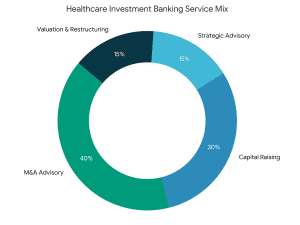 Life sciences investment banking provides a varied area of services. Key services include:
- Mergers and Acquisitions (M&A) Advisory: Advising the healthcare sector on buying, selling or merging with other entities to achieve strategic goals, expand market presence or acquire new technologies/products.
- Capital Growth: Investment Banks help healthcare companies raise capital through debt and equity markets including Initial Public Offering (IPOs). Follow-on offerings, private placements and debt financing to fund overall growth, to fund overall growth and Research and Development (R&D) expansion.
- Strategic Advisory: Provides able guidance on critical corporate finance matters like financial restructuring, joint ventures, spin-offs and divestitures.
- Valuation Services: Conducting a detailed financial analysis to evaluate the fair value of assets, businesses or intellectual property for transactional or reporting purposes.
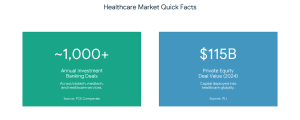
Core reasons healthcare IB is sought after: high deal value and diversified deal flow.
Why Healthcare Investment Banking Matters?
The support and strategic planning that investment banking provides is crucial for the continued evolution and stability of the global healthcare system.
- Innovation and R&D: When a company decides to bring a new medical device or a new drug to the market, it requires a huge amount of financial commitment. Investment Banks in this regard helps raise capital and fund extensive, high-risk R&D pipelines, and clinical trials. Without this funding, life saving innovations would stall.
- Mergers and Acquisitions (M&A): M&A is an important characteristic of the healthcare sector. Investment banks advise on these critical deals.
- Regulatory Complexity: Investment Banks bring with them special knowledge and expertise to structure deals that comply with the complex rules of the healthcare industry. The healthcare industry is heavily scrutinised and regulated by bodies like FDA, CMS, and other international equivalents. This makes sure that transactions don’t run afoul of antitrust laws or healthcare-specific regulations.
- Global Growth: Investment Banking Firms help the healthcare sector in cross-border deals and capital flows. It globalises access to new medical technologies and care models.

How Healthcare Investment Banking Works for Indian Founders
For a founder, engaging a healthcare investment bank typically follows four stages.
- Mandate and preparation. The bank signs an advisory agreement, conducts a detailed business assessment, and builds the information memorandum (IM) — the document that institutional investors and strategic buyers will evaluate you on. This is where valuation benchmarking and deal positioning happen.
- Investor or buyer outreach. The bank runs a structured process — identifying relevant PE funds, family offices, or strategic acquirers, making warm introductions, and managing information flow. For healthcare specifically, this means reaching investors who understand sector-specific metrics: EBITDA margins for hospital chains, IP value for pharma, ARR for health-tech.
- Term sheet and negotiation. Once interest is established, the bank manages term sheet negotiations — protecting your valuation, pushing back on dilutive clauses, and structuring deal terms that reflect the business’s actual worth.
- Due diligence and closure. The bank coordinates legal, financial, and regulatory diligence — keeping the deal on track and resolving issues before they become deal-breakers.
FundTQ has run this process across 200+ mandates in India’s mid-market, including healthcare acquisitions like the Emami–Axiom Ayurveda deal. The difference between a well-run process and a poorly-run one is usually 15–30% of final valuation.
Healthcare Banking Firms
Healthcare investment banking in India is evolving rapidly — driven by consolidation in pharma, PE interest in diagnostics and hospital chains, and growing cross-border activity in health-tech and Ayurveda. The following firms have demonstrated strong deal execution and sector depth across these areas.
Also Read: 7 Effective Tips to Secure Funding for Medical Device Startup
#1 Goldman Sachs
Goldman Sachs, being one of the largest investment banks across the world, continues to hold a dominating position in the healthcare industry. The company still consults on billion-dollar biotech mergers, pharmaceutical IPOs, and acquisitions of enormous healthcare technology firms. Goldman Sachs is highly preferred by healthcare companies to grow strategically and raise capital due to its international network, advanced market intelligence, and investor relations.
#2 FundTQ — Healthcare Investment Banking Advisory (India)
FundTQ is among India’s Top 5 investment banks (Venture Intelligence rankings) and advises growth-stage healthcare companies on fundraising, M&A, and strategic transactions in the ₹5 Cr–₹500 Cr range. The firm’s partners bring backgrounds from IIT Delhi, KPMG, PwC, and EY — giving healthcare founders direct access to senior deal professionals, not relationship managers. Recent mandates include the Emami–Axiom Ayurveda acquisition (up to ₹200 Cr), where FundTQ served as lead advisor. For Indian healthcare founders evaluating capital raise or M&A options, FundTQ offers a combination of mid-market deal depth and institutional-grade execution that most boutique advisors cannot match.
#3 Morgan Stanley
With its strategic precision and innovative approach, Morgan Stanley continues to provide excellent solutions for healthcare clients around the world. The firm’s healthcare investment banking practice is expert in equity and debt financing, cross-border mergers and strategic restructuring. By combining cutting-edge analytics and insights into the global market, Morgan Stanley empowers healthcare companies to navigate the complexities of the financial landscape with clarity and confidence.
#4 Bank of America Merrill Lynch
A world leader in corporate finance, Bank of America provides a robust portfolio of healthcare advisory services spanning the spectrum from capital raising to mergers & acquisitions. Its specialized healthcare business specializes in pharmaceuticals, healthcare services and biotechnology, offering clients unmatched access to capital markets and financial structuring expertise. The company’s combination of banking expertise and industry knowledge makes it a leading player in the field of healthcare investment banking in 2025.
#5 Lazard
With a long standing history and an independent model of advice. Lazard provides high value strategic advice to healthcare companies around the globe. Its healthcare practice deals with intricate M&A, restructuring, and capital advisory deals. Enabling clients to make well-informed decisions that fuel sustainable growth. Lazard’s reputation for trust, independence and analytical depth continue to make it one of the most admired names in medTech capital markets banking.
#6 Evercore Partners
As one of the world’s leading independent advisory firms, Evercore Partners has elite sector expertise in healthcare. The firm’s healthcare financial advisory firms group is consistently ranked as one of the most active in biotech and life sciences deal activity. Evercore’s client-centric approach, coupled with analytical depth and senior-level involvement, guarantees exceptional results for clients seeking transformative healthcare deals.
#7 Centerview Partners
Centerview’s healthcare team continues to be a leader in advising on some of the largest and most complex dealings in the global healthcare industry. With a deep focus on long-term strategy and operational excellence. Centerview’s senior bankers provide unparalleled advisory services in pharmaceuticals, biotechnology and healthcare services. Their commitment to precision and collaborative solutions distinguishes them in a competitive market.
Trends Driving Healthcare Investment Banking in 2025
The five major trends that are significantly shaping the healthcare Investment Banking sector are
- Telemedicine and Digital Health
The shift to the hybrid care models and the massive investment in AI driven solutions like diagnostics,workflow automation, and other AI-driven tools. Are consolidating the fragmentation of the digital health market. Deals which focus on integrating technology for greater efficiency and value based care are preferred. - Biotech Innovation
This is driven by the want to replenish pipelines, big pharma companies are pursuing a “string of pearls” strategy. Acquiring early to mid stage biotech assets in high growth areas like oncology, immunology and rare diseases. IPO activity for quality, differentiated biotech firms is expected to gradually pick up. - Aging population
Demographics are boosting demand and investment in the sectors that cater to the needs of elderly and senior citizens. Home health services, senior living facilities and specialised medical devices and pharmaceuticals for chronic conditions. - Global M&A Activity
Following a period of volatility, M&A is set for a strong comeback exaggerated with corporate cash reserves and a need for strategic scaling. Mid-sized deals and cross border transactions are highly concentrated as companies seek to optimize portfolios and mitigate supply chain risk. - Healthcare IT
Technology cuts production costs and improves the experience of patients. This drives investment in cybersecurity, revenue cycle management (RCM) automation and data analysis to achieve efficiency in operations for providers and payers.

Choosing the Right HIB

Selection of the right HIB for your company is critical to maximising transaction value and success.
Key Criteria include
- Sector Expertise
Banks with deep, specialised focus with able sub-sector experience in the past. Recent relevant deal history demonstrates an understanding of nuanced industry drivers and valuation benchmarks. - Deal History
A strong expert history of successful transactions that are similar to what a company is looking for provides credibility and confidence. Analysing the bank’s ability to secure favorable valuations and structure complex deals. - Investor Network
The overall network of investors or relevant strategic buyers, private equity firms and institutional investors is paramount. A strong network ensures competitive tension and increases the pool of potential partners or acquirers. - Global reach
For companies with cross border aspirations an investment bank with global reach and proven experience is essential. Presence and relevant experience it is essential to navigate regulatory and geopolitical complexities in different markets.
—————————————————————-
FundTQ ticks all four. With 200+ closed deals, partners from IIT Delhi, KPMG, PwC, and EY, and a dedicated healthcare mandate track record — including the Emami–Axiom Ayurveda acquisition — we’re built for exactly this kind of transaction


Frequently Asked Questions:
Q. What does a healthcare investment banker do for a founder in India?
A healthcare investment banker advises founders on structuring and executing capital raises (equity, debt, or hybrid) and M&A transactions. In India’s mid-market, this typically means preparing investor-ready materials, identifying and approaching the right PE funds or strategic buyers, managing due diligence, and negotiating deal terms. The goal is to maximise valuation while minimising deal risk and timeline.
Q. How is healthcare investment banking different from other sectors?
Healthcare deals carry unique complexity — regulatory approvals, clinical IP valuation, compliance with sector-specific FDI rules, and the need to assess intangible assets like patents, drug pipelines, or brand equity (especially in pharma and Ayurveda). Advisors without healthcare sector experience often misvalue these assets or structure deals that fall apart in due diligence.
Q. Which investment bank is best for healthcare companies in India?
For growth-stage healthcare companies in India — particularly those in pharma, medtech, diagnostics, or health-tech — the right advisor is one with direct mid-market experience and an established investor network in the sector. FundTQ, ranked among India’s Top 5 investment banks by Venture Intelligence, has closed healthcare mandates including the Emami–Axiom Ayurveda acquisition and advises on transactions in the ₹5 Cr–₹500 Cr range.
Final Thoughts
The healthcare sector in India is at an inflection point. Pharma companies are consolidating, health-tech platforms are attracting PE interest, and Ayurveda and wellness brands are seeing serious strategic acquirer activity — as the Emami–Axiom deal illustrates. The right investment banking advisor doesn’t just find you a buyer or investor; they structure the deal to protect your valuation, manage the process, and get it closed.
————————————————————————————–
If you’re a healthcare founder evaluating a fundraise or M&A transaction in the ₹10 Cr–₹500 Cr range, speak with FundTQ’s advisory team.
We work on a mandate basis and engage directly at the partner level from day one.