Mergers and Acquisitions

Mergers & Acquisitions Explained: The Role of Investment Banks in M&A Deals

In the modern business environment where business entities are in high competition and striving to achieve faster growth, diversify operations, and enhance market presence, business entities seek Mergers and Acquisitions (M&A) to achieve their objectives. Globalization and aggression among competitors in industries is causing M&A activity to extend across different industries and the size of businesses. Companies seek investment banks to navigate through such complex transactions so as to unlock the maximum value.

These financial institutions play a crucial and often decisive role in executing M&A deals successfully.

What Are Mergers and Acquisitions?

Mergers and Acquisitions (M&A) refer to the process where companies or their key assets are combined through financial transactions. This can happen in several ways:

  • Buy and fully absorb another company
  • Merge with another company to create a new combined entity
  • Acquire some or all of another company’s major assets
  • Make a tender offer to purchase the company’s shares directly from shareholders
  • It may carry out a hostile takeover, even without the target company’s approval

All these methods fall under M&A activities, as part of broader SME growth strategies,  where businesses are combined or restructured. The term M&A also refers to the specialized departments in financial institutions that help plan, advise on, or conduct these transactions.

What Do Investment Banks Do in M&A Deals?

During the stages of M&A, various strategic, financial, legal, and operational issues must be handled. A well-organized, professional structure has been ensured through the involvement of investment banks. These are the roles that are normally executed:

1. Deal Origination and Strategy

Investment banks conduct extensive research on the industry, and through networking, as well as their databases, suitable targets or buyers have been identified. Strategic justification of the deal has also been carried out, such as the identification of synergies and matching them to the long-term corporate interests.

2. Company Valuation

Fair valuations have been determined using financial models and analysis of previous transactions to create precedent and discounted cash flow (DCF) products to determine fair valuations. Valuation services offered through mergers and acquisitions services have helped stakeholders understand both standalone and synergistic values.

3. Diligence Organization

Investment banks have orchestrated due diligence processes that have been financial, legal, tax, commercial, and operational in nature. Outside experts in third-party companies are often called in to do the specialist work, and it has been managed centrally by the bank on matters of coordination and integration of the results.

4. A Deal Plan

Designers structured equity swaps along with asset purchases, stock leveraged buyouts, equity mergers, and stock-for-stock mergers. They considered taxation, regulatory compliance, and future exit routes during the process.

5. Negotiation & Execution

The investment bank has facilitated the discussion of the price, payment terms, representations, warranties, and indemnities. It has also addressed legal documentation, coordination with various parties, including lawyers, accountants, regulators, etc.

At every phase, Strategic insights have always been combined with tactical focus at each step to make sure that there is not only alignment between stakeholders but also an optimal result.

Buy-Side vs. Sell-Side Advisory in M&A

Investment banks can be retained by either party in a transaction. They provide two distinct, yet related, services:

Buy-Side Advisory

On the buy side, the investment bank has worked with companies or investors looking to acquire other businesses. This has involved:

  • Initial outreach and maintaining confidentiality.
  • Conducting valuation and detailed business project operations. 
  • Negotiating and ensuring the transaction closes. 
  • Buy-side engagements are usually sought after by the private equity firms, large enterprises, or multinational companies, looking to acquire to expand.

Sell-Side Advisory

With sell-side engagements, the investment bank has been retained by companies, founders, or institutional shareholders looking to sell either a whole or partial stake in their company. Their responsibilities included:

  • Creating investment teasers and information memorandum
  • Run competitive bidding processes
  • Filtering potential buyers and communicating
  • Managing due diligence and closing the transaction

During the sell-side process, keeping information private, working efficiently, and realising value have been the main priorities.

Buy-side modeling vs sell-side modeling :

Investment bankers on the sell-side and private equity professionals on the buy-side build M&A models to estimate transactions. Bankers create models that they share with potential buyers of the business. These models must be highly presentable, easy to understand, and usable by all involved parties. Although this model will be provided to firms on the buy side by the banks, they will usually develop their financial model to have 100 percent assurance in the analysis.

Why Companies Rely on Investment Banks for M&A?

M&A are always a high-stakes transaction. They require financial expertise, industry comprehension, and negotiation skills. Organizations, especially ones with limited internal resources, have relied upon investment banks for:

1. Expertise

All relevant disciplines – finance, the law, tax, and regulation have been roofed under one supplier. They have read market dynamics and the mood of investors to help companies make better decisions.

2. Access

Relationships with types of investors, corporate, and private equity firms have allowed investment banks to develop qualified leads and generate competition in the auction.

3. Confidentiality

Investment banks have handled sensitive information discreetly to prevent speculation in the marketplace and disruption internally. They have consistently enforced NDAs are more importantly controlled who sees the buyers’ list so companies can maintain their strategic opportunities for as long as possible.

4. Efficiency

They have managed the timeline, from documentation all the way through to scheduling and negotiation. We expedited processes that typically take months, reducing the risk of execution

5. Negotiation Power

Effective support for companies during the negotiations has been provided by the bankers as strategic advisors – this added the correct dose of neutrality. This has enabled companies to have the proper level of rational pricing discussions and improved negotiations.

Conclusion: 

The world of M&A has been shaped by the shifting markets, changing regulations, and increasing investor movements of the day. In this complicated environment, successful deal results have depended heavily on someone skilled in the advisory role that investment banking services provide.

For businesses, at any stage, whether it’s mergers, acquisitions, or fundraising, an accurate valuation process goes hand-in-hand with effective deal structure and strategy! 

Try FundTQ’s free business valuation calculator to get instant insights, industry benchmarks, and investor-ready reports.

Key Takeaways:

  • Companies merge through strategic processes, and acquisitions result in changes of ownership carried out deliberately.
  • An investment bank is very important in all the processes, such as sourcing, valuation, due diligence, structuring, and execution of the deals.
  • Investment banks are advisers on either the buy-side or the sell-side.
  • Companies rely on investment banks for their expertise, market access, confidentiality, efficiency, and bargaining power.

FAQs

1. What is the role of investment banks in M&A?
Investment banks recommend mergers, design them, and provide the same. They also give valuation, due diligence coordination, strategic analysis, and due diligence to the negotiations. 

2. What does a buy-side value-added investment bank do in M&A?
Added value was brought by them, such as identifying the appropriate acquisition targets, negotiating acceptable terms, and finally seeing that due diligence and the closing of the transaction take place well. 

3. Is it just large companies that can avail of M&A services?
Mid-market and emerging companies actively engage mergers and acquisition advisory services to pursue strategic expansion, exit strategies, or reorganisations.

4. What then is the difference between consulting and investment banking when it comes to M&A?
Investment banks specialise in making deals, valuations, and capital structuring. The consulting firms, in turn, are more interested in the post-merger integration and business strategy. 

5. Is it possible to use investment banks in cross-border M&A?
Yes. Global investment banks have capabilities of crossing borders, such as compliance knowledge, cultural alignment assistance, and a global network of investors. 

business valuation report online

Can I Get a Free Business Valuation Report Online?

Understanding the financial worth of a business is crucial in scenarios such as fundraising, planning equity distribution, or preparing for mergers and acquisitions. One of the most convenient ways to access this data today is through a business valuation report online. Although traditionally, valuations were achieved by contracting financial consultants, they are currently becoming available in the form of free digital tools, all of which can make the valuations accessible to early-stage founders and small businesses.

This article explores what a business valuation report is, how free tools like FundTQ – Asia’s Leading startup valuation calculator work, and how these insights can attract investors, prepare pitch decks, and raise funds confidently.

What Is a Business Valuation Report?

A business valuation report is a document created professionally to represent the estimated financial worth of a company. It not only gives the business valuation in a monetary value, but it also details the methodologies, assumptions, and growth projections used in the calculation.

It is commonly required during:

  • Fundraising for startups in India or abroad
  • Discussions with investment banking services
  • Equity sharing between co-founders or workers
  • Strategic plans regarding expansion or exit
  • The use of regulations or taxation

In most valuation reports, methods such as discounted cash flow (DCF), comparables, revenue multiples, or post-money valuation models are applied. The output is presented as an estimated value range, supported by assumptions and benchmarks.

Can a Business Valuation Report Be Obtained for Free?

Yes, free valuation tools are being offered by various fintech and startup-support platforms. These reports are auto-generated using sophisticated calculators as opposed to being prepared manually. The founders should not include any other details besides the bare minimum, such as revenue, growth rate, and market potential. Based on this little information, a valuation report can be created on the fly.

The estimate provided by a tool might not provide as accurate a result as the one that can be created by professionals, but such reports are regarded to be equally accurate during decision-making at earlier stages, preliminary negotiations with investors, and long-term planning

Startup valuation without revenue can also be performed using model-based logic built into such platforms.

Previously, valuations were typically conducted by professionals, with fees ranging between ₹50,000 and ₹2 lakh. However, with the emergence of these tools, even startups without current revenue can be valued using qualitative models such as the Berkus method, which assigns value to ideas, teams, and traction, the Scorecard method, which compares startups to industry averages, or quantitative techniques like the Discounted Cash Flow (DCF) model, which calculates value based on projected future cash flows.

Best Free Business Valuation Software

1. FundTQ – Asia’s Leading Startup Valuation Calculator

FundTQ has been recognized for providing one of the most detailed and startup-friendly business valuation reports onlineCurrently trusted by over 25,000 early-stage founders, the platform has been streamlined to be used by the Indian and Southeast Asian pre-revenue and early-revenue startups.

Key Features:

  • AI has enhanced valuation
  • Models of a given type of startups are applied (D2C, SaaS, marketplace, etc.)
  • Reports are available in a  PDF exportable format
  • Post-money valuation insights are included
  • Specific industry-based benchmarks are offered

In addition to valuation, the tool has been integrated with fundraising checklists, pitch templates, and investor readiness assessments. It is especially relevant for those pursuing fundraising for startups or engaging in startup fundraising in gurugram, Bengaluru, or Mumbai.

2. Equidam

A global tool in which the valuation is computed by five blended methods. Although it has a free version that provides basic data, complete reports can be bought.

3. StartupValuation.io

A  lightweight calculator that makes an approximate estimate based on the input reasoning. Simple assumptions are utilised, but no breakdowns on the details are given.

What Can Be Expected in a Free Business Valuation Report?

Based on a free valuation tool, as a founder, you will be issued with a document that contains:

  • Estimated Business Value

A range of values can be determined (e.g.,₹1.8–2.4 crore) on the basis of moving inputs like revenue, expense, and market.

  • Industry Benchmarks

The data in terms of sector is compared so that you understand the place of your startup in terms of growth, margins, and capital requirements.

  • Explanation of the Valuation Model Used

Information regarding whether the calculation was made using a DCF, Scorecard, Berkus or multiple-based model.

  • Assumptions and Inputs Summary

Such aspects as revenue growth, CAC/LTV ratio, operating margin, and cash runway are also clearly provided.

  • Fundraising Impact

If funding is being planned, post-money valuation figures are included to show expected dilution and valuation after fundraising.

How Should Free Valuation Tools Be Utilized?

Free valuation tools are very effective; however, their effective utilization comes when they are implemented strategically. The following is how the maximum value can be obtained:

1. Investor Discussions Should Be Initiated Using the Report

The report can be attached to your pitch deck or included as part of your outreach to top venture capital firms.

2. Updates Should Be Made Frequently

It is suggested that every 30 to 45 days, the report should be regenerated because startups quickly react to market encounters.

3. Competitor Analysis Should Be Conducted

The report offers benchmarks that should be contrasted with other startups in your industry.

4. Report Data Should Be Aligned with Pitch Deck Slides

Valuation assumptions and revenue projections should be on the same line as those in the deck to be credible.

When these actions are taken, valuation becomes a growth tool rather than just a financial figure.

Free Pitch Deck Templates to Enhance Fundraising

In addition to the valuation report, a number of tools provide free resources to help startups raise funds. At FundTQ, founders get a series of high-conversion pitch deck templates offered very freely.

Templates Are Designed To:

  • Align your messaging with valuation insights
  • Highlight traction and projections clearly
  • Avoid common pitch deck mistakes
  • Meet investor expectations for fundraising for startups in India

Included Templates (available on FundTQ.com):

  • Investor Pitch
  • B2B SaaS Fundraising Deck
  • D2C Pitch Template
  • One-Page Teaser
  • Presentation of a Growth-Stage Startup
  •  Excel Financial Forecasting Template
  • Problem–Solution–Market–Model Slide Kit

These templates are being widely used by those preparing for startup fundraising in Gurugram and other metro ecosystems.

Conclusion :

Ready to get your free business valuation report? Start now with FundTQ and explore pitch deck templates to supercharge your fundraising

These reports:

  • Assistance in finding a start-up worth
  • Provide realistic expectations for fundraising for startups
  • Cut the cost of using costly consultants
  • Bring in transparency amongst founders and investors

To get professional assistance, larger rounds of funding or a due diligence event must be enlisted. However, in the case of early-stage ventures, business valuation report online are a decent place to start, and combined with the startup valuation calculator tools, such as FundTQ.

Key takeaways:

1. Business Valuation Report online is a strategic tool for startups and SMEs by providing information on the projected market value, potential funding prospects as well as investor preparedness, at an early stage of operation without incurring expenses on paid consultancy. Free business valuation tool, such as FundTQ – Asia’s Leading startup valuation calculator, allow entrepreneurs to generate professionally structured valuation reports based on proven methodologies like DCF, VC method, and revenue multiples.

2. These free reports normally have:

  • Approximate business value (pre-money valuation/post-money valuation),
  • Industry benchmarks,
  • Financial assumptions
  • Model explanations are used for calculation.
  • These free tools help to establish a valid basis of pitching, financial planning, and strategic decision-making, although, needless to say, they cannot be taken as a replacement for a large-scale due diligence or professional audit.

 3. The other resource that FundTQ provides is free pitch deck templates, which can assist founders in aligning their valuation story with what investors expect, as well as help streamline fundraising paperwork.

4. Even startups that are at pre-revenue or idea stage can apply these tools to provide indicative valuations by concentrating on market size, innovation, and founder profiles so that they can raise funds even before they necessarily have any traction.

5. When used alongside resources like the fundraising checklist access to top venture capital firms, and localized support such as Startup fundraising in Gurugram, the free valuation report, becomes a powerful launchpad for early capital.

6. Free valuation reports are considered the best recommendation to the founders looking to start their journey into Indian and overall global capital systems, providing them not only with some proper organization of insights alongside visibility but also validation at zero cost.

FAQs

1.Is a free valuation report as good as a paid one?

They are fairly trustworthy in the preliminary planning. Such ascertained tools as FundTQ employ an approved startup valuation process to provide realistic figures.

2. Can a valuation report be used when meeting investors?

Yes. Many founders share their valuation reports in pitch meetings or emails to showcase credibility and preparation

3. Do these tools work for companies that do not generate revenue, yet?

Yes. Models like Berkus or Scorecard allow startup valuation without revenue using qualitative and projected factors.

4. Do these tools need the contribution of an expert?

No. The majority of the platforms do not require a financial knowledge base to use them by founders.

5. Does such a tool have pitch support or templates?

Yes. Platforms like FundTQ also offer fundraising checklists, pitch decks,business valuation report online, and advisory resources tailored for early-stage ventures.

Startup Valuation Calculator

Asia’s Leading Startup Valuation Calculator (Free to Use!)

In competitive startup ecosystem valuation has ceased being merely a number but, having become a strategic asset. As a founder, it is very necessary to understand the true value of their venture as a confidence builder to investors, and fetching the right capital to invest in the venture and making informed business decisions at all stages of maturity. To support this need, FundTQ offers a robust, free-to-use, and founder-focused Startup Valuation Calculator, designed specifically for the nuances of the Asian market. Whether you’re preparing for first startup funding, validating your financials for a VC pitch, or refining your business roadmap, this intelligent tool delivers reliable, real-time valuation within minutes empowering startups with clarity, credibility, and confidence.

Why Accurate Valuation Matters for Startups?

Valuing your startup is not all about attaching a price on your idea. It is all about showing the world something believable based on numbers. That is why it is important:

Establish Trust amongst Investors
A well-grounded valuation enhances trust among investors by showcasing a balanced view of potential and risk. It demonstrates your readiness for fundraising for startups in India and beyond.

Make Attainable Goals
Getting to know your value will enable you to achieve fundraising goals that you are able to raise and select the appropriate instrument, whether it is equality, debt or convertible notes.

Make It Easy to Negotiate
Data-driven valuation puts founders on the same level with investors, eliminating confusion about valued prices and shortening decision time..

Obtain Transparency and Clarity
Regardless of whether you opt to employ talent through stock options or giving them founder equity it is easier when the valuation is proper to communicate ownership, and expectations.

With fundraising for startups becoming more competitive across Asia, having a valuation tool that’s tailored to local markets is no longer optional rather it’s essential.

What Is FundTQ’s Startup Valuation Calculator?

Startup Valuation Calculator by FundTQ is the next-gen tool developed solely by founders of the Asian region. It harmonies the process between the international valuation techniques and local start-up realities.

Instant Real Time Valuation in Minutes

There is no waiting for consultants. It only takes a few minutes to put in your business data and get a professionally prepared court-ready data-driven valuation report at any place and around the clock.

Asian Markets oriented

FundTQ actively tailors startup valuations to dynamic markets like India, Southeast Asia, and MENA by accounting for local traction, regulatory frameworks, and regional cost structures.

Robust Valuation Technique

The tool uses valuation methods that are globally accepted and among them include:

  • Discounted CashFlow (DCF)
  • Risk Factor aggregation.
  • Scorecard Valuation
  • Berkus Method
  • Venture Capital Kaizen method

Also Read: Business Valuation Simplified: Step-by-Step with Online Calculators

Free & User Friendly

Unlike complex business valuation software, FundTQ’s platform is intuitive, educational, and completely free,making it accessible for all founders, regardless of financial background.

Step-by-Step Walk through of FundTQ’s Valuation Calculator:

So, here are four simple steps to the accurate startup valuation:

1 Step -Enter Business Fundamentals

  • Provide such details as industry, pre or post-revenue stage of business, business model (B2B, B2C) and the strength of your team.

 2 Step – Advanced Metrics (Optional)

  • Add such financial KPIs as monthly burn rate, annual recurring revenue (ARR), EBITDA, customer acquisition cost (CAC), and market size. These assist in fine tuning of precision.

3 Step -Select Valuation Method (s)

Choose one, or several methods depending on your level:

  • Early-stage? completely Try Berkus or Scorecard Method.
  • Revenue-generating? Just use DCF or VC Method
  • Uncertain future? Carry out the Risk Factor Summation.

4 Step- Create Valuation Report

Get a report that you can download containing:

  • Rationale-valuation range
  • Methodology breakdown
  • Best-case and worst-case sensitivity analysis We perform a best-case and worst-case sensitivity analysis because we want to draw on the total experience of all the companies that have successfully implemented S.
  • Investor-readiness score

This makes it easier to prepare for fundraising for startups in India and beyond.

Why FundTQ Stands Out?

There are a lot of start up tools available in the market, so why use FundTQ startup valuation calculator?

Asia Driven Algorithm

Regional factors are usually ignored in global calculators. FundTQ incorporates region-tailored growth benchmarks, exit multiples as well as risk premiums.

Various Valuation Models

You can compare 4 6 states and come up with a valid valuation range, being dependent on one methodology will not present an accurate valuation range.

Educational Insights

Founders receive contextual explanations for each valuation figure, making it a great learning resource for those new to investment banking concepts.

No Hidden Cost Policy

There are no paywalls, allowance on surprise charges. The valuation calculator of FundTQ is and will remain free to startups.

Secure and Confidential

Every data is encrypted, and your reporting on valuations is available to you. Your confidential data would not be at risk.

Real-World Impact by Industry:

FundTQ’s valuation tool has been used by over 10,000 startups across diverse sectors. Here’s a glimpse of how it’s driving value across industries:

Industry

Use Case

Valuation Driver

SaaS                 Pre-Series A funding ARR, churn rate, CAC
E-commerce                   Seed-stage pitch deck GMV, repeat customer rate
Healthtech Grant proposal + early VC outreach Patient acquisition, IP value
Fintech Institutional investment (Series A+) Reg compliance, revenue scale
Agritech Valuation for government incubation program Pilot success, market linkages

Regardless of your vertical, FundTQ assists in checking your valuation against the realistic market expectations.

How to Use It Effectively?

Maximize the value of FundTQ’s startup Valuation Calculator tool by following these key guidelines:

Keep Your Financials Ready

Although you may not be able to build out detailed modeling at the early stages of building your company, compiling some simple estimates (such as what you estimate your revenue to be, the breakdown of costs, and burn rate) is going to sharpen up your outcome.

Understand the Methods

The tool tells about every approach, still, it is helpful to know a bit about valuation models. This makes your story more strong at investor meetings.

Use the Report in Pitch Decks

In your pitch deck, you can include the final valuation report, to make the investor trust you. Financial viability is excellent to mark.

 Recalculate Quarterly

Your valuation has to grow with your startup. Track the effects of the growth of your business on value on the calculator on a regular basis.

FAQs About Business Valuation Software:

Q1: Is FundTQ valuation calculator a permanently free tool?

Yes, it is constructed with founders in mind and is also free of charge–no trials and cost entanglements.

Q2: Is it applicable to several startups?

Absolutely. You are able to create numerous reports in the industry and at varying stages of funding.

Q3: What can I do when my startup does not bring revenue?

No problem! FundTQ maintains pre-revenue valuation schemes such as Berkus and Scorecard.

Q4: Is it applicable outside India?

Sure, it is optimized to be used in Asia (Southeast Asia, UAE, and so on), but its practices are approved worldwide.

Q5: Is this an alternative to recruiting a financial advisor?

Not entirely. This can be regarded as an intelligent way to begin. For deeper negotiations and equity structuring, pairing it with expert investment banking advice is recommended.

Conclusion:

Valuation in the case of startups is usually viewed as intricate, subjective and scary. However, it does not need to be so with the Startup Valuation Calculator provided by FundTQ. Within minutes, you will have an investor ready, credible valuation that captures your business potential and the situation in the area you are doing business in. Whether you’re preparing for first startup funding, understanding your current growth trajectory, or exploring future rounds of fundraising for startups, this tool empowers you with clarity and confidence.

Valuing your business is easy when done with FundTQ. The valuation journey starts today: Ensure that your business valuation is accurate and representative by using our free-to-use startup valuation solution, specifically, designed to be founder-friendly. Want to understand how this ties into the broader future of investment banking? Accurate startup valuation is progressively being the start line of information based capital implementation conclusions.

skincare startup

Funding Your Skincare Startup: Step-by-Step Guide for Entrepreneurs

The beauty and health care business can be described as thriving with one of the most dynamic segments on the beauty and health care business being on skincare. Whether it is organic serums or AI-enabled customized skin care regimes, consumers have never been more conscious and caring about their skin before. In case you are a start-up business wondering about what will be next to start a brand in skincare, now is your time. But one of the most important challenges in launching a skincare startup is to obtain funds.

This manual practically covers all major issues linked to fundraising for startups in India with an exclusive focus on the skincare sector-from planning, pitching, scaling, to maintaining. Thus, whether it’s the very first seed funding for your startup or consideration towards investment banking services, or perhaps going the route of crowdfunding, this map will easily help you through its intricacies.

Why Are Skincare Startups a Hot Investment?

It is estimated that the worldwide skincare industry would hit the mark of over 200 billion by; 2026. There are various factors that will develop homegrown brand opportunity like the experience of increased disposable income in India, the wellness obsession of Gen Z and their consumer first approach to digital space.

Here’s why investors are increasingly drawn to skincare startups:

  • Large Margins: The skincare business is sometimes associated with a large profit-margin, depending on a niche aspect such as clean beauty or vegan, or Ayurvedic line.
  • Repeat Purchases: Skincare items need to be replenished on a regular basis as opposed to technology-related and fashion-related products, so they are always in demand.
  • D2C Model Compatibility: Digital media enable the brands to sell their products to the users directly and without involving third-party.
  • Influencer Marketing: Skincare is a purely visual product and it applies well to influencer and content marketing, which makes it appealing to contemporary investors.

How Much Funding Do You Need?

It is best to evaluate your funding needs before you proceed to identify possible sources of funds. The start-up costs will depend on what business model you target to use, whether you intend to produce your goods, white-label suppliers, or create only e-commerce brand.

I give this a rough breakdown:

Category of Expenses

Proposed Cost (INR)

Test and Product Development 

5,00,000- 15,00,000

Branding & packaging  

2,00,000 5,00,000

Set up Website and eCommerce

  1,00,000 – 3,00,000

Opening Stock         

3,00,000 – 10,00,000

Marketing & Influencers

2,00,000 4-8,00,000

Depending on your scale, first startup funding requirements can range from ₹10 lakhs to ₹50 lakhs. It can go a long way and make your pitch stronger when you are clear about these figures.

Top Funding Options for Skincare Startups

As a beauty founder, you’re not limited to a single funding route. Here are some options to explore:

1. Angel Investors

Perfect in the new, young skincare brands. They provide capital, as well as mentoring. One should find an angel with experience in FMCG, wellness, or D2C brands.

2. Venture Capital

VCs come when you have traction product-market fit, expansive customer base or a well-established brand equity. Venture Capitalists in India deal with consumer and lifestyle.

3. Startup Incubators/Accelerators

Such programs include Sequoia Surge, India Accelerator, or NSRCEL by IIM Bangalore which are funded programs as well as provide mentorship and access to a network of investors.

4. Bank Loans & MSME Schemes

Indian government and financial organizations provide business credits according to MSME and Stand-Up India programs: they are applicable to manufacturing-based companies in the skincare sector.

5. Investment Banking Services

When you’re ready to raise larger rounds (Series A or beyond), consider partnering with boutique investment banking services specializing in consumer brands and startup capital raising.

Creating a Skincare Business Plan That Attracts Investors

Loved by investors is clearance. An effective business plan is an indicator that you are not ignorant of the market and you have a scalable business.

Your Skincare Business First regarding are These Selected main points in Your Skincare business Plan:

  • Problem and Solution: What solutions does your brand solve to issues in the skin? And why is it superior to what is available?
  • Target Audience: Who is the target? Millennials? Gen Z? Men?
  • Market Research:It includes industry trends, industry size, industry competition and white spaces.
  • Product Strategy: Ingredients + certifications (no cruelty-free, organic) + the line development of products.
  • Revenue Model: Margins, channels of sale and pricing.
  • Marketing Plan: The influencer, online advertisement, real world events.
  • Finance: How much are you asking, and what is it going to be used on?
  • Financial Forecasts: 3 year revenues estimate, break even analysis.

The better your plan is, the more willing investors would be to invest in your startup.

Building a Minimum Viable Product (MVP)

Your proof of concept would be an MVP. For skincare startups, this usually means developing a small batch of hero products to test market response.

MVP Creation Skincare Tips:

  • Utilize contract manufactures to cut the cost.
  • Pick 12 products or put both energy into 12 products (e.g. a face serum and a cleanser).
  • Undertake dermatology tests and qualifications.
  • Offer tests to those interested or beta testers.

A successful MVP can be your ticket to first startup funding and traction with D2C customers.

How to Pitch Your Skincare Brand to Investors?

The pitch is a decisive part in your funding process.

Keys of an Excellent Pitch Deck:

  • Vision Statement: Build on your Why.
  • Market Opportunity: Allow one to demonstrate the amount, as well as, the possibilities of the skincare industry.
  • Your Unique Solution:  Your innovation, either ingredient, personalization or sustainability.
  • Traction: success of the MVP, revenue, customer love, testimonials.
  • Team: Present founders and specialists in the sphere.
  • Ask:  How many funds, to what?

Practice your pitch and tailor it to different types of investors some care more about numbers, others about brand story.

Strategies Of Crowdfunding That Work:

Crowdfunding is an awesome method to prepare your item, comprehend business viability and get financing without sharing responsibility.

To consider:

  • Ketto and Wishberry of Indian projects.
  • Kickstarter and Indiegogo to reach out to the world.

Tips:

  • Make utterly enticing campaign pages.
  • Storytelling- demonstrate your path.
  • Provide rewards and special care packages.
  • Use influencer shout outs to get traffic.
  • This path does not only attract capital but also wins a community.

Grants and Competitions for Beauty Entrepreneurs:

In India, women and beauty entrepreneurs have access to many programs that they can rely on.

There are Opportunities such as:

  • L’Oréal Women in Science and Business Awards
  • Tata social enterprise challenge
  • Startup India Seed fund scheme
  • FICCI FLO Women Start up Awards

Winning grants or competitions not only funds your skincare startup but also helps in building  credibility and press visibility.

Bonus Tip:

Are you a skincare startup looking to find your business valuation and pitch to investors? Don’t worry—we’ve got you covered! Get instant access to our free business valuation calculator and a ready-to-use skincare startup pitch deck to help you raise with confidence.

Bootstrapping: Advantages & Disadvantages

Many successful skincare startups like Juicy Chemistry and Minimalist began by bootstrapping—self-funding the business until revenues kicked in.

Pros:

  • Complete ownership of your brand.
  • Develop financial control.
  • Narrow-based growth that is organic.

Cons:

  • Small budget in marketing and staffing.
  • Slower scaling.
  • Risk of high personal finance.

A decent place to start would be bootstrapping in case you are not investor ready but have a great MVP and vision.

Scaling After Funding

After you secure your first round, then the game starts.

Focus Areas:

  • Inventory Management: It is important to have regular availability of products.
  • Brand awareness: Invest on Influencer campaigns, PR and video content.
  • Technology: Modernise the website, web-based customer relationship management and supply chain systems.
  • Team Building: Recruit professionals of marketing, R&D and customer service.
  • New Markets: Enter second-tier cities or overseas shipments.

A constant need to determine such metrics as CAC, LTV, and ROAS could confirm the operational capital efficiency of the given company since any investor considers such a factor after making the investment. 

Conclusion:

Making and scaling a skincare company does not just imply having an excellent product; it means building a brand around real issues with which the population has some emotional affinity and which grows sustainably. First startup funding, investment banking services, and crowdfunding should all be seen in light of the founder’s long-term vision.

There could be no better time to start with the growing beauty market in India, the interest of investors in wellness, and the population of digital-first customers. Always be ready, sell intelligently and keep on training. The future of investment banking and startup capital is more founder-friendly than ever—go claim your share.

Fundraising Checklist

Fundraising Checklist: What You Need Before Approaching Investors

One of the most defining moments to a startup is the process of raising capital. Although passion and an innovative idea is the key, affectionately, cash is the reason that idea can become a successful company. But investors do not only invest in ideas, they investing with businesses that are ready, organised, and persuasive. Therefore, before you start reaching out to investors, you must have a thorough fundraising checklist.

This post provides a thorough fundraising checklist to make sure you have everything ready before meeting with possible investors, including data, documents, clarity, and confidence.

Why Do You Need a Fundraising Checklist?

Going to investors unprepared sends a message to investors that you are not ready and well prepared to get investments as well as create a bad image to your startup within the ecosystem. A fundraising checklist helps you:

  • Perpetuate start up fundraising blunders by one better prepared than others on tiny bits of advice
  • Increase documentation order to improve investor confidence
  • Eliminate holes in your business plan
  • Make your company look professional with a convincing power
  • Accelerate the due diligence process after interest of investor is generated

Regardless of the funding process you are approaching (seed funding, angel investment, and Series A funding), the checklist will make your effort stand out among the crowd and make it easier to find a way into the bigger picture.

1. Define Your Fundraising Goals

Begin by simply stating how much funds you desire to raise and why. You should base your target in fundraising on:

  • The stage the startup is VM pre-revenue, MVP, scaling
  • The amount of capital needed to achieve one mile point (e.g. product launch, user acquisition, break-even point)
  • A 12 months, 18 month runway

Checklist Items:

  • Amount you are raising
  •   Use of funds breakdown (tech, marketing, hiring, etc.)
  • Categories for spending money (tech, marketing, hiring, etc.)
  •  Types of fundraising include debt, SAFEs, convertible notes, and equity.

2. Get Your Financials in Order.

No startup is going to receive funding when the investors cannot support the business with reasonable financial arguments. Make elaborate financial records and forecasts.

Checklist Items:

  • Profit & Loss (P&L) statement (the previous 12-24 months, where applicable)
  • Cash flows statement
  • Balance sheet
  • The 3-5 year budgeted financial statements
  • Unit economics (CAC, LTV, gross margin etc.)
  • Break even analysis

Use startup tools such as FundTQ or projections templates to make them as accurate and investor ready.

3. Build a Solid Business Plan

A business plan is your blueprint. It shows investors that you understand your market, customers, competition, and growth potential.

Checklist Items:

  • Executive summary
  • Market size and opportunity
  • Problem and solution overview
  • Product/Service details
  • Revenue model
  • Go-to-market strategy
  • Competitive analysis
  • SWOT analysis
  • Team structure

Remember, the business plan is not just a formality—it’s a decision-making tool for investors.

4. Write a Winning Pitch Deck

A strong pitch is your golden card to an even meeting with investors. It ought to be brief, graphic and convincing.

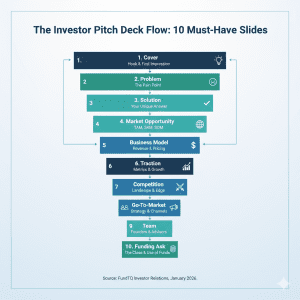
Checklist items (usually 10-12 slides):

  • Overview and mission
  • Solving the problem and the issue
  • Market opportunity
  • Printed product demo/screenshots
  • Business model
  • Traction and milestones
  • Marketing and sales strategy
  •  Team
  •  Financials
  • Question (how much money and use)

Some of the pitch deck errors to avoid include having too many on-screen words, omitting the traction or being ambiguous about your finances.

5. Provide a Legislation Base

Investors are going to demand legal compliance within your startup. Make sure that your business is incorporated and does have the necessary registrations.

Checklist Items:

  • Company incorporation documents (MoA, AoA, PAN, TAN)
  • Goodwill, founders agreement and equity dividing
  • Cap table (realistic and actualized)
  • Licensing and ownership of IPs
  • Contracts of employees and NDA

6. Present Traction and Metrics

Investors are not only interested in how to validate your growth, but they want to see some indicators of growth or validation even though you are at the MVP or early revenue stage.

Checklist Items:

  • Active monthly users (MAU) / Daily active users (DAU)
  • Sales or preorders
  • Case studies or testimonies made by customers
  • Retention/churn
  • The downloading of apps or visits to websites
  • Collaboration or test customers

These measurements validate that you fit within your market and eliminate the perceived risk in the eyes of the investor.

7. Understand Your Strategy on Valuation

A practical sense of the value of your startup is what you must have (at least in the case of equity financing).

Checklist Items:

  • Present Fair valuation (based on revenue, number of users or similar startups)
  • Post-money and pre-money valuation knowledge
  • Rate of equity you are offering
  • Option pools (in case of any)
  • Rationale of valuation

It is recommended to consider a startup valuation software or even valuation experts to develop a possible solution to defend.

8. Get ready to conduct Due Diligence

After a term sheet has been provided, investors will get down to the bone. Preparation of due diligence materials is time-saving and creates trust.

Checklist Items:

  • Due diligence data room (Google drive or dropbox)
  • Having all financial documents at one place
  • Access to product demo
  • KYC Founders
  • Trademarks or patent registrations
  • Minutes and board resolutions
  • Previous fundraising records (in case of any)

Another pro tip is to put testimonials, pitch videos, and product roadmap to make a difference.

9. Develop Target Investor List

Just don’t spray and pray. Find investors who have invested in startups or sectors of the same stage of development. Make your story match their interests.

Checklist Items:

  • Angel investments and VCs in the same business sphere
  • Local ecosystem actors (e.g. incubators, accelerators in India)
  • Mentors or advisors to carry out warm introductions
  • CRM, or tracking sheet (with the contact status, feedback, etc.) of the investor

Check out other platforms (AngelList, LetsVenture, or LinkedIn) to research and find relevant investors.

10. Practice Your Pitch to Investors

You can get the best documents but poor delivery can screw you up. Practice is the right way to go.

Checklist Items:

  •  Pitch script of 10 12 minutes
  •  Expected Q and A (market, financial and gaps in the team)
  •  Backup deck of deep-dive sessions
  •  Pitch sessions to mentor or startup communities
  •  Storytelling device, Why you, Why now, Why this product?

The investors will invest in teams as much as they will invest in ideas. Be self assured, articulate and teachable.

FundTQ? A Smart Tool for Modern Startup Fundraising

As non-professional investors get more choice in what they invest in, and especially when you need to attempt a preliminary test of investment, it is not enough to have a nice pitch, but rather, data, structure and strategic positioning. That’s where FundTQ comes in.

FundTQ is a next-generation fundraising intelligence platform built specifically for startups looking to raise capital in a smarter, faster, and more organized way. It is a digital fundraising assistant that helps its founders manage not just their fundraising materials but also finds them the correct investors, better tells their valuation story, and tracks their whole funding process.

Who Should Use FundTQ?

  • First-time startups still in the early stage
  • Founders having some problems in creating the pitch deck or valuation
  • Startups in the growth stage seeking focused access to investors
  • Indian startups that want to raise funds aligned with compliance

Conclusion:

FundTQ transforms how founders approach fundraising—from confusion to confidence. By integrating financial insights, investor targeting, and structured preparation in one platform, FundTQ equips startups to raise capital like pros.

If you’re starting your fundraising journey, adding FundTQ to your toolkit is one of the smartest moves you can make.

Making money is not all there is to fundraising, there is relationship, preparedness, and consideration.Investors and shareholders want structure, vision, and dedication.

FAQs 

Q1: What is a startup fundraising checklist?

A fundraising checklist is a step-by-step list of key items (documents, metrics, strategies) a startup should prepare before reaching out to investors.

Q2: Why is a fundraising checklist important?

It provides the preparedness, builds up the investor confidence, prevents legal/financial errors, and accelerates the fundraising process.

Q3: What are some of the documents that I need to prepare in order to meet investors?

These will include your pitch deck, your business plans, your financials, the cap table, legal documents and traction data.

Q4: What will be the amount of funding requested?

Raise sufficient to last 12-18 months runway or to your next milestone (a product, revenue or team milestone).

Q5: Which are the common pitfalls to avoid when fundraising a startup?

One of the pitfalls is overestimation of valuation, underdeveloped financials, poor articulation of funds use, and ineffective pitch deck.

Startup fundraising in Gurugram

Step-by-Step Guide to Startup Fundraising in Gurugram

Gurugram is commonly referred to as the Millennium City, which has quickly become one of the Indian startup hubs. It is close to Delhi, connected to international companies, has an increasing amount of coworking facilities, and an active hub of tech entrepreneurs, making it a good place to develop an early-stage business. Fundraising in startups does not solely deal with money: above all, the money validates a startup, may come with mentorship, and can lead to growth and long-term sustainability. Money facilitation is something that can open the doors to developing different businesses, which might involve teams, products, and market shares in a matter of weeks. Every entrepreneur wishing to be successful in such a fast-moving environment has to comprehend the way in which startup fundraising in Gurugram views the growing competition.

Step 1: Recognise the startup and funding ecosystem in Gurugram

Get to know the landscape of the Gurugram startup with its special landscape before raising capital. Major startup success stories, from Zomato to UrbanClap, have had their affectations on talent migration toward capital cities for close interaction with the top-tier VC firms and angel networks over the past 10 years.

Primary Shifters in the ecosystem of Gurugram:

  • Incubators & Accelerators: Early-stage stage mentorship, seed finance, and workspace is offered by Huddle, GHV Accelerator and Gurugram-based TIDES Business Incubator.
  • Government Initiatives: It has the Haryana Startup Policy which has incentives, such as, subsidized incubation, tax reliefs, or equity free grants.
  • Angel Networks: The Indian Angel Network (IAN), Gurgaon angels and Delhi angels are among the actively functional Indian angel networks who have been funding pre seed and seed stage companies.
  • Platforms: FundTQ is one of the tools that support founders to do outreach, organize documentations, and reach verified investors easily.

The entire seed funding process is supported by this thriving ecosystem, which is not only funding-ready but also abundant in investment banking services, legal professionals, and growth mentors.

Step 2: Work out a good business plan and authenticate your idea of startup

The level of selectivity by investors in Gurugram has been on the rise. In order to be different, make sure that your idea addresses a real problem that is in demand. Validation may comprise:

  • Growing a Minimum Viable Product (MVP)
  • User feedback collection
  • Adopting new customers/clients early
  • Analysis of competitors

Paying customers is a proven idea that gains investor confidence. Other indicators of a well-thought-out business that indicate your business startup is not merely an idea, but a scalable company are: a solid business model and realistic revenue projections.

Step 3: Know Your Funding Stage and What Investors Expect

Each startup has the stages of funding, where each of them has a distinct strategy and degree of preparation.

  • Pre-seed: Done before seed, friends and family money or grants. Target: MVP, traction at an early stage.
  • Seed: Product market fit, angel investors, early revenues. Target: Team, scalability, clientele.
  • Beyond and Series A: Preoccupied with rapid expansion and enormous institutional and VC investment in plasma. It is all about unit economics, market leadership and post-money valuations.

Knowing the things that each investing phase dislikes in a typical mistake during common fundraising such as pitching to VC at a too early stage or claiming your startup is overvalued.

Step 4: Prepare the Essential Fundraising Documents

Preparation is everything with respect to fundraising for startups. Two will have to come up with the following documents:

Pitch Deck: It would tell more about your idea, the market, traction, business model, and finance. Avoid common pitch deck mistakes such as crowded slides or poor messaging.

Business Plan: 15-20 page document addressing how you plan to run your business, what gives you an edge over your competitors, the market you have found and how you are going to implement your plan. It is also strategically clear and long-term.

Financial Forecasts: A 3 5 year forecast of revenues, costs, break-even and forecast cash flow. Tools like business valuation software or even startup-focused Excel templates can help.

Note that these are papers that indicate how credible you are. The pitch deck can either make it or break it, given that it is weak or not very accurate.

Step 5: Selecting the Appropriate Funding Source to Your Startup

Not every finance is the same. In Gurugram, here are available main sources of startups for startup fundraising in gurugram:

  • Angel Investors: Best suited during a seed stage. See how to identify local networks or high-net-worth who want to get passionate about your sector.
  • Venture Capital: it fits high-growth companies that are at-scale. Be ready with metrics like average ticket size and CAC to LTV ratios.
  • Government Grants: The Haryana Startup Policy provides equity-free funding to encourage innovation in sectors like AgriTech, EduTech, and medical device startup funding.
  • Incubators and Accelerators: They offer seed money, advice and resources against low equity shares.
  • Online Platforms: Platforms such as FundTQ make it possible to automate discovery of investors, document preparation and compliance with the funding process.

Your long-term goals, repayment capacity, and risk tolerance will all play a role in your decision between equity vs debt financing

Step 6: Establish a Strong Gurugram Network

When one is connected to the right circles, fundraising is made easy.

  • Events: Go to a meetup, a pitch competition, or a summit such as the TiE Delhi-NCR or Nasscom 10,000 Startups.
  • Coworking Hubs: Hubs such as WeWork and Innov8 and 91 Springboard, frequently lead investor evenings, mentorship programs and startup forums.
  • Online Communities: Join local Slack groups, WhatsApp communities, or Facebook groups focused on fundraising for startups in India.

Such networks are also of great help in getting through early obstacles and can result in warm intros, definitely the most productive leads to finding investors.

Step 7: Create and Rehearse a Successful Pitch

As a result, your pitch should be fact-based, succinct, and convincing.Note:

  • The issue and that inimitable idea of yours
  • Opportunity and market size
  • Go-to-market strategy
  • Team experience
  • Traction and financials

Train in front of coaches or budding entrepreneurs. Make a video recording and improve. Such tools as the Y Combinator template of pitching, or templates presented by FundTQ, may serve as an excellent beginning.

Step 8: Reach Out to Investors Strategically 

Do not fall into the mass email trap. Instead:

  • Investors in research that invests in your industry or phase
  • Utilize such agencies as FundTQ 
  • Utilize LinkedIn outreach database and startup databases
  • ors, incubators, or shared contacts to get referrals

Make your pitch unique to each investor. Be aware of the size of their portfolio, size of checks and preferences. Such a personalized process will increase interaction and reaction levels.

Step 9: Negotiate the Deal and Understand Term Sheets

In case your pitch is a success, you will be presented with a term sheet, which describes the terms of investment. The important clauses to be learnt:

  • The valuation (pre and post money)
  • Equity offered
  • Liquidation preference
  • Anti-dilution provisions
  • Board control

Negotiation does not imply a winner and loser, rather there is the need to walk alongside the interests. Don’t hesitate to consult investment banking services or legal advisors. They are able to decode legal terminologies and make fair terms.

Step 10: After Funding: Make Good Use of Capital and Update Investors

Getting funds just marks the start. The attention is now given to:

  • Investing in capital efficiently: Do not invest in vanity metrics; use the money to hire more team members, develop a product, or grow.
  • KPIs tracking: Investors will be updated on KPIs monthly to display responsibility.

Then, you should avoid some usual pitfalls like mindless growth, ineffective hiring, or scaling without planning. These are some reasons startups fail even after funding.

Keeping investors regularly updated on a company does not only help it develop a rapport with the investors but also paves the way to the next round of funding.

Conclusion 

Startup fundraising in Gurugram is an exciting but challenging path. The correct foundation-market research, financial discipline and networking, will help you open the doors to eventful growth.

Whether you’re in healthcare, medical equipment startups, or B2B SaaS, always remember: fundraising for healthcare or any sector demands clarity, vision, and resilience.

As a founder you will grow with each investor call, pitch revision, and rejection. Remain focused, exploit the Gurugram ecosystem and most of all work on tools such as FundTQ, and keep building. The cash will come towards.

Top Venture Capital Firms

India’s Top Venture Capital Firms & How They Define Their Investment Niche

Venture capital has emerged as the pillar of India’s startup ecosystem. And the success of any fundraising is covered with a long chain of VC firms that have a niche in mind and are sure about its potential risk and growth and are ready to support founders. Whether you’re a first-time entrepreneur or a startup looking for your next round, understanding top venture capital firms and what they look for is a must.

In this blog, we would cover how the major VC firms in India arrive at their niche, how founders should be ready to match with the right investor with the help of a tool like FundTQ, and why a good match can transform everything.

Why Investment Niches Matter in Venture Capital?

Definition: A niche investment is a particular industry or kind of a startup that a venture capital company favours to invest in. It is an expression of their touch, skills and contacts there.

VCs do not invest in any business, they select that suits their thesis. An investment fund aiming at health would not easily yield to a fashion market portfolio. Why? Since every industry is associated with varying business models, risks, and exit strategies. Through niches, VCs are able to:

  • Identify winning startups before they get popular
  • Give greater benefit to founders
  • Form stronger and more integrated portfolios

As a founder, it is important to know the niche of a VC to understand how to pitch correctly and have high prospects to receive money.

Also Read: How to Get Funding for a Startup Business?

Why FundTQ Is the Smart Way to Prep for Venture Capital?

FundTQ is a startup getting-ready platform that assists entrepreneurs in making better pitch decks, learning valuation, and identifying investor-fit using business profile. Before approaching any of the top venture capital firms, it’s important to understand how your startup fits into their focus area. FundTQ does so by:

  • Paring your startup with investors according to sector, stage and size
  • Providing the pitch deck gap feedback in real-time
  • Providing start-up valuation tools to give a fair equity value
  • It is the intelligent preparation measure prior to you ending up knocking at the door of a VC.

Understanding Niche Investment Strategy:

A niche investment strategy means a VC fund focuses on a specific type of company or sector. This is the reason why VC firms are dealing with niche strategies:

a) Expertise of the Deep Business

Companies such as Accel India or Lightspeed are familiar with SaaS or EdTech back to front. This aids them to test ideas more and quicker.

b) Network Industry

A HealthTech VC can also open founders to hospitals, labs, and regulators, all of which generalist investors may not be able to connect them with.

c) Synergy in Portfolio

Startups within the same niche are able to cooperate. By way of example, a FinTech portfolio could consist of lending apps, KYC, and payment gateways, the one supporting the other.

d) Speedy Decision-Making

With a niche knowledge, VCs can work swiftly since they are aware of the trend, pitfalls, and potentials of the market.

Read About: How Do Investors Value a Startup With No Revenue?

India’s Top Venture Capital Firms and Their Niches

Here’s an updated list showing the top Venture Capital  firms in India, along with the main areas of investment and some notable investments they have made:

VC Firm Known For Notable Investments
Sequoia India (Peak XV) Multi-sector, strong in SaaS & FinTech Freshworks, Razorpay, CRED
Accel India SaaS, Marketplaces, Consumer Tech Flipkart, Swiggy, UrbanClap
Matrix Partners India B2C, FinTech, SaaS Ola, Razorpay, Dailyhunt
Blume Ventures Early-stage tech startups Dunzo, Unacademy, Slice
Lightspeed India DeepTech, SaaS, EdTech ShareChat, Udaan, BYJU’S
3one4 Capital FinTech, HealthTech, ClimateTech Koo, Licious, Jupiter
Kalaari Capital Consumer Internet, HealthTech Zivame, Cure.fit, Myntra
India Quotient Bharat-focused consumer tech ShareChat, Lendingkart
Elevation Capital FinTech, SaaS, Consumer Tech Paytm, NoBroker, Meesho
Better Capital Pre-seed/seed in SaaS, FinTech, Health Teachmint, Khatabook, Open

Useful Read: SME Growth Strategies and how VC-backed startups scale rapidly.

How VC Firms Choose Their Niches?

VCs do not arbitrarily select industries- they rely on trends, numbers and their expertise to know what sectors they intend to conquer.
Here’s what goes into picking a niche:

a) Market potential

The bigger the growing markets the more VC will pay attention. The scale is the reason why FinTech, SaaS, and EdTech are popular.

b) Founder Quality

VCs adore founders who understand the domain and are executable and gritty. A niche helps them realize such traits easier.

c) New way of doing things/Disruption

Companies support the concepts that reshape the status quo, such as Razorpay in payment processes or Meesho in social commerce.

d) Consistency with Team Expertise

A large number of VCs employ partners who have worked in a certain sector. Their experiences determine their investment prospect in the firm.

Generalist vs Specialist: The Evolution of Indian VCs

Generalist VC is an investor who has a wide-spread distribution and can make investments in many industries; specialist VC is an investor who concentrates on a thin slice. Originally, most of the Indian VC firms began as generalists. However, in the recent decade, the specialization has expanded.

Why?

  • Startups are complicated: SaaS companies and a startup in the AgriTech sector require absolutely different support.
  • LPs (means investors in VC funds) want transparency: Investors who support VC funds today are demanding specific strategies.
  • Faster results in areas of strengths: When VC firms specialize, their success rates are usually higher within their areas of strengths.

Examples:

Experts: Lightspeed in EdTech, SaaS and FinTech 3one4 Capital in FinTech, HealthTech

Generalists Peak XV (formerly Sequoia India), Blume Ventures

Tech-Enabled Sectors Are the New Favorites:

Traditional industries like finance, education, healthcare, and logistics are disrupted by technology in tech-enabled sectors. Indian VCs most desired sector is that of tech-enabled sectors where conventional industries are served by technology to reshape them into new ways. Industries such as Fintech (e.g. UPI, digital lending, insurtech), SaaS (India-built software tools that are consumed worldwide, such as Freshworks), Healthtech (digital healthcare and fitness) and Edtech (online learning and upskilling) are in the prerequisite of heavy investments. They also are high-growth areas that have a large global footprint, and those that address a real-world problem. This makes them excellent venture investments.

Get free pitch deck templates and business valuation with our free business valuation software

FAQs:

1. What does the term investment niche mean in venture capital?

An investment niche is the kind of sectors or categories of startups in which a VC firm focuses and operates, such as SaaS, FinTech, HealthTech etc. It helps them to invest and have knowledge.

2. How do I know which VC firms are right for my startup?

Find out their portfolio using such tools as FundTQ or by checking the VC firm site. Pay attention to companies that have invested in businesses of similar stage, sector and geography as yours.

3.Is it okay to approach generalist VC firms?

Yes, but even generalist firms do have preferences. Just ensure your startup falls under at least a single one of their core investment themes or wins.

4. Are there benefits besides funding in niche-applicable VCs?

Absolutely. They tend to offer more industry connectivity, more meaningful mentorship, access to expertise sources, and introductions to partners or acquirers.

5. How early do VCs invest?

Other companies such as Better Capital put their money in seed and pre-seed rounds. Others such as Peak XV do Series A and up.Pitching without checking organisation focus on the stage will never resound to be a good idea.

Get business Funding
Key Takeaways :

  • In India, venture capital is already getting niche-driven, where the firms work on what they know best.
  • To grow strategically, not only to secure funding, but also to match your startup with the right VCs is a crucial step.
  • Tools such as FundTQ enable startups to prepare, as well as measure their readiness, find investors and create more respectable and more appropriate pitches.
  • Learning the niche of a VC is going to enhance your success and long lasting relations with the VC.
  • Never pitch in the dark, research, portfolio check and always always customise your deck depending on the thesis of the fund.

Conclusion:

Top Venture Capital Firms in India is no longer a generic world, it is increasingly becoming subtle and niche-focused. The VC firms have now become strategic partners, who do not only come to the table with capital. They provide suggestions, networking, employment assistance, market entry strategies and merger and acquisition strategies. However, all this is subject to a single major bit, how well your startup lines up with their investment thesis. When you develop a HealthTech application, it is useless to present it to a consumer retail-oriented VC, despite the fact that you have strong results. Conversely, the more you can align your pitch with a fund that has a mandate to breathe and live HealthTech, the better you are likely to be ten-fold. These companies know where you hurt, what your customer paths are, and what regulatory problems you have and much more, even the companies you are planning to switch to.

With the help of smart prep tools, such as FundTQ, founders can prevent the mismatched investor chat and save their time as well as open the doors to funds that are actively seeking a business like their one. 25 and beyond, it is not enough to know your customer, it is important to know your investor niche.

A start-up, which approaches venture capitalists by researching target areas, and aligning their outreach will rise faster—and stronger.


First Startup Funding

My First Startup Funding: What Worked (and What Didn’t)

Raising your first startup funding isn’t a straight path. It is a combination of ambition and confusion and being haphazard a lot. I thought having a great idea was enough. Spoiler alert- it was not. The next thing was an uncontrollable ride of funding errors, pitch fails and then, success.

Here’s what worked, what did not and how to raise smarter.

The Vision That Started It All

My B2B SaaS product was created to help small manufacturers optimize their supply chain with the idea of cleaning up the procurement process plaguing so many small and medium-sized enterprises through thousands of stories told to me. It is an exciting thought, and with investment banking being the future of the startup world, it felt like money was within a pitch.

What I had:

  • Passion which would stop a room
    I trusted the issue that was being resolved and was passionate about creating something that could make a difference. I can say countless words about our vision. However, passion though significant, does not seal deals.
  • Minimum Viable Product (MVP)
    We had an operational model. It was not exactly beautiful, but it demonstrated that we were able to perform. In fundraising for startups, even a basic MVP can be your biggest asset early on.
  • One Progressive Customer
    One of our SMEs had begun utilising our platform and this gave us a small insight into product-market fit. Just a single customer will tell a lot to some kinds of investors as long as you emphasize it properly.
  • A Two Person Founder Team
    As a team, we were very lean, committed and wearing many hats, including just me and my co-founder. We were skilled technically and in the domain and we were full time.

However, as it turned out to me later, those elements are not enough to get you funded.

What I lacked:

  •  A Strategy for Business Valuation
    I was at a loss for words when an investor inquired about the value of our business. I hadn’t even researched business valuation software or known what determines a startup’s value, particularly for a non-profit organization. I discovered the hard way that narrative, traction, and benchmarks are just as important to valuation as numbers. I later used the free business valuation tool from FundTQ, which provided me with a range that was reasonable and suitable for investors.
  • A Pitch Deck That Is Precise and Powerful
    Our initial pitch deck was a complete mess, with slides that were overly wordy, lacked a visual narrative, and lacked important components like financial projections, expectations for post-money valuation, and a well-defined go-to-market plan. The errors were typical of a pitch deck. No investor made it through.
  • Investor Intelligence
    I was emailing VCs blindly,without knowing their average ticket size, sector focus, or investment stage. I was unaware that locating investors is a real skill that calls for investigation, customisation, and knowledge of what each investor is actually seeking.
  •  Unaware of Investment Banks
    I was not aware of the role of Investment Banking Services into start-up financing. Did they perform the role of  Middlemen? Advisors? All I understood was that they were threatening, and I did not know how and when to address them.

What Didn’t Work ?(Mistakes I Made Early On)

  • Absence of a clear value proposition
    I was unable to sum up our product in a single sentence. That is an issue. Certain investor types seek clarity. Without clarity, there would be no funding.
  • Weak First Impression = Poor Pitch Deck
    We skipped over the basics— I hadn’t read up on pitch deck mistakes, and it showed. I left out essential slides like go-to-market strategy, unit economics and post money valuation expectations.
  • No prepared business valuation
    When an angel investor asked, “What’s your startup worth?”I went into a panic. I had no data. Software for zero business valuation. No responses.
  •  Constructed a poor pitch to investors
    I was sending Series B-focused VCs decks. I had no idea how to locate investors who fit into niche markets like medical equipment startups or seed funding.

A big lesson? Investor fit is important.

What Finally Worked?

After a few rejections, I paused. I stopped pitching and started listening. And that made all the difference.

  • Refined My Pitch Deck (Thanks to Templates)
    I discovered well-structured templates of pitch decks that founders can use and restructure my entire story. Every slide served a definite purpose: there were the problem statements, the financial projections. The narrative was flowing now and investors remained with the deck up to the end.
  • Understood My Business Valuation
    Using FundTQ’s free Business Valuation Tool, I finally got a realistic idea of what my business was worth—even without revenue. The tool provided me with a ballpark, using the market standards, founder risk and average ticket size in our industry.
  • Built an Advisory Boards
    I brought in two experienced mentors as advisors—one from manufacturing, one from investment banking services. Their connections gave me opportunities that I would not have realised.
  • Proof of Traction
    We acquired two retaining customers and enhanced the retention rates. It wasn’t scale yet, but it was validation—something all types of investors look for, especially in fundraising for startups in India.
  • Investor Fit
    I quit looking at VCs and enrolled in a local startup network where I discovered two angel investors. We had a common space as they had invested in medical start-up equipment previously. This orientation altered the whole mood of our discussions.

The “Yes” That Changed Everything!

It took five months of cold emails, personal introductions, investor meetings, and 12 rejections until I got to hear the words every founder was hoping to hear: We are in. Not a mega-round, with 50 lakhs of seed funding  in the form of equity. Still, it was sufficient to draw out some runway and recruit a sales team, as well as plan a bigger round. The initial “yes” not only confirmed my business, but all the failures that I had gone through.

The learning? It is not enough to find somebody to give you the check, but to find the alignment with the investors, trust, and non-money value.

Final Takeaways for First-Time Founders:

If you’re preparing to raise your first startup funding, here’s what I wish I knew at the beginning:

  • Stop chasing  funding—chase clarity. Learn about your customers, your business model and your vision. Confidence is created through clarity.
  • Take advantage of the appropriate tools. FundTQ’s business valuation software helped me estimate valuation credibly. Do not wing it but support it with data.
  • Get the right people to talk to. Not every money is good money. Seek out investors that match your stage, vision and industry.
  • Show traction. A success even in minor victories is important. All those lead to a reduction in perceived risk: early customers, back orders, use cases.
  • Don’t get discouraged. All the no takes you to an improved yes. Remain strong, and take lessons about rejection.

The other essential point which should be comprehended is that both fundraising vs bootstrapping  are acceptable, depending on the desired rate of growth, on your level of risk aversion and on the market in which you operate.

Ready to Raise Your First Startup Funding?

Here’s how you can begin the right way:

  • Determine the value of your company first. Try the free Business Valuation Tool from FundTQ.
  • Tell your story correctly. Get FundTQ’s  Founders’ Pitch Deck Templates here.
  • Recognise the expectations of investors. Discover the differences between Equity vs Debt Financing as well as the seed funding process.
  • Make contact with the appropriate individuals. Learn how to locate investors by round size and sector.
  • To begin with, if you’re entering deep tech, building a medical device startup, or scaling SME strategies, make the most of your first round of funding with a strong plan.

Conclusion:

In fact, proving that you have created something worthwhile is far more important than merely impressing investors with hype when trying to secure your first startup funding. Rejections are inevitable. Of course, the fundraising process will have mistakes. But money is not the only thing which makes belief to rise higher, but the combination of clarity, traction, and storytelling.

And this is all the difference.

Get Investor for startup

Trust as a Growth Strategy: What Investors Want from Founders?

In the high-stakes world of startups, where funding decisions can be made in days and fortunes won or lost in quarters, investors trust isn’t just a nice-to-have — it’s a strategic asset. Product development, market penetrations, and pitch decks are some of the issues that founders pay attention to. However, it is not analytics and concepts which make an investor write that check. It is faith – in the integrity, skill and dedication of the founder. Differently put, it is faith.

Such trust is even more essential in new ecosystems such as fundraising for startups in India, where venture capital is proliferating, yet trust is hard because of the historical experiences of misreporting, overvaluation, and governance failure. Investors gamble on humans rather than statistics. This blog discusses why trust is fundamental in the relationship between investors and why a person can be perceived as trustworthy, and how to portray that to investors at every fundraising level.

Why Trust Matters to Investors?

Start up investing is not a smooth straight forward process. It entails enormous risk, lack of complete knowledge and reliance on future potentiality. This is the reason why the aspect of trust comes at the heart of decision making process of all those investors:

a. High-Risk Environment

Startups work under a volatile environment. There can be a product pivot, passing market conditions, and faster-scaled competitors. Investors are not in a position to either stop or affect these variables, but they will be able to have control over the people whom they partner with. The inherent risk can be countered by confidence in the decision making of a founder, his resilience and truthfulness.

b. Long-Term Relationships

Venture investments are very long-term ventures-unlike stock market where one probably expects gains at the end of the year. This renders trust as an essential part of the founder-investor relationship. It turns out that investors rather prefer those founders who can be increased to greatness, supported in difficult moments, and hailed during prosperous ones.

c. Uncertainty Based Decision-Making

A lot of investment decisions are done on partial information. In this case, financial diligence is equivalent to emotional due diligence. Integrity usually becomes the show stopper when there are conflicting measures.

Key Traits Investors Look for in Trustworthy Founders:

The venture capitalists, angel investors and even strategic investors have devised intuitive radars of testing founder credibility. The characteristics that they all approve of would be:

A. Transparency

Transparency is more likely to build the Investors trust  with founders who are willing to discuss the problems, mistakes, and learning. It is a sign of maturity and sense of risk.

B. Consistency

This message and action should be ensured not only in pitch meetings but also after funding in telephone conversations with a consistent image established. Changing stories are misleading and would destroy confidence.

C. Execution ability

Trust does not only belong to the emotional realm it is an act. Letting a founder state that an MVP will be delivered in three months and a founder delivers it in two, that would prove to be a level of trust.

D. Inclination to take feedback Openness to Feedback

Perfection is not awaited by investors. They do require modest posturing though. Entrepreneurs who accept criticism and go to work on it create a spirit of working together.

E. Integrity of Financials

Fuzzy math is a halo mark. Founders who are trustworthy are conservative on projections, rigorous on accounting and open on burn rates. Clean cap tables and sound post money valuation make it look good.

Tools That Strengthen Trust

Contemporary founders can use tools that can strengthen investor confidence. These are not just good practice, these are the aspects of strategic trust-building.

A. Business Valuation Software

Tools like FundTQ or comparable business valuation software help startups demonstrate professional-grade financial planning and fair valuation. These instruments lower the level of subjectivity and allow objective-based negotiations.

B. Pitch Deck Templates of Investor-Raising

The thing is that clarity, completeness, and professionalism can be guaranteed through well-reviewed pitch deck templates and the absence of common pitch deck mistakes. They assist the founders to develop a story and to state it in a logistic manner.

C. Clean Reporting and Regular Updates

Monthly, or even quarterly updates to investors, even those who are still prospects, generate momentum and participation. Such visible reporting systems, like automated dashboard, are indicators of maturity and discipline in execution.

Common Mistakes That Break Trust:

A. Over promising and under delivering

It is perhaps the greatest and most common pitfall, particularly, in the course of the seed funding. To impress investors, there are cases where founders overstate product launches, customer acquisition or revenue goals in an attempt to get an investor to invest.

After failing to attain those milestones, it does not only show inadequate forecasting but also impairs the reputation of the founder. Aspirants start thinking whether things will change in the future.

What to do instead: Form realistic goal time-bound assessment based end results. It is advisable to under promise and deliver the products quicker than the promise than to promise what you cannot deliver.

B. Hiding Bad News 

All startups take a detour – a goal is not met, a team member drops out, there is a bug in the product, or the market rejects it. The most unsatisfactory thing that a founder can do is to hide these problems before investors in the anticipation that things will automatically resolve themselves.

Such transparency gives a shortfall of trust. Investors do not want perfection, they want to be told the truth and to be accountable.

What to do instead: Take initiative to share the challenges, preferably with a solution in place. Credibility is fostered by being transparent even when the times are hard.

C. Unrealistic Financial Projections

When numbers are offered without any vivid assumptions and highly over taunted revenue projections, investors are bound to raise their eyebrows. The process of preparing financial projections must depend on logic, industry averages and market realities rather than wishful thinking.

When projections do not meet the market realities or previous performance, investors will consider manipulation or gullibility-both have a slippery effect on your credibility.

What to use instead: Structured models which can be found in business valuation software or scenarios explaining your assumptions. The main key  is transparency in numbers  to maintain investors’ trust.

D. Ignoring Competitor Activity

Comparative statements made in relation to the competitors during investor discussions may be perceived as arrogant behaviour or lack of knowledge of the market. There is no startup that exists without other startups around it–investors like to hear how you distinguish yourself, not that you feel there are other startups out there.

When you fail to do this, it will appear that you either forgot to do your homework or you are not ready to adapt.

What to use instead:  Recognise and openly give credit to the competitors and examine their strengths and weaknesses and show how your startup has a superior or more distinct value to the proposition.

D.Neglecting Legal and Compliance Issues

Startups often move fast and break things—but ignoring legal or compliance obligations can break investors trust beyond repair. This consists of intellectual property ( IP ) problems, unpaid taxes, or not having founder agreements, inappropriate ESOPs, or non-conformity in company regulations.

These concerns can be lurking behind the scenes and not arouse until it is too late, but when they do, they have the capability of causing due diligence to stall and deal momentum to be crushed.

What you can do instead: Get your IP, company structure, shareholder arrangements and compliance right early. It can be an idea to use legal services or websites providing startup compliance.

How to Build Trust Before, During, and After Fundraising?

Trust is not something that can be established one time but it is an ongoing process. This is how to do it at each of critical phases:

A. Before Fundraising

  • Map your story: Make your same story appear throughout your website, LinkedIn, investor notes, and pitch.
  • Check your figures: Employ the use of tools or advisors to make sure your numbers are justifiable and within the realms of reason.
  • Get warm intros: Trust is best established when you come in through each other, trusted people.
  • Write down what you learn: Post-mortems or case studies are a sign of self-reflection and candour.

B. During Fundraising

  • Have your data room in place: Be aggressive when it comes to supplying information. Recently a well-organised due diligence folder told much.
  • Keep communicating: Before making any conclusive decision, investors tend to stay quiet. Do not push them too hard on matters of keeping them informed.
  • Make assumptions clear: In the event that a market forecast or CAC value is made on assumptions, this should be stated.

C. After Fundraising

  • Deliver on-boarding packages: Establish Day 1 communication expectation, governing, and update requirements.
  • Provide quick victories: Even trivial gains after the capital injection will testify to them that they made a wise choice.
  • Be seen: Have consistent check-ins, post strategic decisions and ask for feedback.
  • Accept failures quickly: An example of a heartfelt apology and a remedy, is more effective than being silent.

How FundTQ Helps Build Investor Trust?

In the new data era of fundraising, the issue in the use of the right tools can often make an enormous difference in terms of how investors feel about your startup. One such tool making a mark in the ecosystem is FundTQ — an integrated platform designed specifically to support startup founders in navigating fundraising with transparency, structure, and credibility.

Here’s how FundTQ helps enhance investors trust:

A. Valuation that is Realistic and Defensible

FundTQ uses industry-compliant valuation methodologies to offer founders an unbiased and data-backed estimate of their company’s worth. Unlike arbitrary numbers that raise red flags, valuations derived through business valuation software like FundTQ are more likely to be accepted by sophisticated investors during negotiations.

B. Investor-Ready Compliance

From cap table structuring to compliance documentation, FundTQ guides startups through the due diligence process even before the funding round begins. This minimises wastage of time in back and forth and portrays the startup as fund ready boosting the credibility of the investors.

C. Proposal and Budget Template

On the platform, it is possible to access professionally designed templates of pitch decks and financial projection tools. These assets help founders avoid critical pitch deck mistakes and build a narrative aligned with investor expectations.

D. Formal Fundraising Process

FundTQ breaks down the seed funding process into actionable steps, enabling founders to track their fundraising journey from investor outreach to deal closure. This degree of formality indicates to investors that the capital raising is a matter of seriousness to the founder and he/she has made time to understand the process.

E. Investor Communication Dashboard

Once you’re in discussions with investors, FundTQ allows you to share your updates, documents, and financials in a secure, well-organized dashboard. It establishes a single point of truth that is both transparent and effective, and these features strengthen the element of trust.

In essence, FundTQ is more than a platform, it’s a strategic partner in making your fundraising journey more investor-friendly and credibility-driven.

Final Thoughts: Trust is Your Competitive Edge

It is used to go beyond experience and the number of rounds funding raised to actually build trust as the real differentiation in an ecosystem where virtually every pitch deck, AI generated predictions, and hyper-growth tales abound. Startups that build investors trust as a core strategy but not an afterthought that tend to go further, raise smarter capital, and attract long-term allies.

Other than raising funds, trust is also useful in major exits, improved partnership, and adaptive leadership. Trust is something that can become your anchor, and your strength in a space, where making fundraising mistakes, economic crises and rivalry is part of the order of things.

Therefore, be it bootstrapping, or requesting equity instead of debt financing, or when preparing for medical startup funding, founders cannot raise capital upon a vision, but they have to be able to fund it through trust.

Bootstrapping vs. Fundraising

Bootstrapping vs. Fundraising: Which One Is Right for Your Startup?

Bootstrapping vs. fundraising has become one of the biggest choices that every founder has to make in the vibrant world of startups. The choice will not only define the way your business develops, but also the type of control, risks, expectations with which you will schlep as a founder.

If you are working on your next SaaS unicorn or D2C brand, or even a marketplace, you decide to bootstrap it, or raise a round of funding, knowing how Bootstrapping vs. fundraising can make or break the growth process. 

In this BLOG, we are going to deconstruct each of them, reveal the strengths and weaknesses, and assist you in working out what suits your startup the most.

Must Read: How to Get Funding for a Startup Business?

What is Bootstrapping?

Bootstrapping describes any beginning or expansion of your business with your own money (personal savings), internal cash flows or restricted outside resources (friends/family). Quite simply it refers to self financing a startup without investor monies or venture financing.

It is common to most startups, particularly in the early days of the MVP (Minimum Viable Product) or product-market-fit stage, when they may not be able to raise the money easily, or they do need to raise money yet.

Advantages of Bootstrapping:

  • Absolute Corporate Decision Making: There are no investors or a board to whom you report. It is your road-map.
  • Equity Preservation: 100 percent of your business remains there. No dilution.
  • Financial Discipline: Bootstrapped companies tend to form lean establishments, where there is no wastage and unnecessary things.
  • Helps to Establish a Great Business Framework: You will only increase in size once your product or service has caught on and generated profits.
  • Exit Pressure Free: You are able to grow at your pace without the pressure of living up to unrealistic growth criteria of the investors.

Cons of Bootstrapping:

  • Availability of limited Capitals: The cash flows may be limited hence slow growth.
  • Improving Personal Financial Risk: You can put in personal savings and assume debt.
  • Difficult to Scale-Up Fast: It is difficult to go out and make big hires, go out and do marketing blitzes, and expand without external financing.
  • Burnout Risk: It is not uncommon that founders have to do a variety of activities, sometimes wearing many hats and are at risk of burnout.

What is Fundraising?

The fundraising is a task involved in acquiring capital through external funds including venture capitalists (VC), angel investors, accelerators or even crowd funding platforms. It is generally the exchange of ownership (equity) in exchange of capital.

The use of this method is appropriate in case you require quick growth or development of the products, marketing them or expanding in a way which cannot be funded by your existing income or bootstrapping.

 Pros of Fundraising:

  • Access to Larger Capital: You may indulge in extensive spending in product development, recruiting, advertising, and growth.
  • Faster Growth Trajectory: Coupled with sufficient funds, it is one of the ways in which you can however be able to capture a market share
    quicker than your competition.
  • Investor Network and Mentorship:
    Talent Attraction:
    Startups with funding are able to give more attractive packages, perks and ESOPs.
  • Validation and Media Attention:
    The fact that it is supported by known investors makes it more credible and it paves the way to the media and collaboration.

Cons of Fundraising:

  • Dilution of Ownership:
    You sell off some part of your company, sometimes the control as well.
  • Investor Pressure and Expectations:
    Value added Investors will demand increases in value, dividends and commonly the sale (IPO/acquisition), enough to potentially mandate dangerous decisions.
  • Time-Consuming Process:
    It is a long process of angling, due diligence and negotiation to raise the capital.
  • Shift in Vision and Strategy:
    It may be tempting you to pivot or scale to the areas not consistent with your initial mission.

Bonus Tip:
Startup looking for funds but unsure how to find your business valuation or create a pitch deck? Don’t worry! Try this free Business Valuation Calculator and ready-to-use Pitch Deck Templates—designed to help you raise smart, fast, and confidently.

Bootstrapping vs. Fundraising: Comparison Table

Feature Bootstrapping Fundraising
Capital Source Individual savings and company profits External investors (Angels, VCs, etc.)
Equity Ownership 100% with founders Shared with investors
Speed of Growth Slower, sustainable growth Faster, aggressive expansion
Decision-Making Power Solely with founders Shared with board/investors
Risk Level High personal financial risk Shared financial risk with investors
Investor Support Limited Access to mentorship, networks
Operational Flexibility High Moderate to low (depending on investors)
Exit Pressure None High (due to ROI expectations)

Which One Is Correct For You?

The decision between bootstrapping vs fundraising  is based on your market, business model, and attitude.  There is no universal solution, but the given below guiding questions may help you to consider what you want to do:

  • Do you need quick capital to get market share or develop your product on a rush?
    The nature of your business: In some cases, your business must proceed quickly you may have a first-mover advantage to gain or have invested heavily in technology upfront. You will need more capital than you, perhaps, can afford. Such example is the winner taking all in such industries as AI, logistics, or e-commerce. Bootstrapping may in this case drag you behind and enable your competitors to hop forward.
  • Is your business niche, service-oriented or B2B and has an opportunity of steady and organic growth?
    In cases where you have a niche of customers or when your start-up business provides high-margin services, then bootstrapping may be a better option. These models do not usually need a lot of capital at the outset and are instead tied to good relations, customer loyalty and business efficiency rather than blitz-scaling.
  • Do you want to relinquish equity and share power?
    This is because fundraising will bring on board third party stakeholders, including angel investors, and venture capitalists, who will have an influence on the growth of your company. This can benefit you in case you are not opposed to teamwork, formal management, and forfeiting ownership of some share. Otherwise bootstrapping will save your independence.
  • Are you interested in sustainable long term growth, independence and freedom?
    Bootstrapping is a strategy that fits your vision when, in order to achieve a profitable and long-term company on your own, you want to avoid the pressure of Wall Street-mandated growth targets and investor demands, as well as fundraising schedules. It is not as fast but then, it is all yours in terms of direction and choice.
  • Does your market deal sharply with competitive conditions or time-urgency (e.g. fintech, market places, fast-commerces)
    Fundraising can provide you with the muscle necessary to move quickly, attract quality personnel and beat competitors when time is of the essence. In such instances, bootstrapping may not give you an opportunity to grow at a pace that can keep you relevant.

Learn About: How Do Investment Banks Help Structure Large Funding Rounds?

Real Talk: Both Action and Talking are Done by Many Startups

Truth is, the journey isn’t binary.

Bootstrapping is one of the ways used by many successful startups, who then get funds. Such a hybrid allows proving traction, gaining credibility, and allowing to demand more advantageous conditions upon going to raise at long last.

For example:

  • Zoho, and Zerodha are unicorns which were bootstrapped.
  • Freshworks initially bootstrapped, and later took in VC cash to expand worldwide.
  • Never did Mailchimp ever raise any funds and leave with billions.

Even lean startups can seek grants, governmental funding or debt as it is the kind of money they can raise without being equity-related or belong to the realm of a group relying on traditional VC fundraising but they can fill in the gaps.

How FundTQ Can Help?

When it comes to fundraising, the investor scene may be too much to handle, especially when you are going through the process the first time with your startup. This is where FundTQ comes in. FundTQ is a fundraising enablement that assists startups to prepare, connect and close funding rounds in an efficient way. At FundTQ, we provide end-to-end support to all your future financing needs be it a seed-round, Series A or even venture debt, all this at the stage and sector of your startup. They offer an investor readiness service, a pitch deck / financial model and data room preparation, relevant investor outreach and data room management.

The strategic, smart insight is what is unique about them– they help founders, not only raise money, but help them raise it in smart ways. The team of FundTQ can help guarantee that you will be speaking to the right investors and people sharing your vision, business development path, and industry. FundTQ makes the fundraising process less frictional in bootstrapped startups who are ready to scale, or in early-stage ventures wanting to win the confidence of investors. They can also help in legal documentation, valuation strategy and closing support as well-which saves a great amount of time and money. In the bootstrapping vs fundraising debate, if you decide to raise capital, FundTQ can be your partner in securing the right funding at the right time, so you can focus on growing your business instead of getting lost in the paperwork.

Final Thoughts

There is no universal answer in the bootstrapping vs fundraising debate. It is a trade-off (among growth and control, speed and sustainability, risk and ownership). The most important thing is to be aligned with your own personal ambitions, as well as resources and goals because of your startup. Bootstrapping makes one strong. The fundraising creates momentum.

The most intelligent founders know the differences between the two and when it is appropriate to apply them.