First Startup Funding

My First Startup Funding: What Worked (and What Didn’t)

Raising your first startup funding isn’t a straight path. It is a combination of ambition and confusion and being haphazard a lot. I thought having a great idea was enough. Spoiler alert- it was not. The next thing was an uncontrollable ride of funding errors, pitch fails and then, success.

Here’s what worked, what did not and how to raise smarter.

The Vision That Started It All

My B2B SaaS product was created to help small manufacturers optimize their supply chain with the idea of cleaning up the procurement process plaguing so many small and medium-sized enterprises through thousands of stories told to me. It is an exciting thought, and with investment banking being the future of the startup world, it felt like money was within a pitch.

What I had:

  • Passion which would stop a room
    I trusted the issue that was being resolved and was passionate about creating something that could make a difference. I can say countless words about our vision. However, passion though significant, does not seal deals.
  • Minimum Viable Product (MVP)
    We had an operational model. It was not exactly beautiful, but it demonstrated that we were able to perform. In fundraising for startups, even a basic MVP can be your biggest asset early on.
  • One Progressive Customer
    One of our SMEs had begun utilising our platform and this gave us a small insight into product-market fit. Just a single customer will tell a lot to some kinds of investors as long as you emphasize it properly.
  • A Two Person Founder Team
    As a team, we were very lean, committed and wearing many hats, including just me and my co-founder. We were skilled technically and in the domain and we were full time.

However, as it turned out to me later, those elements are not enough to get you funded.

What I lacked:

  •  A Strategy for Business Valuation
    I was at a loss for words when an investor inquired about the value of our business. I hadn’t even researched business valuation software or known what determines a startup’s value, particularly for a non-profit organization. I discovered the hard way that narrative, traction, and benchmarks are just as important to valuation as numbers. I later used the free business valuation tool from FundTQ, which provided me with a range that was reasonable and suitable for investors.
  • A Pitch Deck That Is Precise and Powerful
    Our initial pitch deck was a complete mess, with slides that were overly wordy, lacked a visual narrative, and lacked important components like financial projections, expectations for post-money valuation, and a well-defined go-to-market plan. The errors were typical of a pitch deck. No investor made it through.
  • Investor Intelligence
    I was emailing VCs blindly,without knowing their average ticket size, sector focus, or investment stage. I was unaware that locating investors is a real skill that calls for investigation, customisation, and knowledge of what each investor is actually seeking.
  •  Unaware of Investment Banks
    I was not aware of the role of Investment Banking Services into start-up financing. Did they perform the role of  Middlemen? Advisors? All I understood was that they were threatening, and I did not know how and when to address them.

What Didn’t Work ?(Mistakes I Made Early On)

  • Absence of a clear value proposition
    I was unable to sum up our product in a single sentence. That is an issue. Certain investor types seek clarity. Without clarity, there would be no funding.
  • Weak First Impression = Poor Pitch Deck
    We skipped over the basics— I hadn’t read up on pitch deck mistakes, and it showed. I left out essential slides like go-to-market strategy, unit economics and post money valuation expectations.
  • No prepared business valuation
    When an angel investor asked, “What’s your startup worth?”I went into a panic. I had no data. Software for zero business valuation. No responses.
  •  Constructed a poor pitch to investors
    I was sending Series B-focused VCs decks. I had no idea how to locate investors who fit into niche markets like medical equipment startups or seed funding.

A big lesson? Investor fit is important.

What Finally Worked?

After a few rejections, I paused. I stopped pitching and started listening. And that made all the difference.

  • Refined My Pitch Deck (Thanks to Templates)
    I discovered well-structured templates of pitch decks that founders can use and restructure my entire story. Every slide served a definite purpose: there were the problem statements, the financial projections. The narrative was flowing now and investors remained with the deck up to the end.
  • Understood My Business Valuation
    Using FundTQ’s free Business Valuation Tool, I finally got a realistic idea of what my business was worth—even without revenue. The tool provided me with a ballpark, using the market standards, founder risk and average ticket size in our industry.
  • Built an Advisory Boards
    I brought in two experienced mentors as advisors—one from manufacturing, one from investment banking services. Their connections gave me opportunities that I would not have realised.
  • Proof of Traction
    We acquired two retaining customers and enhanced the retention rates. It wasn’t scale yet, but it was validation—something all types of investors look for, especially in fundraising for startups in India.
  • Investor Fit
    I quit looking at VCs and enrolled in a local startup network where I discovered two angel investors. We had a common space as they had invested in medical start-up equipment previously. This orientation altered the whole mood of our discussions.

The “Yes” That Changed Everything!

It took five months of cold emails, personal introductions, investor meetings, and 12 rejections until I got to hear the words every founder was hoping to hear: We are in. Not a mega-round, with 50 lakhs of seed funding  in the form of equity. Still, it was sufficient to draw out some runway and recruit a sales team, as well as plan a bigger round. The initial “yes” not only confirmed my business, but all the failures that I had gone through.

The learning? It is not enough to find somebody to give you the check, but to find the alignment with the investors, trust, and non-money value.

Final Takeaways for First-Time Founders:

If you’re preparing to raise your first startup funding, here’s what I wish I knew at the beginning:

  • Stop chasing  funding—chase clarity. Learn about your customers, your business model and your vision. Confidence is created through clarity.
  • Take advantage of the appropriate tools. FundTQ’s business valuation software helped me estimate valuation credibly. Do not wing it but support it with data.
  • Get the right people to talk to. Not every money is good money. Seek out investors that match your stage, vision and industry.
  • Show traction. A success even in minor victories is important. All those lead to a reduction in perceived risk: early customers, back orders, use cases.
  • Don’t get discouraged. All the no takes you to an improved yes. Remain strong, and take lessons about rejection.

The other essential point which should be comprehended is that both fundraising vs bootstrapping  are acceptable, depending on the desired rate of growth, on your level of risk aversion and on the market in which you operate.

Ready to Raise Your First Startup Funding?

Here’s how you can begin the right way:

  • Determine the value of your company first. Try the free Business Valuation Tool from FundTQ.
  • Tell your story correctly. Get FundTQ’s  Founders’ Pitch Deck Templates here.
  • Recognise the expectations of investors. Discover the differences between Equity vs Debt Financing as well as the seed funding process.
  • Make contact with the appropriate individuals. Learn how to locate investors by round size and sector.
  • To begin with, if you’re entering deep tech, building a medical device startup, or scaling SME strategies, make the most of your first round of funding with a strong plan.

Conclusion:

In fact, proving that you have created something worthwhile is far more important than merely impressing investors with hype when trying to secure your first startup funding. Rejections are inevitable. Of course, the fundraising process will have mistakes. But money is not the only thing which makes belief to rise higher, but the combination of clarity, traction, and storytelling.

And this is all the difference.

Get Investor for startup

Trust as a Growth Strategy: What Investors Want from Founders?

In the high-stakes world of startups, where funding decisions can be made in days and fortunes won or lost in quarters, investors trust isn’t just a nice-to-have — it’s a strategic asset. Product development, market penetrations, and pitch decks are some of the issues that founders pay attention to. However, it is not analytics and concepts which make an investor write that check. It is faith – in the integrity, skill and dedication of the founder. Differently put, it is faith.

Such trust is even more essential in new ecosystems such as fundraising for startups in India, where venture capital is proliferating, yet trust is hard because of the historical experiences of misreporting, overvaluation, and governance failure. Investors gamble on humans rather than statistics. This blog discusses why trust is fundamental in the relationship between investors and why a person can be perceived as trustworthy, and how to portray that to investors at every fundraising level.

Why Trust Matters to Investors?

Start up investing is not a smooth straight forward process. It entails enormous risk, lack of complete knowledge and reliance on future potentiality. This is the reason why the aspect of trust comes at the heart of decision making process of all those investors:

a. High-Risk Environment

Startups work under a volatile environment. There can be a product pivot, passing market conditions, and faster-scaled competitors. Investors are not in a position to either stop or affect these variables, but they will be able to have control over the people whom they partner with. The inherent risk can be countered by confidence in the decision making of a founder, his resilience and truthfulness.

b. Long-Term Relationships

Venture investments are very long-term ventures-unlike stock market where one probably expects gains at the end of the year. This renders trust as an essential part of the founder-investor relationship. It turns out that investors rather prefer those founders who can be increased to greatness, supported in difficult moments, and hailed during prosperous ones.

c. Uncertainty Based Decision-Making

A lot of investment decisions are done on partial information. In this case, financial diligence is equivalent to emotional due diligence. Integrity usually becomes the show stopper when there are conflicting measures.

Key Traits Investors Look for in Trustworthy Founders:

The venture capitalists, angel investors and even strategic investors have devised intuitive radars of testing founder credibility. The characteristics that they all approve of would be:

A. Transparency

Transparency is more likely to build the Investors trust  with founders who are willing to discuss the problems, mistakes, and learning. It is a sign of maturity and sense of risk.

B. Consistency

This message and action should be ensured not only in pitch meetings but also after funding in telephone conversations with a consistent image established. Changing stories are misleading and would destroy confidence.

C. Execution ability

Trust does not only belong to the emotional realm it is an act. Letting a founder state that an MVP will be delivered in three months and a founder delivers it in two, that would prove to be a level of trust.

D. Inclination to take feedback Openness to Feedback

Perfection is not awaited by investors. They do require modest posturing though. Entrepreneurs who accept criticism and go to work on it create a spirit of working together.

E. Integrity of Financials

Fuzzy math is a halo mark. Founders who are trustworthy are conservative on projections, rigorous on accounting and open on burn rates. Clean cap tables and sound post money valuation make it look good.

Tools That Strengthen Trust

Contemporary founders can use tools that can strengthen investor confidence. These are not just good practice, these are the aspects of strategic trust-building.

A. Business Valuation Software

Tools like FundTQ or comparable business valuation software help startups demonstrate professional-grade financial planning and fair valuation. These instruments lower the level of subjectivity and allow objective-based negotiations.

B. Pitch Deck Templates of Investor-Raising

The thing is that clarity, completeness, and professionalism can be guaranteed through well-reviewed pitch deck templates and the absence of common pitch deck mistakes. They assist the founders to develop a story and to state it in a logistic manner.

C. Clean Reporting and Regular Updates

Monthly, or even quarterly updates to investors, even those who are still prospects, generate momentum and participation. Such visible reporting systems, like automated dashboard, are indicators of maturity and discipline in execution.

Common Mistakes That Break Trust:

A. Over promising and under delivering

It is perhaps the greatest and most common pitfall, particularly, in the course of the seed funding. To impress investors, there are cases where founders overstate product launches, customer acquisition or revenue goals in an attempt to get an investor to invest.

After failing to attain those milestones, it does not only show inadequate forecasting but also impairs the reputation of the founder. Aspirants start thinking whether things will change in the future.

What to do instead: Form realistic goal time-bound assessment based end results. It is advisable to under promise and deliver the products quicker than the promise than to promise what you cannot deliver.

B. Hiding Bad News 

All startups take a detour – a goal is not met, a team member drops out, there is a bug in the product, or the market rejects it. The most unsatisfactory thing that a founder can do is to hide these problems before investors in the anticipation that things will automatically resolve themselves.

Such transparency gives a shortfall of trust. Investors do not want perfection, they want to be told the truth and to be accountable.

What to do instead: Take initiative to share the challenges, preferably with a solution in place. Credibility is fostered by being transparent even when the times are hard.

C. Unrealistic Financial Projections

When numbers are offered without any vivid assumptions and highly over taunted revenue projections, investors are bound to raise their eyebrows. The process of preparing financial projections must depend on logic, industry averages and market realities rather than wishful thinking.

When projections do not meet the market realities or previous performance, investors will consider manipulation or gullibility-both have a slippery effect on your credibility.

What to use instead: Structured models which can be found in business valuation software or scenarios explaining your assumptions. The main key  is transparency in numbers  to maintain investors’ trust.

D. Ignoring Competitor Activity

Comparative statements made in relation to the competitors during investor discussions may be perceived as arrogant behaviour or lack of knowledge of the market. There is no startup that exists without other startups around it–investors like to hear how you distinguish yourself, not that you feel there are other startups out there.

When you fail to do this, it will appear that you either forgot to do your homework or you are not ready to adapt.

What to use instead:  Recognise and openly give credit to the competitors and examine their strengths and weaknesses and show how your startup has a superior or more distinct value to the proposition.

D.Neglecting Legal and Compliance Issues

Startups often move fast and break things—but ignoring legal or compliance obligations can break investors trust beyond repair. This consists of intellectual property ( IP ) problems, unpaid taxes, or not having founder agreements, inappropriate ESOPs, or non-conformity in company regulations.

These concerns can be lurking behind the scenes and not arouse until it is too late, but when they do, they have the capability of causing due diligence to stall and deal momentum to be crushed.

What you can do instead: Get your IP, company structure, shareholder arrangements and compliance right early. It can be an idea to use legal services or websites providing startup compliance.

How to Build Trust Before, During, and After Fundraising?

Trust is not something that can be established one time but it is an ongoing process. This is how to do it at each of critical phases:

A. Before Fundraising

  • Map your story: Make your same story appear throughout your website, LinkedIn, investor notes, and pitch.
  • Check your figures: Employ the use of tools or advisors to make sure your numbers are justifiable and within the realms of reason.
  • Get warm intros: Trust is best established when you come in through each other, trusted people.
  • Write down what you learn: Post-mortems or case studies are a sign of self-reflection and candour.

B. During Fundraising

  • Have your data room in place: Be aggressive when it comes to supplying information. Recently a well-organised due diligence folder told much.
  • Keep communicating: Before making any conclusive decision, investors tend to stay quiet. Do not push them too hard on matters of keeping them informed.
  • Make assumptions clear: In the event that a market forecast or CAC value is made on assumptions, this should be stated.

C. After Fundraising

  • Deliver on-boarding packages: Establish Day 1 communication expectation, governing, and update requirements.
  • Provide quick victories: Even trivial gains after the capital injection will testify to them that they made a wise choice.
  • Be seen: Have consistent check-ins, post strategic decisions and ask for feedback.
  • Accept failures quickly: An example of a heartfelt apology and a remedy, is more effective than being silent.

How FundTQ Helps Build Investor Trust?

In the new data era of fundraising, the issue in the use of the right tools can often make an enormous difference in terms of how investors feel about your startup. One such tool making a mark in the ecosystem is FundTQ — an integrated platform designed specifically to support startup founders in navigating fundraising with transparency, structure, and credibility.

Here’s how FundTQ helps enhance investors trust:

A. Valuation that is Realistic and Defensible

FundTQ uses industry-compliant valuation methodologies to offer founders an unbiased and data-backed estimate of their company’s worth. Unlike arbitrary numbers that raise red flags, valuations derived through business valuation software like FundTQ are more likely to be accepted by sophisticated investors during negotiations.

B. Investor-Ready Compliance

From cap table structuring to compliance documentation, FundTQ guides startups through the due diligence process even before the funding round begins. This minimises wastage of time in back and forth and portrays the startup as fund ready boosting the credibility of the investors.

C. Proposal and Budget Template

On the platform, it is possible to access professionally designed templates of pitch decks and financial projection tools. These assets help founders avoid critical pitch deck mistakes and build a narrative aligned with investor expectations.

D. Formal Fundraising Process

FundTQ breaks down the seed funding process into actionable steps, enabling founders to track their fundraising journey from investor outreach to deal closure. This degree of formality indicates to investors that the capital raising is a matter of seriousness to the founder and he/she has made time to understand the process.

E. Investor Communication Dashboard

Once you’re in discussions with investors, FundTQ allows you to share your updates, documents, and financials in a secure, well-organized dashboard. It establishes a single point of truth that is both transparent and effective, and these features strengthen the element of trust.

In essence, FundTQ is more than a platform, it’s a strategic partner in making your fundraising journey more investor-friendly and credibility-driven.

Final Thoughts: Trust is Your Competitive Edge

It is used to go beyond experience and the number of rounds funding raised to actually build trust as the real differentiation in an ecosystem where virtually every pitch deck, AI generated predictions, and hyper-growth tales abound. Startups that build investors trust as a core strategy but not an afterthought that tend to go further, raise smarter capital, and attract long-term allies.

Other than raising funds, trust is also useful in major exits, improved partnership, and adaptive leadership. Trust is something that can become your anchor, and your strength in a space, where making fundraising mistakes, economic crises and rivalry is part of the order of things.

Therefore, be it bootstrapping, or requesting equity instead of debt financing, or when preparing for medical startup funding, founders cannot raise capital upon a vision, but they have to be able to fund it through trust.

Bootstrapping vs. Fundraising

Bootstrapping vs. Fundraising: Which One Is Right for Your Startup?

Bootstrapping vs. fundraising has become one of the biggest choices that every founder has to make in the vibrant world of startups. The choice will not only define the way your business develops, but also the type of control, risks, expectations with which you will schlep as a founder.

If you are working on your next SaaS unicorn or D2C brand, or even a marketplace, you decide to bootstrap it, or raise a round of funding, knowing how Bootstrapping vs. fundraising can make or break the growth process. 

In this BLOG, we are going to deconstruct each of them, reveal the strengths and weaknesses, and assist you in working out what suits your startup the most.

Must Read: How to Get Funding for a Startup Business?

What is Bootstrapping?

Bootstrapping describes any beginning or expansion of your business with your own money (personal savings), internal cash flows or restricted outside resources (friends/family). Quite simply it refers to self financing a startup without investor monies or venture financing.

It is common to most startups, particularly in the early days of the MVP (Minimum Viable Product) or product-market-fit stage, when they may not be able to raise the money easily, or they do need to raise money yet.

Advantages of Bootstrapping:

  • Absolute Corporate Decision Making: There are no investors or a board to whom you report. It is your road-map.
  • Equity Preservation: 100 percent of your business remains there. No dilution.
  • Financial Discipline: Bootstrapped companies tend to form lean establishments, where there is no wastage and unnecessary things.
  • Helps to Establish a Great Business Framework: You will only increase in size once your product or service has caught on and generated profits.
  • Exit Pressure Free: You are able to grow at your pace without the pressure of living up to unrealistic growth criteria of the investors.

Cons of Bootstrapping:

  • Availability of limited Capitals: The cash flows may be limited hence slow growth.
  • Improving Personal Financial Risk: You can put in personal savings and assume debt.
  • Difficult to Scale-Up Fast: It is difficult to go out and make big hires, go out and do marketing blitzes, and expand without external financing.
  • Burnout Risk: It is not uncommon that founders have to do a variety of activities, sometimes wearing many hats and are at risk of burnout.

What is Fundraising?

The fundraising is a task involved in acquiring capital through external funds including venture capitalists (VC), angel investors, accelerators or even crowd funding platforms. It is generally the exchange of ownership (equity) in exchange of capital.

The use of this method is appropriate in case you require quick growth or development of the products, marketing them or expanding in a way which cannot be funded by your existing income or bootstrapping.

 Pros of Fundraising:

  • Access to Larger Capital: You may indulge in extensive spending in product development, recruiting, advertising, and growth.
  • Faster Growth Trajectory: Coupled with sufficient funds, it is one of the ways in which you can however be able to capture a market share
    quicker than your competition.
  • Investor Network and Mentorship:
    Talent Attraction:
    Startups with funding are able to give more attractive packages, perks and ESOPs.
  • Validation and Media Attention:
    The fact that it is supported by known investors makes it more credible and it paves the way to the media and collaboration.

Cons of Fundraising:

  • Dilution of Ownership:
    You sell off some part of your company, sometimes the control as well.
  • Investor Pressure and Expectations:
    Value added Investors will demand increases in value, dividends and commonly the sale (IPO/acquisition), enough to potentially mandate dangerous decisions.
  • Time-Consuming Process:
    It is a long process of angling, due diligence and negotiation to raise the capital.
  • Shift in Vision and Strategy:
    It may be tempting you to pivot or scale to the areas not consistent with your initial mission.

Bonus Tip:
Startup looking for funds but unsure how to find your business valuation or create a pitch deck? Don’t worry! Try this free Business Valuation Calculator and ready-to-use Pitch Deck Templates—designed to help you raise smart, fast, and confidently.

Bootstrapping vs. Fundraising: Comparison Table

Feature Bootstrapping Fundraising
Capital Source Individual savings and company profits External investors (Angels, VCs, etc.)
Equity Ownership 100% with founders Shared with investors
Speed of Growth Slower, sustainable growth Faster, aggressive expansion
Decision-Making Power Solely with founders Shared with board/investors
Risk Level High personal financial risk Shared financial risk with investors
Investor Support Limited Access to mentorship, networks
Operational Flexibility High Moderate to low (depending on investors)
Exit Pressure None High (due to ROI expectations)

Which One Is Correct For You?

The decision between bootstrapping vs fundraising  is based on your market, business model, and attitude.  There is no universal solution, but the given below guiding questions may help you to consider what you want to do:

  • Do you need quick capital to get market share or develop your product on a rush?
    The nature of your business: In some cases, your business must proceed quickly you may have a first-mover advantage to gain or have invested heavily in technology upfront. You will need more capital than you, perhaps, can afford. Such example is the winner taking all in such industries as AI, logistics, or e-commerce. Bootstrapping may in this case drag you behind and enable your competitors to hop forward.
  • Is your business niche, service-oriented or B2B and has an opportunity of steady and organic growth?
    In cases where you have a niche of customers or when your start-up business provides high-margin services, then bootstrapping may be a better option. These models do not usually need a lot of capital at the outset and are instead tied to good relations, customer loyalty and business efficiency rather than blitz-scaling.
  • Do you want to relinquish equity and share power?
    This is because fundraising will bring on board third party stakeholders, including angel investors, and venture capitalists, who will have an influence on the growth of your company. This can benefit you in case you are not opposed to teamwork, formal management, and forfeiting ownership of some share. Otherwise bootstrapping will save your independence.
  • Are you interested in sustainable long term growth, independence and freedom?
    Bootstrapping is a strategy that fits your vision when, in order to achieve a profitable and long-term company on your own, you want to avoid the pressure of Wall Street-mandated growth targets and investor demands, as well as fundraising schedules. It is not as fast but then, it is all yours in terms of direction and choice.
  • Does your market deal sharply with competitive conditions or time-urgency (e.g. fintech, market places, fast-commerces)
    Fundraising can provide you with the muscle necessary to move quickly, attract quality personnel and beat competitors when time is of the essence. In such instances, bootstrapping may not give you an opportunity to grow at a pace that can keep you relevant.

Learn About: How Do Investment Banks Help Structure Large Funding Rounds?

Real Talk: Both Action and Talking are Done by Many Startups

Truth is, the journey isn’t binary.

Bootstrapping is one of the ways used by many successful startups, who then get funds. Such a hybrid allows proving traction, gaining credibility, and allowing to demand more advantageous conditions upon going to raise at long last.

For example:

  • Zoho, and Zerodha are unicorns which were bootstrapped.
  • Freshworks initially bootstrapped, and later took in VC cash to expand worldwide.
  • Never did Mailchimp ever raise any funds and leave with billions.

Even lean startups can seek grants, governmental funding or debt as it is the kind of money they can raise without being equity-related or belong to the realm of a group relying on traditional VC fundraising but they can fill in the gaps.

How FundTQ Can Help?

When it comes to fundraising, the investor scene may be too much to handle, especially when you are going through the process the first time with your startup. This is where FundTQ comes in. FundTQ is a fundraising enablement that assists startups to prepare, connect and close funding rounds in an efficient way. At FundTQ, we provide end-to-end support to all your future financing needs be it a seed-round, Series A or even venture debt, all this at the stage and sector of your startup. They offer an investor readiness service, a pitch deck / financial model and data room preparation, relevant investor outreach and data room management.

The strategic, smart insight is what is unique about them– they help founders, not only raise money, but help them raise it in smart ways. The team of FundTQ can help guarantee that you will be speaking to the right investors and people sharing your vision, business development path, and industry. FundTQ makes the fundraising process less frictional in bootstrapped startups who are ready to scale, or in early-stage ventures wanting to win the confidence of investors. They can also help in legal documentation, valuation strategy and closing support as well-which saves a great amount of time and money. In the bootstrapping vs fundraising debate, if you decide to raise capital, FundTQ can be your partner in securing the right funding at the right time, so you can focus on growing your business instead of getting lost in the paperwork.

Final Thoughts

There is no universal answer in the bootstrapping vs fundraising debate. It is a trade-off (among growth and control, speed and sustainability, risk and ownership). The most important thing is to be aligned with your own personal ambitions, as well as resources and goals because of your startup. Bootstrapping makes one strong. The fundraising creates momentum.

The most intelligent founders know the differences between the two and when it is appropriate to apply them.

startup valuation without revenue

How Do Investors Value a Startup With No Revenue?

When you’re building a startup ,it may seem that you are selling a dream  and have not yet earned profits. But investors invest in dreams regularly- provided they have a good story and strong potential behind them. So how does startup valuation without revenue actually work?

What are the fundamental drivers, approaches and the practical logic employed by investors when they are analyzing pre-revenue startups? Let us find out.

Why Valuation Still Matters Without Revenue?

Your startup is valuable even if you don’t make a single sale. Pre-revenue assessments are crucial for:

  • Choosing the appropriate amount of equity to forfeit during fundraising
  • Having reasonable expectations for investments
  • Bringing in the proper kind of investors

Valuation is a strategic tool used by startups in long-term planning, negotiations, and fundraising services. It all comes down to risk versus potential for investors.

Key Factors Investors Consider in Pre-Revenue Valuation:

Investors rely on qualitative and proxy measures of potential in the absence of revenue. The following are the most important factors they consider:

  • The Founding Team:

 Investors placed their money on people. Without generating any income, a solid team with complementary abilities, domain knowledge, and a track record of success can greatly increase your startup valuation without revenue.

  • Market Potential (TAM, SAM, SOM):

Large markets are what they desire. Clearly define your serviceable available market (SAM), serviceable attainable market (SOM), and total addressable market (TAM). The upside for investors is increased by a higher TAM.

  • A prototype or product:

Having a concrete solution, whether it’s an early prototype or a Minimum Viable Product (MVP), demonstrates dedication. Bonus points for validating the product-market fit.

  • Non-Revenue Traction:

Traction is important even in the absence of paying users:

  1. Beta testers
  2. Waitlists
  3. Measures of engagement (DAUs, MAUs)
  4. Collaborations or experimental initiatives

These signals lower investor risk and show demand.

  • Business Plan and Revenue Generation Strategy:

A well-defined monetisation strategy is crucial. Freemium, subscription, or licensing? Demonstrate how you will generate revenue.

  • Competitive Environment and Distinction:

What distinguishes you from your rivals? This aids investors in comprehending your distinct moat and value proposition.

  • Prospects for Exit and Vision:

How they will generate a return is what investors want to know. What are your plans for the next five to seven years? IPO? Purchasing? Your pitch deck will be more investor-ready if you have a clearer exit strategy.

Also Read: What Is the Typical Ticket Size Raised Through Investment Banks?

Popular Valuation Methods for Pre-Revenue Startups:

While traditional revenue-based methods don’t apply, these frameworks are widely used:

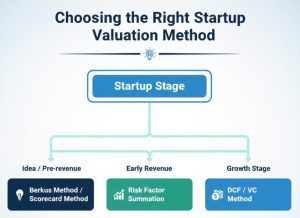
  • The Berkus Method 

It gives five important success factors monetary values:

Effective concept

  1. A prototype
  2. Team Quality
  3. Strategic alliances
  4. Sales or the launch of a product
  5. usually reaches a maximum of $2 million to $2.5 million.
  • Scorecard Valuation Method:

It evaluates your startup against comparable ones that have received funding recently in your area. Factors such as the team, market, product, stage, etc. are assigned weights.

  • Risk Factor Summation Method:

It begins with the average pre-money valuation and makes adjustments according to 12 risk areas (such as technology, management, and laws).

  • The Venture Capital Method:

It is based on the desired ROI and anticipated exit value. finds the valuation for today by working backwards.

  • Discounted Cash Flow (DCF):

Though uncommon for pre-revenue startups, it is feasible if future cash flows are fairly predictable.

Real-World Example: Valuing a SaaS Startup With No Revenue

Let’s say you’re evaluating a SaaS startup that:

  • Holds an MVP
  • Is founded by a top-tier MBA graduate and a former Google engineer.
  • 2,000 beta users were acquired in just three months.
  • Plans to bill $49 per month
  • Works in a market worth $500 million.

Applying the Berkus Technique:

  • $500K for a tech prototype
  • $500K for the founding team
  • Traction of beta users: $250K
  • Market potential: $250K
  • IP & monetisation plan: $500K

Pre-money estimate: 

  • About $2 million
  • They forfeit 20–25% of the equity if they raise $500K at this valuation.

This demonstrates how investor discussions can be supported by the quantification of qualitative aspects.

Tips to Improve Valuation Without Revenue:

The following strategies will help you increase your valuation before you start making money:

  • Enhance your pitch deck: To communicate effectively, use a well-designed pitch deck template for startups.
  • Expand your user base or waitlist: Traction includes even free users.
  • Emphasise team strengths: Capable founders are what investors want.
  • Make your business plan better: Demonstrate your strategy for scaling and making money.
  • Keep a record of everything: To compare yourself, use a free business valuation tool.
  • Obtain mentions from partners or the media: increases social proof and credibility.

Also Learn about: A Guide to Investment Banking Services for Startups and Enterprises

Common Mistakes Founders Make in Pre-Revenue Valuation:

Steer clear of these warning signs that could undermine your perceived worth:

  • Excessive expectations for valuation
  • Absence of a defined monetisation plan
  • Disregarding the competitive environment
  • Not determining the size of the target market
  • Pitch decks that are generic or inadequately organised
  • Insufficient preparedness for investor due diligence
  • Investors value professionalism, clarity, and realism

What Investors Really Want?

When evaluating a startup valuation without revenue, investors search for indications of:

  • Fit between the founder and the market
  • Scalability
  • Early traction, despite its qualitative nature
  • Capacity for execution
  • A vision with the ability to leave

They are investing in the capacity to transform that idea into a profitable business, not just an idea. Tools like fundraising services or automated valuation platforms can help you align with these expectations.

How FundTQ Helps With Startup Valuation Without Revenue?

Let’s now discuss FundTQ, a platform that assists startups in overcoming funding and valuation obstacles, particularly during the pre-revenue phase.

  1. Automated Support for Valuation

FundTQ provides valuation frameworks designed with early-stage startups in mind. The platform recommends a reasonable valuation benchmark by examining your team, traction, market size, business model, and product readiness. This keeps your startup from being overhyped or underpriced.

  1. Templates for Investor-Ready Pitch Decks

A funding conversation can be made or broken by a well-designed pitch deck. FundTQ offers real-time feedback and startup-friendly templates to ensure your deck:

  • Hits all critical investor checkpoints
  • Aligns with your valuation
  • Tells a compelling story with data
  1. A Fundraising Strategy Led by Experts

FundTQ links you with advisors who focus on pre-revenue startup fundraising. They will:

  • Help you decide what kind of valuation to request
  • Assist in improving your equity split
  • Get ready for enquiries from investors.
  1. Market Analysis & Comparisons

FundTQ gives you the ability to strategically position your startup—not just on the basis of hope, but supported by data—by providing you with access to market sentiment, competitor valuations, and current funding trends.

  1. Enhancement of Investor Credibility

You are already pre-screened with a verified valuation and a well-defined plan when you approach investors through FundTQ. This improves your credibility and raises the likelihood that you will receive funding.

FundTQ helps you close the gap between your dream and a deal, whether you’re getting ready for a seed round, angel investment, or bootstrapped pitch.

Conclusion 

Valuing a startup with no revenue is both an art and a science.  Despite the small number, potential and storyline are powerful. Familiarize yourself with the techniques, speak out clearly and back up your arguments with facts and examples.

Whether you are pitching angel investors or getting ready to raise a seed round, smart tools, such as free business valuation calculators, investor-ready pitch decks, and expert fundraising services will help you increase credibility when pitching angel investors or a seed round.

Do you need assistance writing your story? Use our proprietary tool to obtain a free valuation estimate or download our startup pitch deck template.

Startup valuation without revenue is all about future value. Tell a story worth investing in.

Are You Prepared to Receive Funding?

Get professional advice suited to your startup’s stage, download your investor-ready pitch deck template, and begin with FundTQ‘s free valuation tool.

The goal of startup valuation without revenue is to present an appealing future. Turn that future into money with FundTQ’s assistance.

FAQs:

  1. Can a startup really be valued without any revenue?

Indeed. Many startups are pre-revenue, particularly in their early phases. To determine value, investors consider qualitative elements such as your team, market potential, prototype, traction, and business plan. The most important thing is that these indicators point to potential for the future.

  1. How can a non-revenue startup be valued most accurately?

It has no standard answer. However, the Risk Factor Summation, Scorecard Method, and Berkus Method are the most popular ones

  1. How can FundTQ help me with my startup’s valuation?

FundTQ streamlines the procedure by providing:

  • Tools for automated startup valuation
  • Templates for pitch decks that are ready for investors
  • Feedback on the fundraising plan in real time
  • Access to experienced fundraising advisors
  • Industry comparisons and market benchmarks

post money valuation

What Is Post-Money Valuation and Why It Matters in Startup Funding?

In raising capital, particularly in convertible notes and equity, startups and their founders tend to wander in a labyrinth of financial terminologies. One of the most important yet misunderstood terms is post money valuation. Seed rounds and Series A rounds are different financing preparations, and the knowledge of post-money valuation becomes important to not give up too much equity or retain control of the startup.

In this article, you will get acquainted with everything concerning the post-money valuation, its importance, how it differs from the pre-money valuation, and how to employ it judiciously in making decisions with regard to funding.

Bonus Tip:
Want to find out the value of your business but tired of companies charging a fortune? Don’t worry — use this free business valuation tool and get an accurate estimate in just 10 minutes. Fast, easy, and founder-friendly!

What Is Post-Money Valuation?

Post-Money Valuation is how much a company costs immediately following an investment. Sometimes referred to as including the investment cash, it is basically how investors assign a percentage of ownership of the business to themselves once the funding round has been completed.

Also Learn About: How to find investors?

Why Does Post-Money Valuation Matter?

For founders, investors, and anyone else in charge of a startup’s capital table, knowing your post money valuation is essential. This is the reason:

  • Determines Equity Ownership

The percentage of equity that an investor receives is determined by dividing their contribution by the post-money valuation. This directly affects how much of your business you are giving away.

For instance, an investor who invests $500K in a $2M valuation after investment gains 25% ownership.

  • Sets the Benchmark for Future Rounds:

Your most recent post-money valuation will frequently be used as a benchmark by future investors. Additionally, if your valuation has increased since the last round, it may indicate that you have little room for growth going forward, which could lead to down rounds or unfavourable terms.

  • Effects Control Cap Table

Your control is affected by the dilution problem. Over time, you risk losing majority control if you don’t keep an eye on your post-money valuation. A balanced and healthy cap table is ensured by being aware of this metric.

  • Used in Convertible Note and SAFE Agreements

The amount of equity that SAFEs and convertible notes convert into in a future priced round is determined by the valuation after investment cap. A misinterpretation of this could result in unanticipated dilution.

 Pre-Money vs. Post-Money Valuation: Key Differences

Feature 

Pre-Money  Valuation

Post-Money Valuation

Timing

Before investment

After investment

Includes New Capital?

No

Yes

Used for

Negotiating ownership before funding Calculating final ownership
Affects Dilution? Not directly

Yes

Appears on SAFE Notes?

Not typically

Yes, with caps

Simpler for Founders? Yes 

More precise but more complex

Example:

  • As an example, Startup A is valued at $6 million before funding.
  •  It raises an investment of $2 million.
  • $8 million is the post-money valuation.
  • The investor receives $2 million divided by $8 million, or 25% equity.

How Do Investors Feel About Post-Money Valuation?

When deciding how much of a company to invest in, investors use the post-money valuation as a standard. But it’s more than just numbers:

  • They frequently aim for a particular ownership percentage (10–25%).
  • They receive less equity for the same investment if the post-money valuation is higher.
  • Their expected return multiple is set by it. Your exit must be larger to give them the same return if the valuation is higher today.

Therefore, make sure your growth forecast and milestones are both ambitious and credible if you’re requesting a high post-money valuation.

Real-World Example:

Let’s compare two similar startups:

Startup A: 

  • Pre-money valuation:$4 million
  • Investment: $1 million
  • Post money valuation = $5 million
  • Investor receives:$1 million divided by $5 million equals 20% equity for the investor.

Startup B:

  • Pre-money valuation: $9 million
  • Investment: $1 million
  • Post money valuation = $10 million
  • Investor receives:$1 million divided by $10 million, or 10% equity.

The investor receives 10 percent equity or 1 million dollars/ 10 million dollars.

Lesson: If higher pre-money valuation leads to higher post-money valuation then equity dilution of the founders is reduced.

Common Mistakes Founders Make:

Although post-money valuation is important, many founders make mistakes in a few crucial areas:

  • Confusion between pre- and post-money:

Unexpected dilution results from many early founders’ ignorance of the distinction. Not understanding that this is post money, which releases more equity than anticipated, they might believe they are raising at a $5 million valuation.

  • Neglecting the Effects of Convertible Notes and SAFEs:

Founders are unaware of the dilution that may result from these instruments’ conversion into equity at a post-money valuation cap until it is too late. Your cap table may be severely disrupted if you don’t model this.

  • Overestimating Too Early :

If your metrics don’t support it, a high after funding valuation could hurt your chances in the next round. This may result in a down round, which hurts your credibility.

How to Use Post-Money Valuation Strategically?

You can use valuation after investment as a potent tool to influence your fundraising and expansion once you understand how it operates.

  • Model Dilution

Use your post money valuation to estimate your ownership before you sign a term sheet. Always think about how future rounds, SAFEs, or options pools will affect things.

  •  Make Smart Negotiations by Using Valuation

Consider the significance of the valuation figure for ownership rather than just the number itself. If it means getting better terms or investors, you can offer a slightly lower valuation.

  • Align It With Milestones

Connect your desired post financing valuation to quantifiable, real-world benchmarks (market share, user growth, and ARR). This helps you prepare for the next funding round and supports your request.

 Post-Money Valuation in Today’s Fundraising Landscape:

Investors are more cautious in the current market. The days of exorbitant valuations with little traction are long gone. This implies:

  •  Valuations Are Under More Scrutiny:

Metrics-driven valuation justification is now required by investors. The days of raising $20 million post-money on an idea alone are long gone.

  • SAFEs are more prevalent, but they are also riskier:

Valuation after Investment caps are now present in the majority of SAFEs. The founders were not aware that during Series A or B, these converts might experience significant dilution.

  •  Capital Is Concentrated

Fewer startups will receive more funding. Clear conversion value ,what does their equity buy,is what investors want to see. Post financing valuation is used to calculate that.

  •  Tools Make It Easy to Be Informed:

Founders have no excuse for not knowing their numbers, thanks to resources like Carta, Pulley, and free online cap table calculators.

How Valuation After Investment Affects Option Pools?

The effect of valuation after Investment on the employee stock option pool (ESOP) is a frequently disregarded factor. The pre-money valuation frequently includes the 10–15% option pool that investors typically demand be established prior to funding. This indicates that the founders, not the investors, are the source of the dilution. For instance, if an investor wants a 15% option pool after funding a startup with a $8 million pre-money valuation, that pool must be set aside prior to the investment, which lowers the founders’ equity. To ensure that the dilution is distributed equitably, the founders should bargain for the option pool to be included after the money is raised. Being aware of this can help prevent unplanned ownership loss.

 Key Takeaways:

  • Post money valuation = Pre-money + Investment
  • It establishes the amount of equity investors receive.
  •  It impacts your control, cap table, and upcoming fundraising.
  • Common founder errors include overvaluing too soon, ignoring SAFEs and notes, and conflating it with pre-money.
  • Make strategic use of it to align with goals, model dilution, and engage in wise negotiation.
  • Knowing your after funding valuation is essential in the current environment.

Conclusion:

Mastering the concept of after funding valuation is not just a finance exercise,it’s a leadership decision. It shows investors that you are long-term oriented, understand their expectations, and value the equity of your team.

A vanity metric shouldn’t be used for valuation. It ought to show your present development as well as your potential for the future. Make sure your post financing valuation fits your plan, not just your goals, whether you’re raising money through convertible notes, SAFEs, or equity.

As in the start up environment, being unaware of valuation may make you pay with everything, including control, ownership and even the future of your business.

Also Read: What Types of Investors Do Investment Banks Work With?

Frequently Asked Questions (FAQs):

1. What is post money valuation in simple terms?

The total value of a startup following an investment is known as post financing valuation. The amount of capital invested is one of its components. It aids in figuring out the investor’s post-round ownership stake in the business.

2. How is post financing valuation calculated?

The following formula is used to calculate it:

 Post Money Valuation  is equal with Pre Money Valuation and  Investment Amount

E.g., consider a startup that raises 1m and is pre-money valued at 5m, then its post financing valuation is 6m.

3. What founders need to know about valuation after Investment?

The amount of equity a founder gives up is directly impacted by post financing valuation. Control, upcoming funding rounds, cap table structure, and the conversion of SAFEs or convertible notes into equity are also impacted.

4. How does post money valuation affect investor ownership?

The calculation of investor ownership is:

Investment/Post-Money Appraisal

When an investor invests 1 million dollars in a business at a post financing valuation of 5 million dollars, the investor gets 20 percent ownership of the business.

5. Do SAFEs and convertible notes use post money valuation?

In fact, one typical aspect of current SAFE and convertible note agreements is the presence of post financing valuation caps, which represent the maximum price, in which case those instruments are converted into equity.

How to find investors

How to Find Investors for Your Business?

How to find investors is one of the most crucial questions every entrepreneur faces while starting or scaling a business. If you have an innovative idea, a team that works well, and some progress, it is still possible for your startup to stall without enough financial support.

Investors have ways other than money to help. The right investor may introduce you to important people, help you make decisions, and stop you from making big mistakes. Whether you’re launching a tech product, a D2C brand, or a service-based venture, knowing how to find investors who believe in your vision can be a complete game-changer.

You will find information here on why you require investors as well as useful tips and practical steps to build trust. So if you’ve been wondering how to find investors for your business without feeling overwhelmed, you’re in the right place. Let’s start our discussion.

Why Do You Need Investors?

Launching a business has a lot in common with working on a plane as it is rising off the ground. You have an interesting idea, you are enthusiastic about it, and have a few customers. Nevertheless, if you don’t have enough money, your business may not move forward. That is the role of investors to fill.

Not only do investors give money, but they also give advice, introduce people, and make things trusted by others. Having sufficient funds when you are young allows businesses to reach their team goals, expand their presence online, and experiment with their first product.

Understanding how to find investors is the first step toward turning your dream into a sustainable, scalable business.

Types of Investors You Can Approach

It’s important to know who you’re looking for before you learn how to find investors. Here are six common types of investors:

1. Angel Investors

They are affluent people who give personal funds to early startup businesses. Most of the time, they get involved at the idea or MVP phase and can also give advice and introductions.

2. The term Venture Capitalists (VCs)

VCs invest the pooled money that corporations or individuals give them. Most of the time, they aim for fast-growing companies and expect to get equity instead. Remember them while you’re quickly expanding the company.

3.Friends and Family

People you trust the most are very likely to be your first angels. Even though things are not as formal, you should record everything to avoid having problems in the future.

4. Crowdfunding Investors

Options like Kickstarter, Indiegogo, and SeedInvest help you collect public funds, one small amount at a time. It’s important to get both money and legitimacy from the market.

5. Corporate Investors

They pick startups that suit their targets for funding. In fact, a prominent tech enterprise can choose to invest in a startup focused on health solutions using AI. Bringing in funding allows this type of business to expand its strategy.

6.  Government Grants and Incubators

Grants and incubators give capital and encouragement like investors, but they do not require any ownership in the company. It’s perfect for companies starting out.

Knowing these types helps narrow down how to find investors based on your business stage, industry, and funding needs.

Learn About: What Types of Investors Do Investment Banks Work With?

Preparing Before You Approach Investors:

It’s necessary to prepare yourself from the start before you pitch. Following is what is needed to become investor-ready:

• A Solid Business Plan

People who invest in companies need to learn about your product, purpose, intended customers, and potential profits. A plan that is fully written and organised gives the business a credible image.

• A Compelling Pitch Deck

Your presentation should outline the issue, the response, the chance in the market, the business model you’re using, some accomplishments, and who is on your team. It needs to be brief but strong.

• A Clear Ask

Tell them the amount of money needed and what the funds are meant for. Things work better if you are clear rather than vague.

• A Financial Projections

You should set goals for your numbers that are possible to achieve. Make sure to mention every revenue source, every expense, each profit margin, as well as when things are expected to happen.

• A Valuation & Equity Offer

Understand the value of your startup and be willing to explain and confirm how much equity you are ready to give for the investment.

Before asking how to find investors, ensure you’re worth investing in.

How to Find Investors /Through Actionable Steps?

Now that you’re prepped, let’s dive into actual steps on how to find investors for your business.

1. Make use of Your Existing Network

You may be able to find the best investors right where you least expect them. Request advice from previous workmates, your professors, and alumni from your educational background. Getting an introduction adds a strong advantage to the process.

2. Use Online Investor Platforms

AngelList, SeedInvest, and Gust provide a platform for you to share information that attracts investors and reach out to potential funders from all over the world. With social media, your company can raise its level of exposure.

3. Attend Startup Events & Pitch Competitions

Try to join events such as Startup Grind, or local expos for companies. These occasions are full of investors searching for interesting new investments.

4. Sending cold emails to the right people is important.

You can use cold emails for their intended purpose if you know what to do. Look into who you want as an investor and address them uniquely.

Example : 

Subject : Disruptive [Industry] Startup Seeking a Strategic Partner.

Hi [Name of Investor]

I am closely aware of your involvement in the [specific industry], and your choice to support [Startup X] indicates how much you believe in finding new solutions.

As the founder of [Your Startup Name], I have developed a platform centered on solving [couple sentences on the problem you are addressing] for [target audience]. We just achieved [a significant achievement – e.g., generated over ₹10L each month, signed up over 5K users, or cooperated with a significant brand], so we are now working on the next stage of our development.

Your interest in big and effective companies shows that there is a good connection between your investment strategy and our work. Connecting is a great way for us to discover how we could develop this vision.

I am looking forward to answering your questions.

Warm regards,

[Name of your Full Name]

Leader and owner of [Your Startup Name]

On both [LinkedIn and your Website], I found similar information.

[Here are your contact details]

5. List Your Startup on Deal Platforms

PitchBook, Crunchbase, and F6S are websites where startups can announce their existence and attract investors and venture firms.

Learning how to find investors is also about being where they are and showing up with value.

Read About: How to Get Funding for a Startup Business?

What Investors Are Looking For?

Considering these factors is common for investors.

  • Team – The things you know, your passion, and the leadership skills you’re capable of.
  • Market Size –.By choosing a bigger market, you can make better profits.
  • Traction – Any type of progress through increased revenue, users, or connections to others.
  • Unique Value Proposition-Why are you different from the others in the industry?
  • Growth – Will your business be able to increase at high rates?

Understanding these factors helps you position your pitch accordingly when thinking about how to find investors.

How to Build Investor Trust?

Trust has to be present at all times. You should use these steps to build your marketing plan:

  • Make sure you reveal any problems or risks that could occur.
  • Share regular updates and see how far you have advanced.
  • Make realistic goals instead of overestimating what you want to achieve.
  • Make sure you can explain every number within your business very well.
  • Keep the timeline and commitments in mind, so the project succeeds.

Trust turns a “maybe” into a “yes” and is a vital part of how to find investors who stick around.

Mistakes to Avoid When Looking for Investors:

Even if you know how to find investors, these mistakes can hurt your chances:

  • Trying to find investment before you have proof your idea works.
  • Not making it clear what amount you expect for your project.
  • Inflating the worth of your company without any reason.
  • If you do not adjust your pitch to meet the requirements of various investors, then you are neglecting to make your pitch stand out.
  • Not paying attention to comments from others or getting easily defensive.

Take care of these factors to use every opportunity successfully.

Follow-Up Matters:

You pitched. Now what?

  • Tell them thanks through an email.
  • Deliver further information they asked for.
  • Share information about how things are going forward.
  • Don’t constantly send them emails, but ensure they remember you once in a while.

It is important to follow-up regularly but never come across as pushy, since this proves your professionalism and dedication.

Bonus Tips for First-Time Founders:

If you are only starting the game, these are some essential things to know:

  • Start small. Don’t try to get ₹10 crores if your business demands ₹10 lakhs.
  • To avoid problems from lack of valuation, look at convertible notes.
  • Register for a mentor program if you want advice in starting a startup.
  • A solid team of founders helps make investors feel confident in your business.
  • Dealing with rejection helps you strengthen your skills.

The journey of how to find investors is smoother when you’re prepared and positive.

Conclusion:

To sum up, locating investors takes patience and effort, not just a fast sprint.The question isn’t just how to find investors, but how to find the right ones. Besides funding, the ideal investors can guide you, open new doors, and work with you for a long time. Preparation, persistence, and passion are the key parts of the process. By reading this blog, you’ll learn how to find investors—next, get investor-ready with a solid business valuation calculator and a pitch deck. Use our free business valuation software and startup pitch deck template to get started.

Get your message straight, research the job, prove yourself, and remain reliable. Someone who can help you can appear after sending only one message.

business valuation software

Business Valuation Simplified: Step-by-Step with Online Calculators

For startups about to get funding and for experienced entrepreneurs heading for an exit strategy, your business valuation can decide everything. These days, you can find your business’s value without being a financial expert or working with expensive consultants. Thanks to modern business valuation software, anyone from entrepreneurs to financial advisors now can assess a business’s value quickly, accurately, and confidently

 Here with the help of this blog,you will learn about the way to use internet-based calculators for determining and taking advantage of your company valuation.

What Is Business Valuation?

Business valuation  refers to finding out the financial value of a business. It demonstrates how much your company might cost in the current market. Here, financial numbers, facts about the market, potential for growth, the company’s assets, liabilities, and intangibles like its reputation and important ideas are assessed.

In fact, this number serves as a base for better decision-making. No matter if you’re seeking capital, arranging a partnership, or planning to acquire another business, your company’s valuation matters a lot.

Why Does Business Valuation Matters?

Here are the reasons why all entrepreneurs should use valuation:

  • If the business valuation is correct, it helps investors figure out what they are investing in.
  • Start by assessing your current market position and then plan your company’s movements for better expansion, increased sales, or possible diversification.
  • If you are either buying or selling, understanding valuation is very important in the negotiation.
  • When conducting and arranging an estate, or dealing with tax audits, you might have to obtain a professional valuation.
  • Using valuation, you can notice the consequences of your choices on the company’s development.

With startup valuation tool, this process becomes accessible and actionable for businesses of all sizes.

Common Business Valuation Methods:

Most reliable business valuation tool integrates one or more of the following standard methods:

1. Income Approach (Discounted Cash Flow – DCF)

Forecasts cash flows that will happen in the future and adjusts them to the present time. The method is best suited to startups and growing companies that have reliable revenues.

2. Market Approach:

Assess your company in the same way as other businesses that were just recently sold. It is focused on several factors such as revenue and EBITDA (Earnings Before Interest, Taxes, Depreciation, and Amortisation).

3. Asset-Based Approach:

The net asset value is obtained by taking away the total liabilities from total assets. This way of dealing with debt is good for businesses that possess significant assets.

4. Earnings Multiplier Method:

Earnings are multiplied with industry standards to find the company’s value. Industries everywhere use it without much difficulty.

Modern Company valuation calculator often uses a blended approach to improve accuracy and relevance.

Best Online Business Valuation Calculators (2025)

With many options on the market, choosing the right business valuation program is key. Meet the leading tools that we can expect in 2025:

1. Business Valuation Calculator – FundTQ:

FundTQ has become well known in India’s valuation software industry, being popular among both startups and small and medium-sized businesses. This approach mixes DCF, earnings multipliers, and learning from what other firms in similar industries do.

Pros:

  • The app was given free access to those using it in its first phase.
  • It is easy to use for people without financial backgrounds.
  • Structures for the financial world in India

Cons:

  • There is not a lot of history to connect data from.
  • For you if: You are starting from scratch with your organization and don’t have the budget for major expenses

2. Valutico

Valutico is an enterprise-grade business valuation tool built for financial professionals. It gives you access to more than fifteen types of valuations and lets you compare your business with rivals internationally.

Pros:

  • Financial analysis that is thorough and well created
  • Such competencies benefit those working in investment banking, PE, and M&A.

Cons:

  • Premium pricing
  • You must have financial knowledge to handle your business well.
  • This report is most recommended for big organizations, financial experts, and consultants.

3. MoneySoft

Financial experts such as CPAs and financial advisors use MoneySoft because it’s a desktop app for valuation. With it, users can prepare scenarios, manage taxes, and create financial forecasts.

Pros:

  • Advanced financial modeling instruments
  • This is especially useful for following regulations and planning your taxes.

Cons:

  • Not cloud-based
  • This is created mainly for those with experience in hacking.
  • Accountants, CFOs, tax professionals will find this system most useful.

4. BizEquity

With BizEquity, the process of valuing small and medium-sized enterprises is simple and done quickly through the internet. Most financial advisors and insurance companies rely on this information to help their clients.

Pros:

  • There are white-label options available on the cloud platform.
  • Valuing clients’ accounts in a speedy manner

Cons:

  • It is not always possible to customise the tool for difficult scenarios.
  • This is mostly useful for advisors and insurance brokers, as well as small companies.

5. ValuAdder

You can use ValuAdder to assess your business using more than 15 types of valuation methods, such as those for intellectual property and franchises. One of the reasons it’s known is because of how easy it is to automate reports.

Pros:

  • Scenario testing
  • The industry favours businesses based on intellectual property or licenses.

Cons:

  • Outdated interface
  • It is more challenging to master the skills with cryptography.
  • Mainly Beneficial For: People who run a franchise and IP consultants, especially advanced users.

Also Read: 7 Reasons Why Business Valuation Is Important For Investors?

Step-by-Step: How to Use a Valuation Calculator

To give an example, we will show you how to use the business valuation calculator on FundTQ.

Step 1: Choose Your Industry and Business Type:

The first thing to do is choose the field and kind of business you are interested in.This supports the software’s ability to select proper standards for setting prices.

 Step 2: Enter Financials:

The second step is to enter the company’s financial information.

Add in your business’s revenue, its expenses, and the profits it makes.

Step 3: Set Growth Expectations:

Provide information on growth in the upcoming years, rates of customer churn, and other predictions.

Step 4: Review Valuation Summary:

Review the Valuation Summary when you have completed all the tasks above.Through several models, FundTQ can give you an estimated price with a low, medium, and high figure.

Step 5: Download Report:

Access a PDF file you can share that has graphs, a description of the approach used, and the breakdown of your value.

Most business valuation software follows a similar flow—simple inputs, clear results.

Advice to Ensure Your Valuation Is On Point:

  • Use the Latest Financial Data:Work with the latest data for your finances; using past data won’t give you correct answers. Update quarterly.
  • Stay Realistic with Projections: Setting false goals could impact the outcome and misguide people tracking the company’s progress.
  • Include Intangible Assets: Remember to have brand power, patent holdings, loyal customers, and a positive reputation in your SEO efforts.
  • Understand Multipliers:Find out what the usual Earnings Before Interest, Taxes, Depreciation, and Amortizatio. or revenue multiples are in your type of business.
  • Cross-Verify Using Multiple Tools: You should not just use the same calculator every time. Make your graphs by picking a few of the best cases rather than many detailed cases.

Modern business valuation software often provides side-by-side comparisons to help you see multiple perspectives.

Also Read:  Typical Ticket Size Raised Through Investment Banks

What Investors Look for in a Valuation?

While explaining your valuation to investors, always keep in mind that the value goes beyond a figure. They’re evaluating:

  • Credibility of Method Used: Is the way you value businesses logical and does it make use of appropriate models?
  • Market Opportunity:Is the business active in an industry that is getting larger or smaller?
  • Revenue Quality:The quality of revenue is better when it is recurring rather than coming in one time only.
  • Scalability:Can the organisation expand its operations without having to pay much more?
  • Exit Potential:Does the business plan include the possibility of the investor earning a good profit within 5–10 years?

Using professional business worth estimator helps make your case with data, not just ambition.

Should You Use a Valuation Calculator for Fundraising?

Absolutely,but it’s important to stay aware of these things.

Online Valuation software for startups like FundTQ are great starting points for:

  • Creating your investor pitch
  • Measuring your achievements
  • Checking how the business can react to various events

But for series A and the following stages, investors generally ask for formal valuations, audited financial statements, and reports from other parties. Take advantage of calculators as a starting point, yet make sure to check with a professional when you are playing with huge amounts.

Conclusion: 

Figuring out your business’s true value can now be easily achieved. With the rise of intuitive and powerful Pre-money valuation calculator, entrepreneurs now have access to tools that were once limited to investment bankers.

When you decide on the platform that matches your present situation and plans, choose FundTQ that aims at knowing your value and gives you the strength to achieve success and achieve your goals.


Average Ticket Size

What Is the Typical Ticket Size Raised Through Investment Banks?

Why Investment Banks Still Hold the Power in Big Deals?

When someone wants to attract investors, sell a company or make a strategic merger, they usually rely on the help of investment banks. However, one thing always comes to mind: How big are the typical transactions these banks manage? No matter if the investment is for a huge merger or a simple funding round, the average ticket size raised by banks shows the market’s confidence and how the economy is heading.

Let’s discuss how common investment banking deals sizes are, their structure and how they change depending on where and in which industries they happen.

What Does “Ticket Size” Mean in Investment Banking?

Basically, average ticket size means the entire capital involved in a transaction handled by an investment bank.

Whether it’s an IPO, a private equity round, debt syndication, or a merger, the typical investment bank ticket size depends on:

  • Company size can range from a startup, SME (small to medium enterprise) or large enterprise.
  • Decide if you are doing an M&A, issuing equity or raising debt.
  • Business fields and economic industry
  • Country or area

As an illustration, investing through private equity means dealing with amounts from ₹40 crore to ₹4,000 crore, whereas an IPO could go beyond ₹8,000 crore.

Why Ticket Size Matters?

  • Allows us to assess potential investors such as angels, VCs, PEs and others.
  • It impacts how much the company is worth and reduces the value of equity currently held.
  • Sets the rules for how complex treatment is needed and what is needed for monitoring
  • Changes the outlook of investors and determines the future development strategy.

Bonus Tip:
If you’re a startup founder struggling with business valuation or pitch decks, avoid relying on free online tools and templates. Most free valuation calculators use generic assumptions and overlook the unique strengths of your business. Similarly, pitch deck templates for startups often lack the customisation and investor insight needed to stand out. For serious fundraising, invest in expert-driven tools or consult professionals like FundTQ — where strategy meets execution.

Types of Tickets Invested into Startups by their Funding Level:

Indian investment bankers deal with different sizes of investments depending on the stage of growth. Let’s now discuss what makes up the average ticket size.

Seed Round and Early Stage

  • Many buybacks involve an average amount of ₹80 lakhs to ₹15 crores.
  • Some kinds of investors include angel investors, seed funds and early-stage VCs.
  • Main objectives: Build the MVP and start discovering how successful the new app will be in the market

The Series A and B Rounds

  • Most tickets purchased were for investments of ₹20 crores – ₹100 crores.
  • Investor types include Institutional VCs as well as strategic investors.
  • Aim: To expand the business, promote it and recruit more staff

End stage and Pre-IPO

  • The average value of film tickets reaches from ₹150 crore to ₹800 crores.
  • The capital comes from private equity groups, mega venture funds and hedge funds.
  • The main reason is to broaden the company’s reach, carry out acquisitions and prepare for an initial public offering.

Mergers & Acquisitions (M&A): Where Crores Become Thousands

Average M&A deal size usually involve the most significant amounts of money. Many deals such as Tata’s Air India or Reliance’s startup purchases, typically have values in the thousands of crores.

1. Small Cap Mergers and Acquisitions

  • The size of the company’s ticket is less than ₹400 crore.
  • Handled by smaller companies located in a certain area

2. Mid-market deals in the M&A space

  • The ticket size can be anything between ₹400 crore and ₹4,000 crore.
  • Banks that belong to the mid-tier or major national advisory firms

3. This approach is also called M&A with Large-Cap companies

  • The ticket size for this bond will be between ₹4,000 crore and ₹40,000 crore.
  • International firms like Goldman Sachs, Morgan Stanley and Axis Capital are responsible for them.

Globally, the average M&A deal size stands around ₹1,200 crore, though India sees a wide spectrum depending on industry and policy climate.

Factors That Influence Ticket Size

How much a business is worth is referred to as its business valuation.

Business Valuation:
Valuing the company high lets you raise more capital without giving up a big percentage of the business. Just offering 20% of its equity enables a startup that is valued at ₹300 crores to raise ₹60 crores.

Industry Type:
Businesses that depend on resources (such as renewable energy and manufacturing) usually need bigger investments.
Asset-light models like SaaS and similar platforms grow when they need less initial capital.

Market Conditions:
Increased interest in the market leads to bigger investment shares from buyers.
If the market is sluggish or there is uncertainty about policies, investors generally invest less money.

Investor Type:
Investments from Angel investors can be between ₹10 lakhs and ₹2 crores.
Funds range from ₹5 crores to ₹100 crores provided by Venture Capital firms
M&A and IPO services are an important part of investment banks’ operations and they charge fees ranging from ₹50 crores to over ₹1000 crores.

Also Read: Top 5 Fundraising Mistakes Startups Make – And How to Avoid Them

How the Standard Size of Tickets Performs Compared to Other Global Laws?

  • This is how tickets are usually priced across different regions, shown in rupees:
  • In the USA, the market can be worth between ₹100 million and ₹1 trillion.
  • In Europe, funds available are ranging from ₹600 crore to ₹40,000 crore
  • In China & Southeast Asia, the investment is likely to be anywhere between ₹400 crore and ₹20,000 crore.
  • ₹80 crore is the smallest amount and the largest figure is ₹20,000 crore for India.

Because of startups and mid-market companies being bought and sold, there is a lot of growth in the ₹100 crore – ₹2,000 crore range in Bengaluru, Mumbai, Delhi and Hyderabad.

How to Prepare Your Business for Large Funding Rounds?

Strengthen Financials:

  • For at least 3 years, keep all your financial records showing what has been audited.
  • Make sure your earnings keep rising, margins get better and return on investment improves.

Create a Solid Pitch Deck:

  • Ensure that your pitch deck is well developed and easy to understand.
  • Be sure to include the following in your investor presentation.
  • Company’s vision and mission
  • Size of the market (TAM/SAM/SOM)
  • The way financial projections are done and money is used
  • Bio of the founders and information about the team

Work with the Right Investment Bank:

  • Choose bankers who display the characteristics you want.
  • Concentrate on your area of work which can be tech, manufacturing or retail.
  • We have managed to close tickets with similar sizes previously
  • Can advise companies for a while after they get funds.

How Investment Banks Help in Big Capital Raises?

They do more than just act as intermediaries. They handle the creation of significant funding deals.

  • Valuation: They find out the true value of your company
  • Due Diligence: Checking the company’s finances, legal matters and overall operations thoroughly
  • Structuring: Equity, debt or convertible which is the right choice for your business is chosen accordingly .
  • Investor Reach: They target your deal to a global audience of high-net-worth investors, VC groups and funds.
  • Compliance: During IPOs, they assist companies when complying with SEBI guideline

An investment bank will help you improve the valuation and control the risks of ₹50 crore just the same as ₹5,000 crore.

Typical Investment Bank Ticket Size by Type of Firm

Typical Investment Bank Ticket Sizes have different limits on the deals they accept. Here’s how it looks in INR:

Firm Type Typical Ticket Size (INR):

  • Global Bulge Brackets range from ₹4,000 crore to more than ₹80,000 crore.
  • Mid-Tier Banks from India usually fall between ₹400 crore – ₹4,000 crore.
  • Earnings of Boutique Advisory Firms are generally between ₹20 crore and ₹500 crore irrespectively .

Smaller companies, including startups, first work with smaller institutions and then move on to banks with more capital as they require more resources.

Learn About: Future of Investment Banking in India

Conclusion:

In conclusion ,understanding ticket size is very important.

To know the average ticket size in investment banking is like understanding the health of the market. It helps organisations secure the money they need, guide expectations from investors and create strategies for upcoming growth.

Whether you’re aiming for a ₹100 crore growth round or a ₹10,000 crore IPO, knowing the typical investment bank ticket size keeps your fundraising goals aligned with market norms.

Key Takeaways:

  • Ticket size equals the value of a deal: investment, M&A or capital raise.
  • Average M&A deal size globally ≈ ₹1,200 crore; India varies widely
  • Investment banks ensure the setup, assess the fees and finish deals of all kinds.
  • Currently, funding rounds in India involve amounts of cash between ₹4 crore and ₹8,000 crore+
  • The size of a business is often influenced by what is happening within the sector, the stage of development and the market aspects.

FAQs

1. What price is put up for an Indian IPO ticket?
An initial public offering (IPO) can be anything between ₹500 crores and ₹8,000+ crores, with the valuation of the company and investor interest playing key roles in the whittling down or up of the gross issue price.

2. Do investment banks work on deals under ₹50 crore?
That is especially the case for boutique and regional investment banks.

3. How does the sector impact ticket size?
Real estate and technology projects normally require large amounts of start-up money, but the service and retail sectors are often less expensive to get off the ground.

4. What’s the average investment bank capital raise size in India?
The figure may go from ₹160 crore to ₹8,000+ crore depending on what kind of transaction it is and how established the company is.

5. Are ticket sizes higher in debt or equity deals?
Because of the lower risk involved and larger borrowing figures, most debt raises are more than (₹800 crore+).

Role-of-investment-banks

How Do Investment Banks Help Structure Large Funding Rounds?

Raising a large amount of capital isn’t just about approaching investors for funds. The process covers study, analysis of risk, negotiations, completing the required documents, compliance and respecting deadlines. Investment banks are there to help in these situations. The financial industry depends on the role of investment banks to secure funding when unicorn startups pursue mega rounds or mid-sized organisations expand into new markets.

This blog covers the ways investment banks provide assistance in structuring funding rounds and large capital raises.

What Is the Role of Investment Banks in a Large Capital Raise?

The role of Investment banks provides financial guidance alongside deal management services. Investment banks primarily focus on obtaining necessary capital for their clients through three main methods:

  • Divesting business assets in exchange for capital.
  • Receiving financial funds through debt
  • Important low-time and low-risk instruments include convertible notes and others.

Investment banks manage the following for significant capital raises:

  • Organising and setting up the funding round
  • Locating suitable lenders or investors
  • Terms of negotiation
  • Managing legal and regulatory tasks
  • Ensuring the funding aligns with current market conditions.

To put it briefly, they serve as intermediaries between businesses and capital, supported by extensive financial knowledge.

Also Read: Future of Investment Banking in India 

How Do Investment Banks Assist in Funding Round Structure?

Creating funding rounds entails deciding what kind of funding will be raised, how much, from whom, at what price, and under what conditions.

Investment banks can assist with this in the following ways:

1. Evaluating Needs for Capital

They begin by assessing:

  • How much money the business actually needs
  • What it will be used for, such as working capital, R&D, expansion, and M&A
  • Whether it would be better to use debt, equity, or a combination.

2. Selecting the Funding Route

They determine the round’s structure:

  • Is private equity the best option? A matter of public concern? Convertible debt?
  • What kind of securities or shares ought to be made available?

3. Pricing and Appraisal

Investment banks assist in making decisions in the following ways:

  • What is the company’s fair valuation?
  • For the required capital, how much equity should be given up?
  • To determine a price that investors will accept, they employ a number of techniques, including precedent transactions, comparables, and discounted cash flow (DCF).

4. Setting Up the Rounds

Funding is frequently staged in tranches during large raises. Banks organise this so that:

  • Reduces dilution
  • corresponds with the company’s growth benchmarks
  • Maintains Investor Confidence

In short,even a promising business may find it difficult to successfully raise significant capital without appropriate structuring.

How Do Investment Banks Find the Right Investors?

The role of investment banks takes more than just making calls to raise 500 crore or 1,000 crore; it takes targeted matchmaking.

Investment banks stay in touch with:

  • Private equity funds and venture capital
  • The funds of sovereign wealth
  • Institutional investors
  • Family Offices 
  • High-net-worth individuals, or HNIs,

They compile lists of investors using:

  • Sector of interest
  • Prior investment performance
  • Appetite for ticket size
  • The ability to tolerate risk

After that, they save time and improve results by pitching your business to the appropriate investors.

What Materials Do They Prepare for Fundraising?

To make your business appear investment-ready, investment banks create a comprehensive set of documents. These consist of:

  • Pitch deck for investors
  • Information memorandum (IM)-A lengthy business profile that includes financials, strategy, market outlook, and risks 
  •  Financial model: Cash flow, balance sheet, and projected P&L
  • Value sheet: Rationalising the cost
  • Term sheet: The proposed deal’s draft structure.

In short,these documents are essential for establishing investor confidence and initiating due diligence.

How Do Investment Banks Manage the Actual Capital Raise?

Once the materials and strategy are prepared, investment banks:

  • Present your opportunity to attract and engage prospective investors.
  • Conduct investor meetings, presentations, and Q&A.
  • Handle conflicting term sheets if several investors express interest.
  • Discuss terms of the deal, such as control, valuation, and exit clauses.

They also manage public fundraising (such as initial public offerings) by:

In essence, they ensure seamless execution by guiding you from planning to closure.

Learn About: 5 Fundraising Mistakes Startups Make – And How to Avoid Them

How Do Investment Banks Handle Legal and Compliance Aspects?

Large capital raises come with a heavy regulatory burden. Investment banks work with accountants and solicitors to oversee:

  • Due diligence
  • Agreements with shareholders
  • Filings with regulatory bodies (e.g., SEBI, RBI, MCA)
  • The structure of taxes
  • Investor KYC and AML checks

They make sure everything complies with the law, shielding the business from disputes that may arise after the deal.

What Happens When the Market Is Uncertain?

Fundraising is more difficult in unpredictable or doomed markets. However, this is when experienced investment banks come in handy:

  • They better time the hike, delaying or accelerating it in response to market cues.
  • They modify the round structure to incorporate bridge financing or convertibles.
  • They locate counter-cyclical investors through their networks.

Their job is not just to raise capital, but they also have to do it safely and intelligently, even under difficult circumstances.

How Do Investment Banks Charge for Their Services?

Most investment banks charge based on:

  • A retainer fee (fixed monthly advisory fee)
  • A success fee (usually 1%–5% of capital raised)
  • Larger the deal, lower the percentage. But do remember that a good investment bank adds far more value than the fee they charge.

Why Can’t Companies Raise Large Capital Without Investment Banks?

Technically you can ,However, when businesses attempt to raise large sums of money without a bank, the following is what actually happens:

  • Off-course valuation
  • Inappropriate investors (or none at all)
  • Poor documents don’t engender trust.
  • Missed legal steps cause delays in the deal.
  • Poor handling of dilution that compromises long-term control

What Are Some Examples of Investment Banks Structuring Large Rounds?

Here are some real-world examples from India:

  • Morgan Stanley and Kotak structured Zomato’s ₹9,000 crore initial public offering.
  • Avendus and others helped with PE rounds for Byju’s Series F (₹3,000+ crore).
  • Axis Capital is in charge of organising Nykaa’s ₹535 crore pre-IPO round.
  • Several investment banks are supporting Delhivery’s ₹2,346 crore initial public offering.

An investment bank typically does the heavy lifting behind every high-profile fundraising event.

Conclusion:

The role of investment banks in fundraising is a part of raising funds, particularly when structuring funding rounds and managing a large capital raise.  For everything from choosing the right mix of equity and debt to picking suitable investors and buying necessary terms, investment banks rely on their expertise and main focus. They link companies to capital markets, so that the fundraising procedure is effective, legal and designed for lasting success.

Investment banks guide companies away from possible challenges such as getting undervalued, not matching the investors’ needs or running into regulatory problems. It is particularly important for them to get involved when markets are unstable, because the right timing, price levels and investors’ confidence are crucial. Thanks to their skills in handling documents, managing checks and directing the process effectively, investment banks finish large investment rounds without any risks.

An experienced investment bank greatly assists with the structuring of funding rounds, managing investor relationships, and executing large capital raises. Wise fundraising helps companies keep their future plans secure along with the finances. Any business that wishes to expand a lot, add new products or go public should make good use of the full set of investment banking services.

Bonus Tip: Are you a startup trying to figure out how to value your business and impress investors? Don’t worry — we’ve got you covered! Use our free Business Valuation Calculator and access free Pitch Deck Templates to confidently prepare for your next investor meeting.

Key Takeaways

  • Investment banks help companies manage the difficulties of fundraising, especially when seeking huge amounts of money.
  •  They know how to organize funds that are ideal for each company and still fulfill what investors are expecting.
  • An important benefit of using investment banks is their access to a wide network made up of many institutional investors and private companies. 
  • Investment banks also make sure that all legal standards are satisfied, appraisals are correct and business transactions are handled without problems.
  • Any company aiming to expand its activities, go public or grow can benefit a lot from involving an investment bank.

FAQs:

  1. What is the role of investment banks in fundraising?
    With the role of investment banks , companies can organise fundraising rounds, attract qualified investors, check compliance and negotiate the terms of finance.
  2. How do investment banks structure large capital raises?
    To reduce a decrease and increase efficiency, they evaluate capital needs, choose the best funding instruments (equity, debt, or hybrid), price the deal, and stage the funding round.
  3. Why should companies involve investment banks in large funding rounds?
    Owing to their proficiency in market strategy, investor relations, legal compliance, and valuation helps in making the process more efficient and fruitful.
  4. Do investment banks also provide services for small companies seeking funds?
    In general, investment banks specialise in medium compared too small, considering how hard and expensive larger transactions can be.
  5. What are the typical documents investment banks prepare during fundraising?
    They create financial models, valuation reports, investor pitch decks, information memorandums, and term sheets during fundraising.

Types-of-investors

What Types of Investors Do Investment Banks Work With?

Investment banks provide money-related help to people and organisations such as large financial firms. Have you ever considered the identity of the people they do business with? Which companies and organisations are the firm’s clients. This blog will focus on the types of investors that typically connect with investment banking services. We will outline the services these banks give to various investors such as high-net-worth individuals (HNWIs) and institutional investors.

Understanding Investment Banking Services

Before diving into the different types of investors, let’s briefly define investment banking services

These Services  generally belong to three types.

  • Advisory Services: Mergers, acquisitions, restructuring and strategic planning assistance are part of advisory services.
  • Underwriting: Giving clients a way to raise capital by offering debt or equity.
  • Trading and Brokerage:Traders and brokers manage their client’s investments, focus on risk and may be involved in establishing market prices.

Now, let’s look at who  makes up the main users of these services.

What Do Investment Banks Do?

It’s important to know what investment banking services are first, before discussing investors.

  • People and companies use investment banks for help with:
  • Helping clients decide whether to acquire or merge with another business (called M&A)
  • Getting funds by offering shares or bonds
  • Selling shares and making investments through the stock market
  • Using special financial tools called derivatives is an example of managing risks.

Unlike normal banks, they do not offer the chance to open a savings account. They usually deal with clients who either want to invest or want to handle sizeable investments.

1. High-Net-Worth Individuals (HNWIs)

Who Are HNWIs?

An HNWI is a person who has assets amounting to over $1 million (excluding their house). Certain individuals have vast amounts, for example $5 million or even $30 million or more.

Why Investment Banks Work with HNWIs?

HNWIs receive special services from investment banks, for example:

  • Supporting them in looking after and increasing their assets
  • Figuring out what to do with their estate
  • Making private and exclusive investments open for their clients
  • Working on real estate, business startup or international initiatives

Most high-net-worth clients are offered guidance by a personal financial advisor.

2. Institutional Investors

Who are Institutional Investors?

Institutional investors are organisations that gather large amounts of money to put into securities, real estate and different assets. Examples include:

  • Pension funds
  • Insurance companies
  • Mutual funds
  • Hedge funds
  • Organisations called endowments and foundations
  • Sovereign wealth funds

Because they hold so many assets, these investors influence the capital markets a lot.

Bonus Tip: Are you a startup struggling to define your business value or pitch to investors? Don’t worry — use our free business valuation software and pitch deck templates to present your startup with confidence!

Why Investment Banks Serve Institutional Investors?

Institutional investors use investment banks for a wide range of services:

  • The ability to complete big deals with low market influence
  • Offerings of IPOs and debt
  • Market studies and intelligence reports
  • Techniques for trading derivatives and hedging are now widely available.
  • Financial products specifically tailored to a person’s needs

Because institutional investors typically trade in sizeable amounts that move the markets, the services of investment banks are very important.

Also Read: Comprehensive Guide to Investment Banking Services for Startups and Enterprises

3. Corporations

Who are Corporations?

Even though corporations are not directly referred to as “investors,” they make up a main client group for investment banks.

Why Corporations Engage with Investment Banks?

Raising Capital: Raising money by either issuing debt or conducting an IPO

Mergers & Acquisitions: Provide services for securing and carrying out buyouts, mergers and divestitures

Treasury & Cash Management : It involves ensuring there are sufficient funds and resources to meet financial needs

Risk Management:Using derivatives and investor protection to control risk.

In some cases, corporations also act like institutional investors by managing employee pension funds and excess reserves through structured investment vehicles.

4. Family Offices

Who are Family Offices?

Family offices are private companies that look after the money of the extremely wealthy, as most families using them have at least $100 million. Some family offices supervise just one family’s funds and others figure out the finances for a number of families.

Why Family Offices Engage with Investment Banks?

  • Only partners get access to these deals.
  • Projects have access to private equity and venture capital.
  • Ways to arrange investments for lower tax exposure
  • Real estate and art investment management
  • Philanthropic advisory

Similar to HNWIs, family offices value privacy, worldwide connections and detailed financial planning and investment banks are good at providing these services.

5. Government and Sovereign Entities:

Who are Government and Sovereign Entities? 

Governments and sovereign wealth funds (SWFs) are  qualify under the broader types of investors working with investment banks.

Why Government and Sovereign Entities Engage with Investment Banks?

  • Administration of sovereign wealth is usually related to long-term investments worldwide.
  • Advice on government plans to privatise companies
  • Currency and commodity hedging are types of risk management strategies.
  • Issuing and managing government bonds

Those in this industry need their banks to be highly trustworthy and knowledgeable about regulations.

6. Private Equity and Venture Capital Firms

Who are Private Equity and Venture Capital Firms?

They are companies that put money into businesses, mostly those that are starting out or trying to grow. The Private equity firms purchase larger businesses.On the other hand,Smaller and newer businesses are the main targets of venture capital firms.

Why Private Equity and Venture Capital Firms Engage with Investment Banks?

  • Search for deals and identify which stocks to invest in.
  • Working on helping the company make sales or prepare for an IPO
  • Supply information and help with making financial decisions

Many times, investment banks remain partners with these firms for several years.

7. Retail Investors (Small Investors)

Who are Retail Investors?

The majority of  retail investors, are not involved with investment banks.

But still,

Why Retail Investors Engage with Investment Banks?

  • Trading platforms found online
  • Guidance and resources for financial decisions
  • The Basic types of investment opportunities

Still, big investment banking services like mergers or big investments are not meant for small investors.

Why It Matters: Different Services for Different Investors

As every type of investors are different in what they want and can afford, investment banks do not give out the same services to everyone. A High-net-worth individuals (HNWIs) may require guidance on keeping their savings, saving on taxes or finding unique private investment deals. On the other hand, big investors such as pension funds or mutual funds need help with large trading, thorough market analysis and complex strategies to handle managing billions of dollars.

Corporations may approach banks to get funds, spread into other markets or manage merger or acquisition activities, whereas family offices look for wealth plans that last for several generations and a wide range of assets. Public funds and global investment decisions are regularly approached by governments and sovereign wealth funds with advice from investment banks. Alternatively, private equity and venture capital companies rely on services for finding deals, valuing companies and managing exits. Even though each of these types of investors work with the same investment bank, their needs are very different. That’s why investment banking services are always tailored—designed to match the investor’s size, goals, and risk tolerance. Many aspects of finance, including why investment banks are vital, rely on understanding these differences.

Conclusion

Investment banks work with many different types of investors from High-net-worth individuals (HNWIs)

to huge institutional investors and even governments. Various types of investors hope to improve their wealth, but some choose to involve themselves in national or regional investment plans. They are all united because people in these situations need expert advice, large transactions and careful planning.

By understanding who uses investment banking services, you get a better idea of how global finance works—and how important investment banks are in managing money and opportunities around the world.

FAQs

Q1: Who are the main types of investors investment banks work with?

They usually work with high-net-worth individuals (HNWIs), institutional investors, big companies, family offices, and governments.

Q2: What do rich individuals get from investment banks?

Managing wealth, cutting down on taxes and looking for special investment ideas are areas where they need help.

Q3: What is meant by an institutional investor?

It is a kind of large investment body such as a pension fund or mutual fund, that looks after other people’s funds.

Q4: Are there examples of investment banks working with individual small investors?

Not usually. Mostly, their services target big organisations, yet they can provide some tools for users online.

Q5: What does a family office handle?

They work with the wealthy to look after their finances, choose suitable investments, handle taxes and plan for the future.