
Investment banking services assist businesses in the capital-raising process, the merger and acquisition cycle, and in making highly deliberated financial decisions with confidence. From the entrepreneur to the start-up founder, to the mid-market business owner or anyone curious about the financial world — this guide explains it all.
What Is Investment Banking — and Why Does It Matter?
An investment bank is at the heart of all major business deals, whether it is an IPO, acquisition or a big debt offering. These are places where companies meet capital that they need to expand, and where they get the strategic advice that they need to make the best decisions. Large multinationals are not the only market for investment banks. Thousands of businesses, ranging from D2C consumer brands to healthcare companies to industrial manufacturers all rely on investment banking services to unlock funding opportunities, structure exits, and accelerate growth in India’s dynamic mid-market.
Quick Answer
Investment banking services include capital raising, M&A advisory, business valuations, debt and equity issuance, underwriting, and corporate restructuring. They are used by companies of all sizes to make complex financial decisions with expert support.
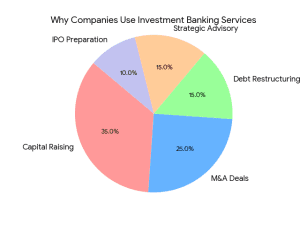
Core Investment Banking Services — Explained
Here is a breakdown of the most important services and what each one actually does for a business:
1. Mergers & Acquisitions (M&A) Advisory
M&A advisory is arguably the most visible investment banking service. From target identification, due diligence, structuring the deal, valuing the target, and negotiating, bankers are there to help both buyers and sellers.

2. Capital Raising — Equity and Debt
For businesses to grow, they need capital. It is raised with the support of investment banks, whether through equity financing (venture capital, private equity or public markets) or debt financing (bonds, term loans or structured credit). The right capital structure depends on stage, sector, and business model. A growth stage D2C brand is very different to a profitable manufacturing business looking to be acquired.

3. Business Valuation
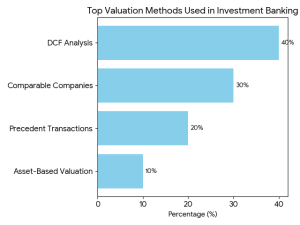
No matter whether you are raising a round, selling your business, adding in a co-investor or restructuring debt, valuation is the foundation of all financial decisions. Investment bankers employ techniques such as DCF (Discounted Cash Flow), comparable company analysis, and precedent transactions to reach an amply defensible and market-tested valuation. For founders, knowing your company’s valuation isn’t just about the number — it’s about knowing which levers move that number.

4. Underwriting
An investment bank that underwrites new shares or bonds sells the securities to individual investors and purchases any unsold shares or bonds, thus taking the risk of the securities. The underwriting of IPOs, follow-on issues, and huge debt raises are integral to the process.
5. Corporate Restructuring
They aren’t always a growth story. In some cases companies need to reorganize their assets, specially their debt, or to sell off non-core business, or to generate a return to profitability. In the execution of restructurings investment bankers can offer the strategic and financial skills necessary to preserve value and meet the needs of various parties.
6. Market Research & Industry Intelligence
Investment banks do extensive sector analysis before any deal is struck, covering competitive landscape, peer benchmarking, demand-supply analysis, and regulatory environment. This intelligence supports all recommendations that are provided to clients.
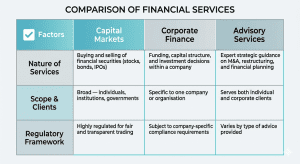
The Three Core Divisions of Investment Banking
Investment banking is organised around three primary functions. Understanding the difference helps founders and businesses know exactly what service they need.
How the Front Office Works — Where Deals Get Done
The front office is the part of an investment bank that is in front of the client, dealing with the business. This is where relationships are formed, mandates are gained and transactions are accomplished.
Let’s face it, here’s what bankers in the front-office do:
- Client Relationship Management: Knowledge of each client’s financial objectives, business model, and market position.
- Pitching and Advisory: Proposals to the right strategy: capital raise, M&A, restructuring, or a mix of all three.
- Due Diligence: Detailed investigation of operations, finances and risks prior to any agreement.
- Financial Modelling and Valuation: Analyzing the financial aspects of each transaction, including Forecast Models and Scenario Analysis.
- Execution: The entire transaction process ranges from mandate to close, which encompasses investor outreach, documentation and regulatory filings.
- Risk Assess: Identifying deal level risks and creating the structures to mitigate them on behalf of the client.
If you are a founder who is working with an investment bank for the first time, the front office is where you will deal with them from the beginning.
——————————————
FundTQ’s deal team has closed transactions across consumer, healthcare, and industrials.
If you are exploring a fundraise or acquisition:
Key Stakeholders in Every Investment Banking Transaction
Every deal involves multiple parties working in co-ordination. Understanding who they are — and what they want — is essential for any founder or business owner going through a transaction.
1. Investment Banks
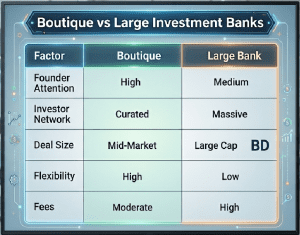
Act as the advisor and intermediary. In India’s mid-market, firms like FundTQ occupy the space between boutique advisors and large global banks — offering specialist expertise, a curated investor network, and hands-on deal execution.
2. Corporate Clients (Founders and Companies)
The businesses seeking to raise capital, complete an acquisition, or execute a strategic exit. Their goal is to maximise value while minimising risk and disruption to operations.
3. Institutional Investors
Private equity funds, venture capital firms, family offices, and sovereign wealth funds that deploy capital into deals. FundTQ’s network includes 7,000+ investors — covering the full spectrum from seed-stage VCs to large buyout funds.
5 Trends Reshaping Investment Banking Right Now
The industry is evolving fast. These are the five shifts every founder and business owner should be aware of:
1. AI and Data-Driven Deal-Making
Artificial intelligence is being applied to investment banks for risk assessment, portfolio analysis, due diligence, and even to investor matching. AI is not about replacing judgment, it’s about enhancing it.
2. The Fintech Challenge
Fintech companies are opening up new channels to access financial services, which are otherwise dominated by traditional banks. Investment banks are evolving – becoming more advisory.
3. ESG and Impact Investing
Environmental, social, and governance considerations are now central to institutional investor mandates. Companies with high ESG scores tend to have a larger pool of capital available and may enjoy higher valuations.
4. Blockchain and Transaction Transparency
The technology of distributed ledgers is helping to optimize transaction records, verify and audit transactions without friction in cross-border deals and improve regulatory compliance.
5. RegTech and Compliance Automation
The banks are increasingly turning to RegTech solutions to automate compliance functions, thereby holding up deal execution without compromising on regulatory integrity.
Top Challenges in Investment Banking — and What They Mean for Clients
- Regulatory Complexity: Specialist knowledge is needed to meet the requirements of SEBI guidelines, RBI guidelines and FEMA norms for cross-border transactions, along with sector-specific rules. Knowing what you are looking for in a banker is essential: you don’t just pick anyone.
- Market Volatility: Deal timing and valuations can be materially impacted by interest rate cycles, geopolitical events and macro uncertainty. All but the most novice bankers are familiar with what it takes to structure a deal that’s not as vulnerable to market timing risk.
- Cybersecurity: Sensitive data is associated with financial transactions. The investment banks and their clients need to uphold stringent cybersecurity measures during the deal process.
- Talent and Relationship Depth: A person’s deal outcome relies a lot on their network and execution capability — not their firm’s brand name.
The Global Impact of Investment Banking
Investment banking is not just about individual transactions — it shapes entire economies.
- Cross-border capital flows enable companies to fund expansion in new markets and geographies.
- M&A activity merges industries, eases inefficiencies, and makes category leaders.
- FDI facilitation draws foreign investment to developing economies, jobs and infrastructure.
- Capital market development results in greater liquidity and allows more and more companies to access the public markets.
- Systemic risk is better managed by banks, particularly in times of downturn, which helps to build economic stability.
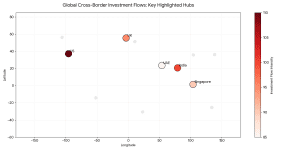 In India specifically, mid-market investment banking is a key driver of the startup ecosystem — connecting high-growth companies with the institutional capital they need to scale, acquire, or exit.
——————————————-
FundTQ is ranked among India’s Top 5 Investment Banks by Venture Intelligence, with partners from IIT Delhi, KPMG, PwC, and EY.
Explore how we can support your transaction:

Careers in Investment Banking — What It Takes
For those interested in building a career in investment banking, here are the core competencies that matter most:
Technical Foundation
Analytical Thinking
One of the key skills needed to be a successful investment banker is being able to analyse vast quantities of information and present it in a way that is easy to understand and act on. This skill is honed in case study practice, real deal analysis and financial modelling exercises.
Interpersonal and Communication Skills
The sales are made or lost in the client talk. What sets the good bankers apart from the great ones is their ability to convey complex financial concepts in an easy-to-understand manner, deal with many stakeholders, and demonstrate trust in stressful situations.
Investment banking is challenging, but for the high-stakes problem solver, it’s also the best place to be for exposure, pay and career growth.
How to Choose the Right Investment Banking Partner
This is the most important decision a founder makes when entering a transaction. Here is what to evaluate:
- Do they have any closed deals in your industry? The domain knowledge has a direct impact on the quality of the deals and investor access.
- Network of investors- How broad and relevant is their network? A bank having 7,000+ investors will give more opportunities than a bank having 200 investors.
- Track record- Request similar transactions. While logos are important, deal size and complexity are more important.
- Team quality- Who is working on your deal? The attention of the senior is important throughout the process.
- Transparency and alignment- Do they charge transparently and in a way that is aligned with your results? Are they clear and frequent communicators?
 Why Founders Choose FundTQ
FundTQ brings together partners from IIT Delhi, KPMG, PwC, and EY with a curated network of 7,000+ investors across VC, PE, family office, and strategic acquirer categories. Our focus on consumer, healthcare, and industrial sectors means we bring targeted expertise — not generic advisory. Recent transactions include the Emami–Axiom Ayurveda acquisition and the Secret Alchemist Growth Capital raise.
Frequently Asked Questions – FAQs
Q. What are investment banking services?
They help businesses raise capital, execute M&A, obtain valuations, and make strategic financial decisions with expert support.
Q. Why do companies need investment banks?
Investment banks bring financial expertise, investor networks, and deal execution capability — enabling businesses to close complex transactions efficiently and at better terms.
Q. What is the difference between capital markets, corporate finance, and advisory?
Capital markets handles securities issuance and trading. Corporate finance focuses on a company’s internal funding and structure. Advisory covers M&A, restructuring, and strategic guidance.
Q. What do investment bankers do day to day?
They model financials, meet clients, prepare investor materials, conduct due diligence, manage deal timelines, and negotiate on their client’s behalf — from mandate through to close.
Q. What skills are needed to work in investment banking?
Technical finance skills (modelling, valuation), analytical thinking, and strong interpersonal and communication ability. It rewards ambition and continuous learning.
Q. How do I choose the right investment banking partner in India?
Prioritise sector expertise, investor network depth, comparable deal track record, and team quality. Look for a firm that treats your transaction as a strategic partnership — not just a fee engagement.
Conclusion
Investment banking advisory are a combination of capital, strategy and execution. From your initial institutional round to an acquisition to a strategic exit — the right investment banking partner can make the difference between a good outcome and a great outcome. The mid-market in India is one of the hottest deal markets in the world today. Whether it’s consumer brands expanding nationally, healthcare companies becoming targets for PE interest or industrial companies being attractive strategic acquisition targets, the opportunity is there — and investment banking is the vehicle for unlocking it.
——————————————
Ready to explore what investment banking can do for your business?
FundTQ has advised on transactions across consumer, healthcare, and industrials.




Comments (09)