
India’s skincare and beauty market has become one of the most active consumer startup segments for investors. However, fundraising for skincare brands has also become significantly more selective. Today, investors evaluate far more than branding and social media traction. They closely examine repeat purchase behavior, gross margins, customer acquisition efficiency, inventory management, and long-term brand defensibility.
This guide explains how skincare startups in India raise funding, what investors evaluate before investing, common fundraising mistakes founders make, and how to improve investor readiness before approaching capital partners.
Planning to Raise Capital for Your skincare Brand?
FundTQ works with D2C and consumer startups on fundraising strategy, investor readiness, financial modeling, and capital raise preparation.

Why Are Skincare Startups a Hot Investment?
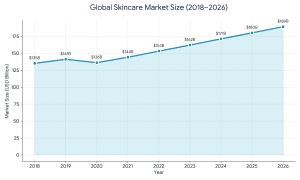
The skincare industry is projected to cross $200 billion by 2026, driven by rising disposable incomes, wellness awareness, and digital-first consumer behavior.
This growth is creating strong opportunities for new skincare brands, especially in niches like clean beauty, Ayurvedic skincare, and personalized products. Several structural trends continue to attract investor interest toward skincare and beauty startups in India:
– Rising disposable income
– Increasing skincare awareness among Gen Z consumers
– Growth of dermatologist-led and clinical skincare brands
– Expansion of D2C commerce
– Higher repeat purchase behavior compared to many consumer categories
– Premiumization of wellness and personal care
Here’s why investors are increasingly drawn to skincare startups:
- High Gross Margins:
Many skincare brands operate with attractive gross margins, especially in premium, clinical, Ayurvedic, or ingredient-focused segments. - Repeat Purchase Behavior:
Unlike several consumer categories, skincare products generate recurring demand, making customer retention highly valuable for investors. - Scalable D2C Distribution:
Digital-first distribution allows skincare startups to scale nationally without building traditional retail infrastructure early. - Content & Community-Led Growth:
Beauty products naturally align with creator-led marketing, influencer ecosystems, and visual storytelling channels.
How Much Funding Does a Skincare Startup Need in India?
It is best to evaluate your funding needs before you proceed to identify possible sources of funds. The start-up costs will depend on what business model you target to use, whether you intend to produce your goods, white-label suppliers, or create only e-commerce brand.
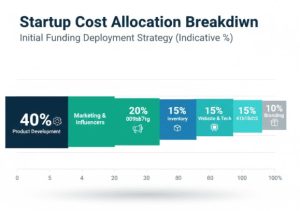 Here’s a realistic cost breakdown for launching a skincare startup in India:
|
Category of Expenses |
Proposed Cost (INR) |
|
Test and Product Development |
5,00,000- 15,00,000 |
|
Branding & packaging |
2,00,000 5,00,000 |
|
Set up Website and eCommerce |
1,00,000 – 3,00,000 |
|
Opening Stock |
3,00,000 – 10,00,000 |
|
Marketing & Influencers |
2,00,000 4-8,00,000 |
One of the biggest mistakes skincare founders make is underestimating working capital requirements. Inventory cycles, product shelf life, retail expansion, and customer acquisition costs can rapidly increase capital requirements as the brand scales. Depending on your scale, first startup funding requirements can range from ₹10 lakhs to ₹50 lakhs. It can go a long way and make your pitch stronger when you are clear about these figures.
Know exactly how much funding your startup needs
Get a customized financial plan & valuation
Top Funding Options for Skincare Startups
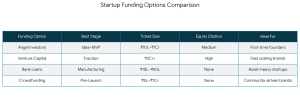 As a beauty founder, you’re not limited to a single funding route. Here are some options to explore:
1. Angel Investors
Angel investors are often the first institutional capital source for early-stage skincare startups. Many consumer-focused angels evaluate founder-market fit, product differentiation, retention potential, and early customer traction more closely than short-term revenue.
2. Venture Capital
Venture capital firms typically invest once skincare brands demonstrate repeat purchase traction, scalable acquisition channels, and strong customer retention metrics.
3. Startup Incubators/Accelerators
Such programs include Sequoia Surge, India Accelerator, or NSRCEL by IIM Bangalore which are funded programs as well as provide mentorship and access to a network of investors.
4. Bank Loans & MSME Schemes
Indian government and financial organizations provide business credits according to MSME and Stand-Up India programs: they are applicable to manufacturing-based companies in the skincare sector.
5. Investment Banking Services
When you’re ready to raise larger rounds (Series A or beyond), consider partnering with boutique investment banking services specializing in consumer brands and startup capital raising.
What Investors Evaluate Before Funding a Skincare Startup
Most investors today evaluate the quality of growth rather than just top-line revenue. Key metrics investors closely monitor include:
1. Repeat Purchase Rate:
Strong retention usually signals product-market fit and customer trust.
2. CAC vs LTV:
Investors evaluate whether customer acquisition costs are sustainable relative to long-term customer value.
3. Gross Margins:
Healthy gross margins are critical because skincare brands require ongoing investment in marketing and inventory.
4. Contribution Margin:
Revenue growth without contribution profitability often raises concerns around scalability.
5. Inventory Management:
Poor inventory discipline can create operational inefficiencies and working capital pressure.
Not sure which funding is right for you?
We help you choose & connect with the right investors.

Creating a Skincare Business Plan That Attracts Investors
Investors look for clarity, scalability, and strong market demand in your business plan. Investors expect skincare founders to demonstrate clarity around customer positioning, unit economics, inventory planning, and long-term brand differentiation.
What Investors Expect in a Skincare Business Plan:
- Problem and Solution: What solutions does your brand solve to issues in the skin? And why is it superior to what is available?
- Target Audience: Who is the target? Millennials? Gen Z? Men?
- Market Research: Industry size, consumer trends, competitor positioning, and whitespace opportunities.
- Product Strategy: Ingredients + certifications (no cruelty-free, organic) + the line development of products.
- Revenue Model: Margins, channels of sale and pricing.
- Marketing Plan: The influencer, online advertisement, real world events.
- Finance: How much are you asking, and what is it going to be used on?
- Financial Forecasts: 3 year revenues estimate, break even analysis.
The better your plan is, the more willing investors would be to invest in your startup.
Building a Minimum Viable Product (MVP)
Many skincare founders raise early funding only after validating repeat customer demand through a focused MVP strategy rather than launching a large product catalogue immediately.
MVP Creation Skincare Tips:
- Utilize contract manufactures to cut the cost.
- Focus initially on 1–2 hero products rather than launching an extensive catalogue too early.
- Undertake dermatology tests and qualifications.
- Offer tests to those interested or beta testers.
A successful MVP can be your ticket to first startup funding and traction with D2C customers.
How to Pitch Your Skincare Brand to Investors?
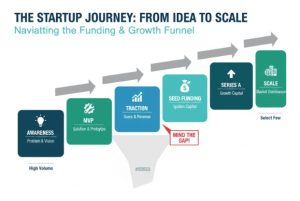 Investors increasingly prioritize operational clarity over storytelling alone. Strong skincare pitch decks combine brand vision with retention metrics, contribution margins, customer behavior insights, and realistic growth assumptions.
Keys of an Excellent Pitch Deck:
- Vision Statement: Build on your Why.
- Market Opportunity: Allow one to demonstrate the amount, as well as, the possibilities of the skincare industry.
- Your Unique Solution: Your innovation, either ingredient, personalization or sustainability.
- Traction: success of the MVP, revenue, customer love, testimonials.
- Team: Present founders and specialists in the sphere.
- Ask: How many funds, to what?
Practice your pitch and tailor it to different types of investors some care more about numbers, others about brand story.
Bonus Tip:
Bootstrapping: Advantages & Disadvantages
Many successful skincare startups like Juicy Chemistry and Minimalist began by bootstrapping—self-funding the business until revenues kicked in.
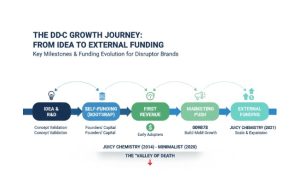 Pros:
Pros:
- Complete ownership of your brand.
- Develop financial control.
- Narrow-based growth that is organic.
Cons:
- Small budget in marketing and staffing.
- Slower scaling.
- Risk of high personal finance.
A decent place to start would be bootstrapping in case you are not investor ready but have a great MVP and vision.
Scaling After Funding
After you secure your first round, then the game starts.
Focus Areas:
- Inventory Management: It is important to have regular availability of products.
- Brand awareness: Invest on Influencer campaigns, PR and video content.
- Technology: Modernise the website, web-based customer relationship management and supply chain systems.
- Team Building: Recruit professionals of marketing, R&D and customer service.
- New Markets: Enter second-tier cities or overseas shipments.
A constant need to determine such metrics as CAC, LTV, and ROAS could confirm the operational capital efficiency of the given company since any investor considers such a factor after making the investment.
Conclusion:
Making and scaling a skincare company does not just imply having an excellent product; it means building a brand around real issues with which the population has some emotional affinity and which grows sustainably. First startup funding, investment banking services, and crowdfunding should all be seen in light of the founder’s long-term vision.
There could be no better time to start with the growing beauty market in India, the interest of investors in wellness, and the population of digital-first customers. Always be ready, sell intelligently and keep on training. The future of investment banking and startup capital is more founder-friendly than ever—go claim your share.

FAQs: Funding for Skincare Startups
Q1. How do I get funding for a skincare startup in India?
You can raise funds through angel investors, venture capital, crowdfunding, or MSME loans.
Q2. How much funding is needed to start a skincare brand?
Typically ₹10 lakh to ₹50 lakh depending on scale.
Q3. Do investors invest in early-stage skincare brands?
Yes, especially if you have a strong MVP, traction, or unique positioning.
We work with D2C and consumer brands to help them raise funding, build financial models, and connect with the right investors.